Through our books, case studies, journal articles, papers, and surveys, the Ash Center is home to some of the world’s most advanced research and publications on issues related to democratic governance and self-governance.
VIDEO—Democracy 250: The Impact of Sports on the History of Civil Rights in America
A recent event explored how sports have shaped movements for racial justice, gender equality, religious freedom, LGBTQ+ rights, disability rights, and broader inclusion in the United States.
Full Disclosure: Using Transparency to Fight Climate Change
Cap-and-trade bills can take years to pass — but a disclosure rule could pass tomorrow. Elena Fagotto and Mary Graham point to a 1984 chemical disaster that led to mandatory US toxic-emissions reporting and cut pollution nearly in half within a decade. Could the same trick work on greenhouse gases?
Disclosing Plant Closings and Layoffs to Reduce Community Disruptions
After a wave of plant closings in the 1970s and ’80s, Congress settled on a modest compromise: companies above a certain size would have to warn workers and communities sixty days before a mass layoff. But the definitions of “mass layoff” and “covered employer” were carved so narrowly — and enforcement left so entirely to workers suing in federal court rather than any government agency — that researchers found the law barely touches most permanent layoffs. Even 9/11 and the offshoring wave of the mid-2000s, each triggering congressional hearings about expanding the rule, changed nothing.
Disclosing School Performance to Improve Public Education
After a 1983 federal report warned that American schools were falling behind, states rushed to publish school report cards, betting that transparency would push parents toward better schools and administrators toward better results. But by 1999, researchers found barely half of teachers and less than a third of parents had actually looked at one — and when No Child Left Behind forced every state to disclose more data in 2001, confusion multiplied just as fast as disclosure did, with some states juggling more than one report card per school. Two decades and a pandemic later, 45 states still publish their report cards in English only.
Labeling Genetically Modified Foods to Protect Health and the Environment
When genetically modified crops hit the market in the mid-1990s, Europe erupted — boycotts, “Frankenfood” headlines, Prince Charles weighing in — while American shoppers kept eating GMO corn and soy without a second thought. The transatlantic divide got so sharp that African nations facing famine turned away U.S. food aid rather than risk losing European export markets. Two decades later, Congress finally passed a national labeling law in 2016 — but only to kill off a patchwork of state rules, with no hearings, no debate, and a loophole letting up to 5 percent of a product be unlabeled GMO material.
Harmonizing Disclosure of Corporate Finances to Reduce Risks to Investors
No treaty created it. No government voted it into being. Yet by 2005, a board of accountants headquartered in London — funded partly by the same “big four” firms whose clients it regulates — had convinced the European Union to make its rules binding law for seven thousand companies, with the US, Russia, and India weighing whether to follow. Businesses were already complaining the standards made their accounts “unreadable and irrelevant.” Enforcement was left entirely to the same national governments that had just given up control.
Congress was debating climate bills that wouldn’t take effect for half a decade — meanwhile emissions kept climbing. Mary Graham and Elena Fagotto had a faster fix: make every factory and product disclose its greenhouse gas emissions now. It had already worked once before, after a very different disaster.
A color-coded terror alert system nobody understood. A calorie-labeling bill Congress kept burying. Archon Fung, Mary Graham, David Weil, and Elena Fagotto lay out exactly why some disclosure laws save lives and others just generate paperwork — and which future is winning.
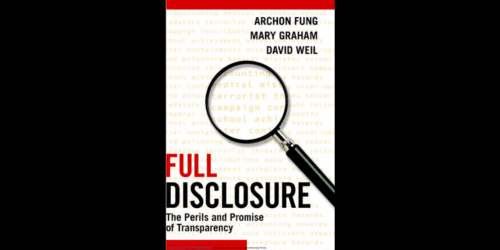
Full Disclosure: The Perils and Promise of Transparency
Full Disclosure explores how transparency policies, like corporate disclosures and nutritional labels, can empower citizens and improve governance, but often fall short due to incomplete or irrelevant information, offering insights into making them more effective.