Feature
After Neoliberalism: From Left to Right – Day Two
The second day of After Neoliberalism: From Left to Right continued Day One’s conversations on emerging visions for the future of the political economy. A previous article covers Day One.
Feature
The first day of After Neoliberalism: From Left to Right brought together hundreds of leading thinkers to explore and debate emerging visions for the future of the political economy. A second article covers Day Two.
By:
 Dana Guterman
Across the political spectrum, there is a growing consensus that the neoliberal economic order has failed to address deep structural challenges in the American economy, politics, and society. In response, scholars and policymakers have advanced competing visions that interrogate its normative foundations, economic assumptions, and consequences for public goods, work, technology, and democratic governance.
Against this backdrop, on December 11, 2025, scholars, policymakers, journalists, and civic leaders convened for After Neoliberalism: From Left to Right, a two-day conference presented by the Ash Center for Democratic Governance and Innovation and the Allen Lab for Democracy Renovation. Together, participants explored these emerging frameworks and debated what kind of political economy might come next.
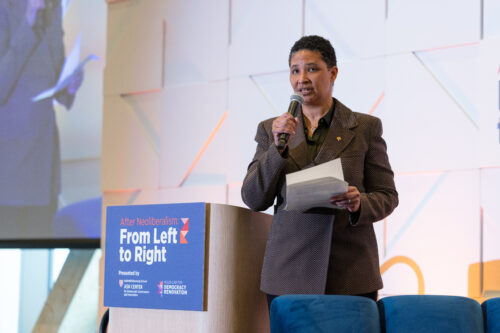
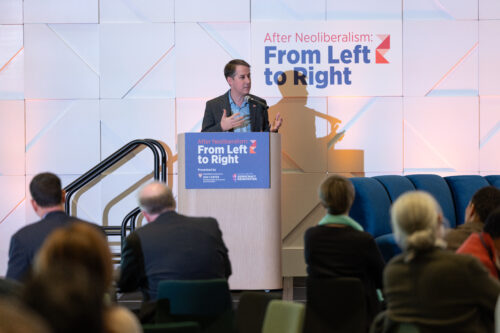
“This convening has been long in the making,” said Danielle Allen, James Bryant Conant University Professor at Harvard University, as she opened the conference. She grounded the gathering in personal experience, reflecting on supporting a cousin through reentry after more than a decade of incarceration. “I come from a family that has had a long and enduring belief in the opportunity that this country provides,” she said. But after struggling to assemble the basic components of a stable life, including employment, housing, education, and transportation, the experience ended in tragedy, leading her to question the social contract she had long believed in. Allen framed the conference around fundamental questions of what the economy is for and who it is for. “The economy is always for something …” she concluded, “and at the end of the day, it should matter for the project of human flourishing.”
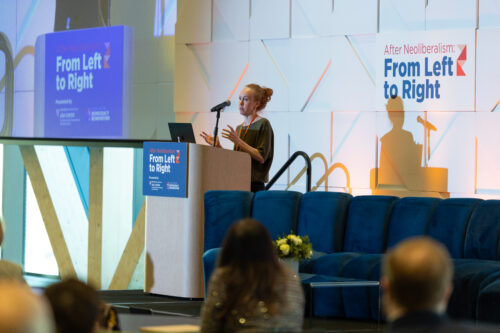
Next, Jennifer Harris, director of the Economy and Society Initiative at the William and Flora Hewlett Foundation, situated this moment historically. Neoliberalism, she argued, is understood to be over, with broad agreement that “treating markets as ends in themselves has damaging consequences.” Unlike earlier paradigm shifts shaped by academic economists, today’s transition is being driven largely by policymakers and practitioners. Harris outlined three imperatives for what comes next: balancing power in deeply unequal markets, intentionally shaping markets to serve democratically determined goals, and rethinking both how wealth is distributed and what constitutes economic success. “As the kids might say, the vibes are bad, even if the pie keeps growing,” she said.
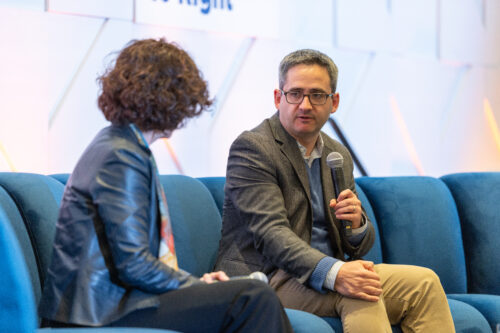
Moderated by Anne-Marie Slaughter, CEO of New America, the first panel explored the ideas beginning to replace neoliberalism. Slaughter framed the discussion not as a search for a “fully formed” paradigm, but as an effort to identify the “big ideas” already reshaping debate, including human flourishing, well-being, community and place, and national cohesion. She described an economy designed for whole people — “human beings who need connection and belonging as much as they need separation and achievement.”
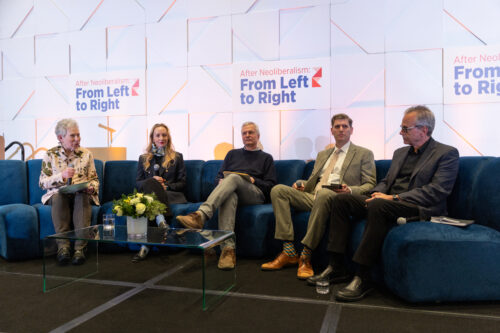
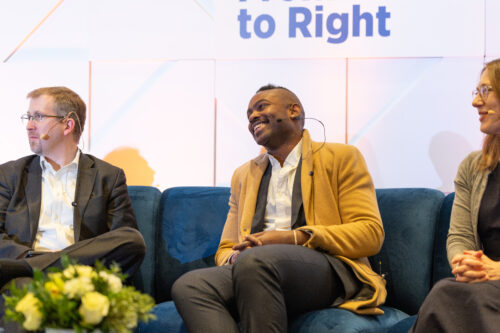
Panelists discussed emerging ideas based on their varied perspectives. Aaron Hedlund of the White House Council of Economic Advisers contrasted past emphases on globalism and technocracy with today’s focus on sovereignty and democratic accountability. Kadeem Noray, an assistant professor at Harvard Business School, pointed to declining trust in knowledge elites and the lack of effective translators between expertise and public understanding. Heather Boushey, a senior fellow with the Reimagining the Economy initiative at Harvard Kennedy School, emphasized the importance of place, while Jason Furman, Aetna Professor of the Practice of Economic Policy at the Kennedy School, highlighted the need for careful measurement and fiscal analysis. Slaughter closed by noting the panelists’ agreement on accountability and the dignity of work: “We opened more questions than we answered, but that’s exactly what we should do,” she added.
Larry Kramer, president and vice chancellor of the London School of Economics and Political Science, next reflected on the longer journey that led to the conference. Drawing on his work at the Hewlett Foundation, Kramer described a growing recognition that declining trust in democratic institutions reflects not only process failures but a lack of shared ideas capable of building compromise in a complex society. Rebuilding democratic faith, Kramer argued, will require synthesizing emerging ideas into a story that ordinary citizens can understand and connect with — one that “can become intuitive to them.”
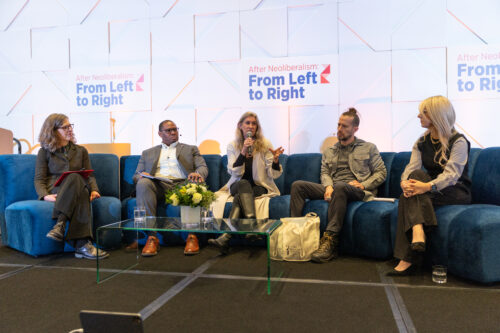
Moderated by Kathy Cramer, Natalie C. Holton Chair of Letter & Science and Virginia Sapiro Professor of Political Science of the University of Wisconsin-Madison, the discussion next turned to the role of listening and storytelling with respect to the political economy. Cramer explained that the panel of scholar-activists and expert storytellers was chosen because “if we are truly going to reimagine the political economy … we need to listen to people more.”
Rob Watson Jr., executive director of the EdRedesign Lab at Harvard Graduate School of Education, began by describing the “declining American dream” and his efforts to empower local communities to effect change and overcome intergenerational problems. Kate Woodsome of Invisible Threads connected trauma, mental health, and democratic erosion, while D. Graham Burnett, Henry Charles Lea Professor of History and History of Science at Princeton University, highlighted the commodification of human attention. Panelist Bri Stensrud of Women of Welcome discussed her work with conservative women, translating their compassion into advocacy for immigrants and refugees. Together, the panel underscored that reimagining political economy requires listening deeply to diverse lived experiences.
Oren Cass, chief economist of American Compass, and Rebecca Henderson, John and Natty McArthur University Professor, Harvard Business School, sat down to discuss Cass’ book, The Once and Future Worker, which argues that U.S. policy has prioritized consumption over workers. Henderson framed the discussion by asking, “How do we create great jobs for working people and build strong communities?” Cass argued that neoliberalism failed by ignoring what markets are for, then outlined concrete policy directions, including rethinking education and subsidizing low-wage work.
Moving into the afternoon sessions, Jeremy Weinstein, Dean and Don K. Price Professor of Public Policy at Harvard Kennedy School, focused participants on the conference’s forward-looking agenda. Speaking as a scholar of emerging technologies, he urged everyone to confront the transformative impact of AI and automation on work, opportunity, and democratic life. “I’ve been called a luddite for drawing attention to the social impacts of technological change,” he said. “… I’m not against technology, but I do believe that solving for the public good means taking seriously the role of government in shaping the path of technological change. This is a posture that’s pro-democracy, not anti-tech.”
Moderator Margaret Levi, professor of political science at Stanford University, began this panel by focusing the conversation on specific principles and priorities for a new political economy. She invited panelists to identify the values driving their work and the areas of the economy most in need of attention. Allison Schrager, a senior fellow at the Manhattan Institute, emphasized inclusive growth through a more dynamic economy. Dani Rodrik, Ford Foundation Professor of International Political Economy at Harvard Kennedy School, focused on good jobs and services. Matt Stoller, director of research at the American Economic Liberties Project, highlighted the imbalance of returns to capital, while Manuel Pastor, director of the USC Equity Research Institute, pointed to social and economic disconnection. Despite differing prescriptions, Schrager concluded, “we all agree that this economy is not giving everything the opportunity and security they need and a lot of people are left out.”
This panel examined how governments, civil society, and other actors might shape technological development beyond market forces alone. Moderator E. Glen Weyl, a research lead at Microsoft, framed the discussion around alternatives to a purely venture-capital-driven model of innovation.
Daron Acemoglu, institute professor of economics at MIT, emphasized the power of automation and the need to learn how to regulate organic systems. Zoë Kettler Hitzig of OpenAI raised questions about addressing specialized skills in an era of centralized knowledge. Finally, Shane Tews of the American Enterprise Institute and Emma Waters of the Heritage Foundation highlighted both innovation and grassroots engagement in tech policy. The discussion reflected widespread agreement that technology will be central to any new political economy.
In the final panel of the day, moderated by Danielle Allen, panelists explored how family and migration policy shape the social fabric of American society. Allen emphasized the interconnected roles of markets, civil society, and public institutions in supporting flourishing communities.
Bradford Littlejohn, director of programs and education at American Compass, stressed the centrality of families as “gatekeepers of information” to family stability. Alisha Holland of Harvard University examined immigration’s role in shaping care economies and middle-class family life. Luma Simms of the Ethics and Public Policy Center highlighted challenges of cultural cohesion in the context of her experience as an Iraqi immigrant, while Anne-Marie Slaughter emphasized balancing relational and individual identities.
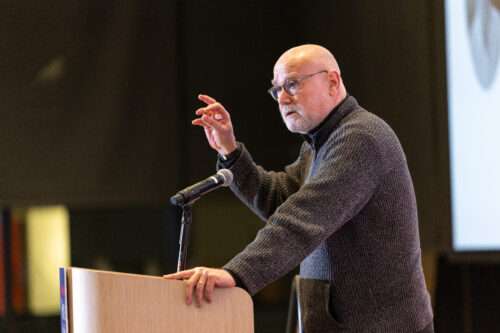
Yochai Benkler, Berkman Professor of Entrepreneurial Legal Studies at Harvard Law School, closed Day One by reflecting on the need for a “new theory of capitalism” attentive to power, work, and dignity. Looking toward a better, more just society, he highlighted recurring themes from the day, including the centrality of work as a source of meaning, the challenges of technological change, and the importance of structuring markets to reduce exploitation while sustaining innovation. Benkler emphasized that rethinking political economy does not require displacing markets but reshaping them to better serve people’s needs, setting the stage for further exploration on Day Two.
Dana Guterman is a copy editor and writer with the Ash Center for Democratic Government and Innovation.
Feature
The second day of After Neoliberalism: From Left to Right continued Day One’s conversations on emerging visions for the future of the political economy. A previous article covers Day One.
Additional Resource
Ensuring public opinion and policy preferences are reflected in policy outcomes is essential to a functional democracy. A growing ecosystem of deliberative technologies aims to improve the input-to-action loop between people and their governments.

Video
The Allen Lab for Democracy Renovation’s Making Democracy Interesting webinar brought together scholars, writers, and creators to explore how storytelling can make democratic life feel more accessible, human, and compelling.
Feature
The second day of After Neoliberalism: From Left to Right continued Day One’s conversations on emerging visions for the future of the political economy. A previous article covers Day One.

Article
Economists and policy analysts broadly agree that more housing needs to be built in order to reduce costs in America’s most expensive cities. Using a novel survey of mayors of mid-sized and large cities to explore mayors’ views on the roots of America’s housing crisis and what solutions they believe will most effectively address their constituents’ housing challenges, the authors summarize mayors’ attitudes and perceptions on key issues related to expanding the housing supply, reporting how well these views correlate with mayors’ assessments of their own cities’ supply needs.
Podcast
Jonathan Rauch joins the podcast to discuss why he now believes “fascism” accurately describes Trump’s governing style.