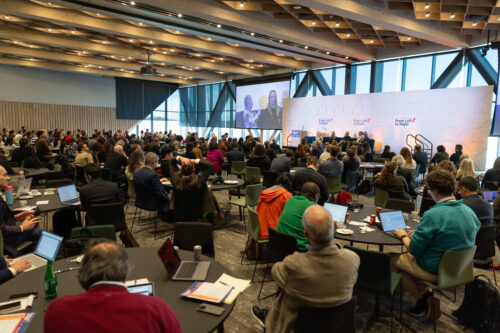
Opening Remarks with Rebecca Henderson
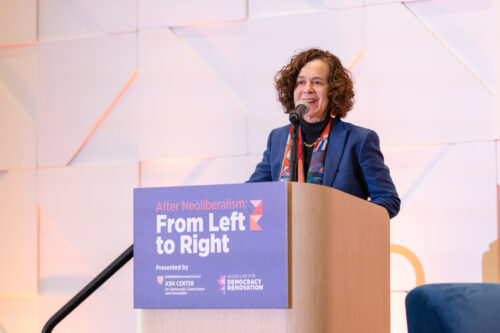
Rebecca Henderson, John and Natty McArthur University Professor at Harvard Business School, opened Day Two by declaring, “I have 10 minutes and I’m going to talk about love.” While Day One surfaced compelling policy ideas, she stressed that the harder question remains how to move from agreement to action. Noting that public support for policy proposals often collapses with partisan labels, Henderson suggested that implementation can feel “fantastical” unless ideas “speak across lines.”
To do so, she continued, requires love, connection, and values, all of which are missing from today’s economic and political debate. Drawing on Dr. Martin Luther King Jr.’s warning that “power without love is reckless and abusive,” she argued for rebuilding at the community level. The best-designed policies, she cautioned, will fail if they cannot be translated into values and stories people recognize as meaningful. We need “the union of power and love” to strengthen social bonds and institutions, allowing democratic action to thrive.
Applications of a New Paradigm: Housing, Health, Education, and Jobs
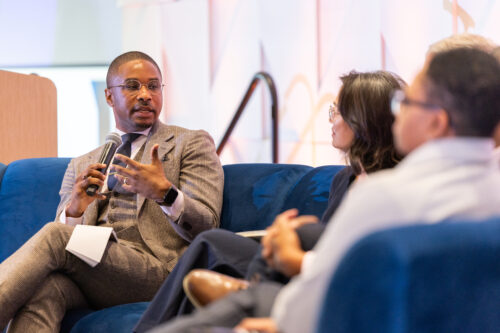
Moderated by Brandon Terry, John L. Loeb Associate Professor of the Social Sciences at Harvard University, this panel examined domains where economic crises are most directly experienced by ordinary people, and where conflict over obligation and deservingness is most visible. Terry framed housing, health, education, and jobs as sites of “experimentation and contestation” that are generating news ways of thinking and reshaping what these goods mean in practice.
Felicia Wong of the Roosevelt Institute argued that while progressives like her have succeeded in breaking from the neoliberal paradigm post-pandemic, they still lack a coherent “vision of the good life … and, even harder, the good society.” Gordon Hanson, Peter Wetheim Professor in Urban Policy at Harvard Kennedy School, focused on structural barriers to access to good jobs, arguing that neither recent administration has meaningfully addressed them. Gerard Robinson, professor of practice in public policy and law at the University of Virginia, emphasized the absence of a shared democratic philosophy of education, dedicating his response to Dr. Charles Willkie, while Erica Smiley of Jobs with Justice framed labor organizing as a frontline site of democratic struggle.
Applications of a New Paradigm: Democracy, Effective Governance, and State Capacity
The conference’s final panel, moderated by Danielle Allen, James Bryant Conant University Professor at Harvard University, addressed how institutions can successfully govern a reimagined political economy that supports collective prosperity and well-being. “At the end of the day, questions of governance are fundamental to what kind of economy we have, how it operates, how we steer it,” explained Allen.
Jack Goldsmith, Learned Hand Professor of Law at Harvard Law School, described the erosion of separation of powers, with policymaking increasingly concentrated in the executive branch and reviewed by courts rather than legislated. Jennifer Pahlka of the Recoding America Fund highlighted “a crisis of state capacity,” noting that governments often cannot deliver policy outcomes within politically relevant timeframes. Jedediah Britton-Purdy, Raphael Lemkin Professor of Law at Duke Law School, emphasized declining political trust as a barrier to collective action, while Rashad Robinson, a social justice leader and strategist, stressed the challenge of moving forward amid competing narratives about the past. Finally, Julius Krein of American Affairs pointed to growing business demand for state capacity, even as democratic contestation becomes more volatile.
Reflections and Looking Ahead
Danielle Allen closed the conference by returning to Abraham Lincoln’s definition of democracy as “of the people, by the people, for the people,” examining each element in the context of today’s political economy. State capacity, democratic participation, and substantive outcomes vary widely, she said, and require renewed attention.
Finally, Allen invited participants to reflect on the past two days, sharing insights gained and “a burning question you’ll be leaving with.” Additionally, other audience members invited skeptics of artificial intelligence to engage directly with the tools shaping today’s political economy. Allen closed by expressing hope that attendees had found “points of connection and … rich nourishment” that would carry their work forward. With table-topic breakouts extending the conversation over lunch, the conference concluded.
Dana Guterman is a copy editor and writer with the Ash Center for Democratic Government and Innovation.