Additional Resource

Commentary
Allen Lab Policy Fellow Christine Slaughter makes the case that democracy must be understood through people’s lived experiences and agency, not just institutions.
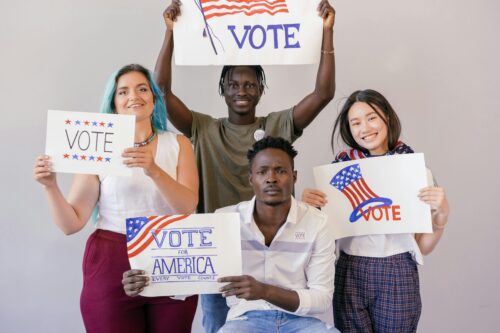
By Christine Slaughter
Why This Moment Matters
American democracy is again at a crossroads. Some interpret this period as one of institutional strain; others see an opportunity for renewal and reinvention that places power more firmly in the hands of ordinary people. What is clear, however, is that democracy cannot be understood solely through elections and institutions. It must also be understood through people’s lived experiences—how they encounter power, navigate inequality, and exercise agency in everyday life.
Foregrounding the agency that citizens possess—and how institutions constrict agency at the nexus of race, class status, and gender – is a key feature of my research agenda. While political behavior researchers typically find that increased resources (time, money, education) predict participation, I’ve found that Black women exhibit agency through their diverse political perspectives and engage despite differential resources. Civic duty led Black women, especially Black women Democrats, to the ballot box. Black women’s civic duty mobilizes their voting behavior. In other work, I find that optimism about the country’s future engages Black women in politics with optimism at the forefront. In times of financial crisis, such as during the Great Recession, Black women who were more optimistic about the future of the country were more participatory in non-electoral political acts than their white and Black optimistic counterparts. These psychological resources and political predispositions – optimism and civic duty – are pivotal to understanding Black women’s high levels of participation in American electoral and non-electoral politics. Elsewhere, I examine how the racial resilience of Black voters is key in their willingness to confront voter suppression efforts – including waiting in line to vote, and during the 2024 Presidential campaign.
The Problem: Interlinked Democratic Challenges
Voting is a form of civic engagement and, unlike other forms of engagement, voting is regulated by states. Strict identification requirements and other administrative barriers– such as signature verification for mail-in ballots — are often justified as safeguards against fraud, yet , and these cases have been tracked through the Heritage Foundation. Policies like identification requirements that make voting more difficult do not affect all citizens equally; limiting who can participate.
At the same time, other developments receive far less attention but carry equally significant political consequences. The recent exit of large numbers of Black women from the workforce, for example, is not simply an economic trend. Economic precarity shapes time, resources, and psychological bandwidth for civic engagement. Economic conditions are political conditions that influence participation, representation, and voice.
If democracy is fundamentally about people, agency, and voice, then restricting participation in elections or overlooking structural economic exclusion undermines those goals. These developments narrow the range of voices present in public life and weaken the foundations of democratic participation.
Historical Perspective: Democracy as an Ongoing Project
It is difficult to identify a period in American history in which democracy has not faced erosion or exclusion. As the nation marks 250 years, it is essential to remember that African Americans secured the legal right to vote only in 1965. Democracy in the United States remains, in many respects, a recent and unfinished project.
As Fannie Lou Hamer reminded us:
“And we can no longer ignore the fact that we can’t sit down and wait for things to change. Because as long as they can keep their feet on our neck, they will always do it. But it’s time for us to stand up”.
Her words underscore a broader point: beyond our professions, we are people who experience politics in our everyday lives. Scholars, educators, and practitioners all share responsibility not only to study democracy but to sustain it.
It’s imperative that we all develop and articulate our vision for politics. We are not at a moment in history when it is possible to ignore what is unfolding around us.
This involves asking difficult questions:
This also involves developing practical and intellectual skills:
Why Interdisciplinary Work Matters
The study of politics properly belongs to political science, yet politics is also a central concern of sociology, psychology, communication, economics, American studies, and racial and ethnic studies globally- among other disciplines. Many of the most pressing questions about democracy—inequality, identity, trust, participation, and power—cannot be fully understood within a single disciplinary framework.
The interdisciplinary character of the upcoming Peopling Politics symposium, Bringing the People Back In, reflects this reality. Bringing together scholars and practitioners across fields allows us to examine democracy from multiple vantage points and to develop more comprehensive explanations of political behavior and institutional change.
Bringing People Back into Politics
Democracy has never been perfect. It has never worked for everyone, and it has never fully included everyone. But its future depends on whether we are willing to observe carefully, analyze rigorously, and act collectively to make it more representative and more responsive.
That work belongs to all of us.
Christine Slaughter is an Allen Lab Policy Fellow for the FY25-26 academic year and an Assistant Professor of Political Science at Boston University.
The views expressed in this article are those of the author(s) alone and do not necessarily represent the positions of the Ash Center or its affiliates.
Additional Resource

Additional Resource
The Allen Lab is proud to have contributed to this timely landscape report from The David & Lucile Packard Foundation mapping the emerging field of AI and democracy.

Commentary
Allen Lab Affiliate Benjamin A. Barsky examines alternative emergency response programs — arguing for a democratic model of public safety governance in which responses to nonviolent incidents are shared across government and civil society rather than dominated by police.
Additional Resource

Podcast
Professor Eitan Hersh, the inaugural director for Tufts University’s new Center for Expanding Viewpoints in Higher Education, wants create a new campus atmosphere of “robust intellectual life, where norms of curiosity and goodwill reign.”
Podcast
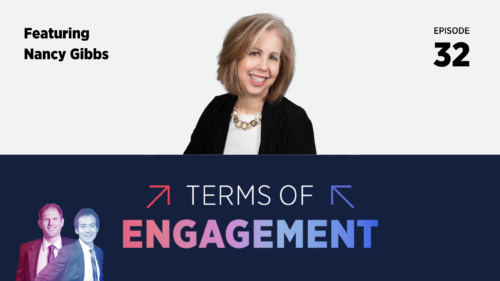
Harvard Kennedy School Shorenstein Center director and former TIME editor Nancy Gibbs joins co-hosts Archon Fung and Stephen Richer to discuss the impacts of billionaire media consolidation and pressure from the Trump administration on the flow of information vital to democracy.