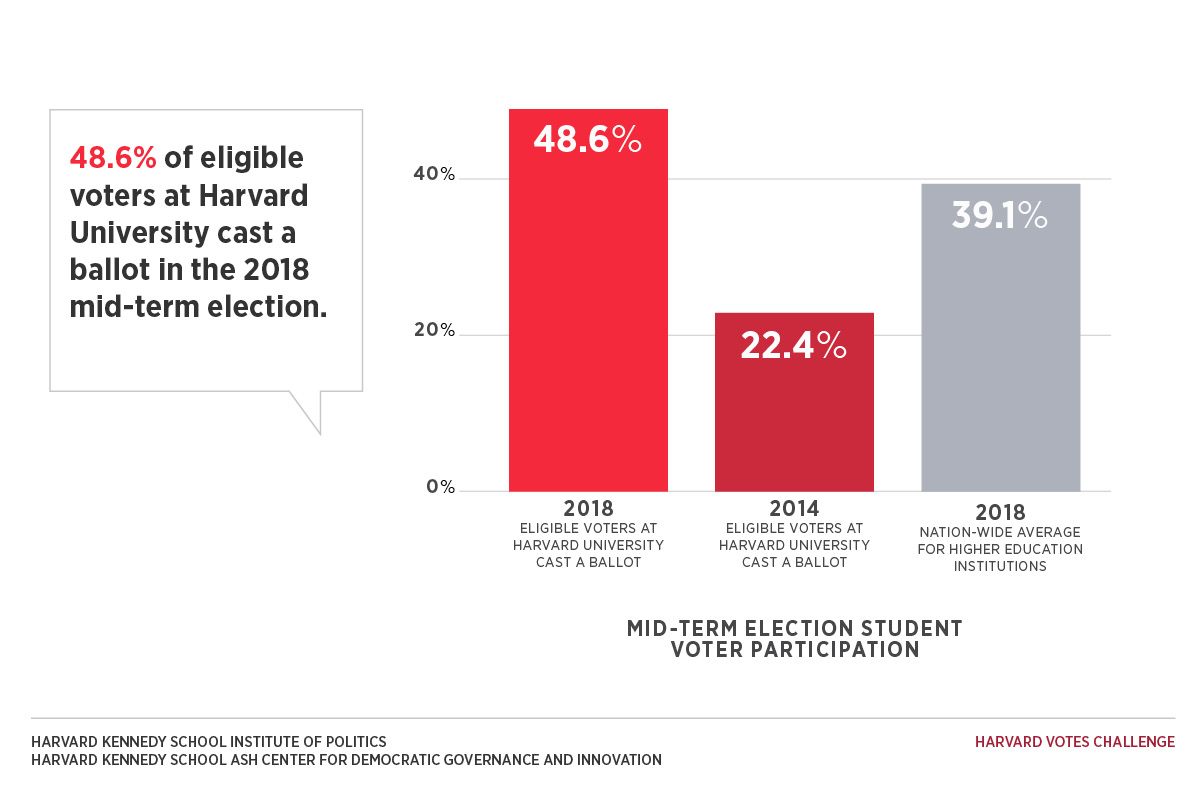
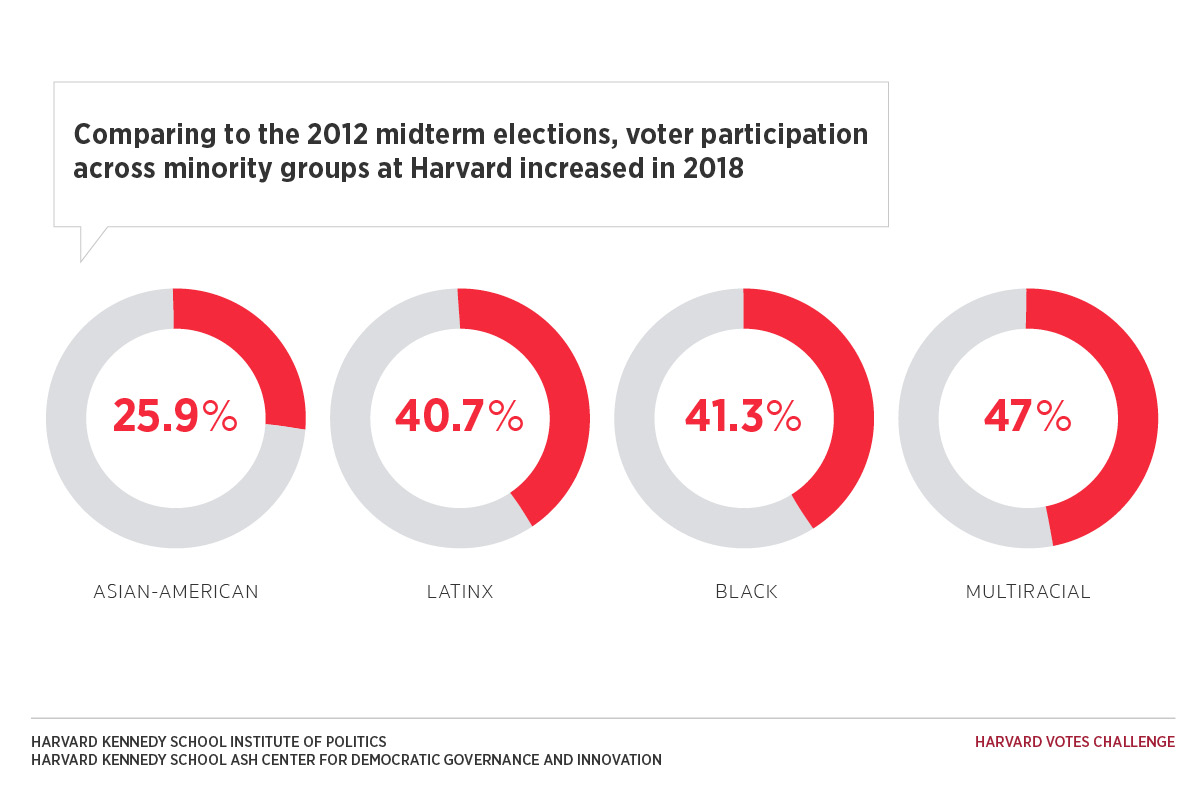
The National Study of Learning, Voting, and Engagement (NSLVE), a report examining voting behavior among younger Americans produced by Tufts University’s Institute for Democracy and Higher Education, found that Harvard’s eligible student voter participation rate jumped to 48.6 percent in 2018, up 25 percentage points from 2014 and about ten points higher than the national average. The NSLVE data includes voting figures for both eligible undergraduate and graduate students across all of Harvard’s schools and departments.
This increase in participation comes at a time when the University is taking further steps to institutionalize a culture of voting across campus. Leading up to the 2018 elections, the Harvard Votes Challenge, a voter engagement and education initiative launched by the Harvard Kennedy School’s Institute of Politics and Ash Center for Democratic Governance and Innovation, rallied students from Harvard’s twelve degree-granting schools to register and vote.
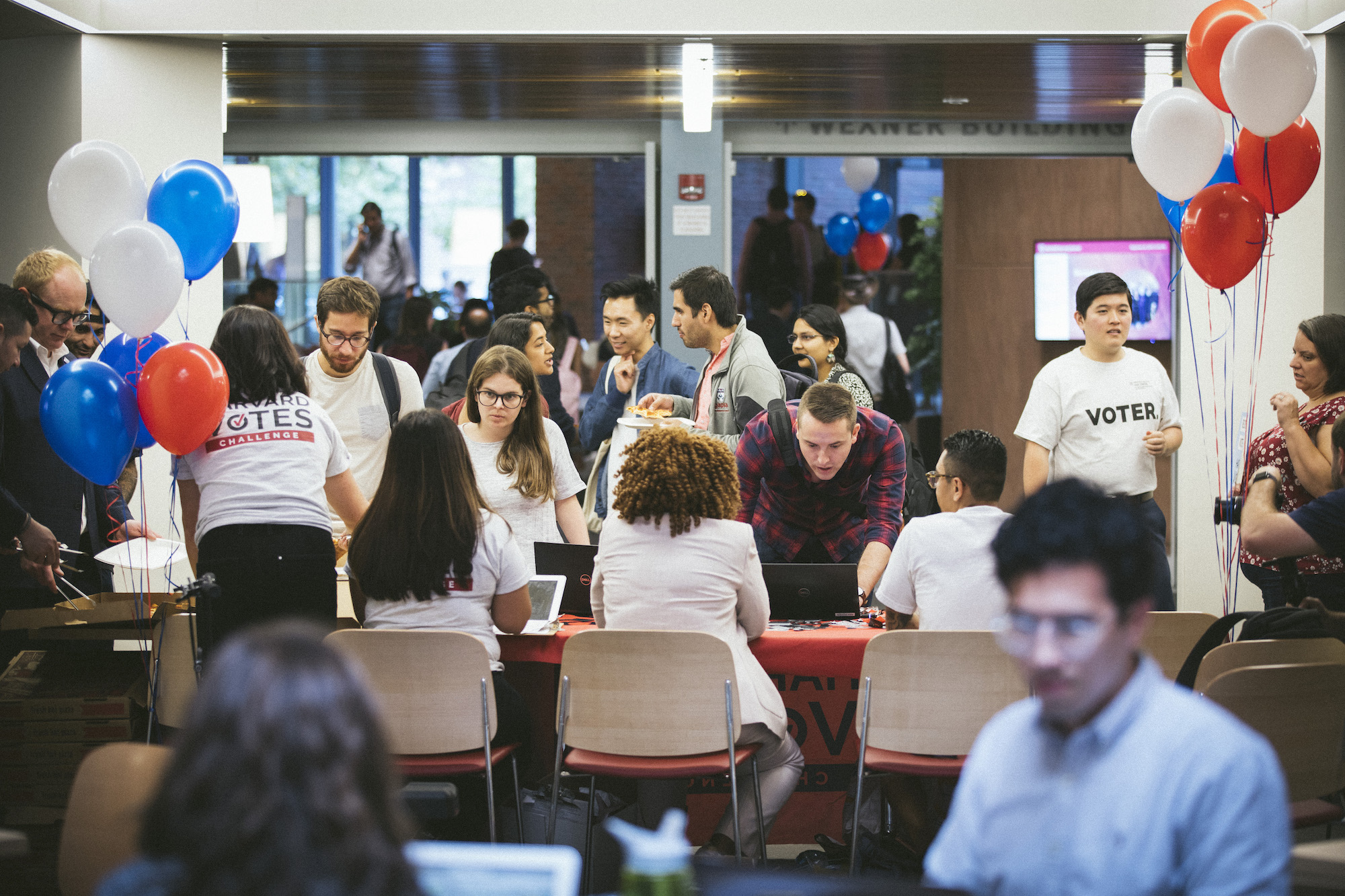
Led as a joint-effort from students, faculty, and administrators, members of Harvard Votes Challenge hosted registration drives, on-campus events, and even a friendly competition with rival Yale to boost voter participation numbers. Harvard Kennedy School mobilized to help register over 90 percent of eligible students as part of the challenge.
“The Harvard Votes Challenge brought a new excitement around voting to campus in 2018,” said Teresa Acuña, Associate Director for Democratic Governance at the Ash Center. “This latest report on voter participation exemplifies the impact institutional support can have on civic engagement at the University. The organizing team will build on the success of the last election to ensure every student, staff, and faculty participates in our democracy.”
The increase in Harvard voter participation is consistent with findings showing a notable rise in young voter participation across the U.S. in 2018. NSLVE reported that nationally, 39 percent of eligible students enrolled at institutions of higher education voted in the midterms last year, nearly 20 percentage points higher than 2014’s turnout numbers. This data coupled with reports showing similar increases among all eligible voters aged 18-29 has observers predicting that young voters will play a pivotal role in the 2020 presidential election.
“Voting is a foundational civic rite of passage that has the potential to become a defining element of the Harvard experience. We believe it’s an institutional responsibility to ensure that all our students learn how to vote and feel supported and empowered to cast their ballot,” noted Rob Watson, Director of Student Programs at the Institute of Politics.
With the added support from the Harvard University President’s Administrative Innovation Fund, the team behind the Harvard Votes Challenge will expand its voter engagement efforts with the goal of achieving 100 percent voter participation in 2020.
“We knew that if we got organized, we could be a part of a powerful youth-led civic movement happening across the country,” said Teddy Landis ’20, Student Co-Chair of Harvard Votes Challenge. “The Harvard Votes Challenge is excited to build upon this success and continue the momentum until we reach full-voter participation across our Harvard community.”