
Additional Resource

Commentary
Allen Lab Affiliate Benjamin A. Barsky examines alternative emergency response programs — arguing for a democratic model of public safety governance in which responses to nonviolent incidents are shared across government and civil society rather than dominated by police.
By:
 Ben Barsky

Some six years after George Floyd’s murder and the anti-police mobilization efforts that ensued, dozens of U.S. jurisdictions have launched programs that send unarmed responders to nonviolent community incidents — such as behavioral health crises — instead of police. The public’s call for these alternative emergency response programs (Alternative Responses) was clear: to end racialized criminalization and police brutality.
In an article published in the Emory Law Journal, Benjamin A. Barsky shows that these programs’ real-world implementation has proven far more complicated, and paradoxical. On the one hand, Alternative Responses continue to be institutionally connected to police in a multitude of ways — calling into question their status as genuine police alternatives. On the other hand, at the street level, these programs employ a crisis intervention approach that does move away from traditional policing tactics of coercion and deterrence. This approach — which Barsky calls “supported crisis response” — seeks to ensure that people have the agency to make decisions free from domination, access life-sustaining resources, and receive tailored follow-up services.
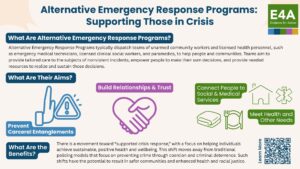
Moving forward, Barsky emphasizes the need for a robust democratic model of public safety governance grounded in what he calls the principle of integration — one in which responses to nonviolent incidents are addressed across a range of government bodies and civil society organizations rather than controlled by police.
In the near-term, reforms might require creating emergency communication channels that allow community members to reach Alternative Responses without needing 9-1-1; expanding call types that Alternative Responses can handle; and conducting rigorous, democratically responsive program evaluations that give the public meaningful insight into whether these interventions are working.
On a longer time horizon, more structural changes might include establishing mechanisms for long-term community input; building sustainable financing mechanisms — potentially through expanded Medicaid reimbursement — to ensure that programs can survive precarious local budgets; and constructing theories of public safety governance grounded in empowerment and health rather than more traditional criminal law metrics, such as crime deterrence.
Please find the full paper here.
Benjamin A. Barsky is Associate Professor of Law at UC Law San Francisco (formerly UC Hastings). He is an affiliate of the Allen Lab for Democracy Renovation.
The views expressed in this article are those of the author(s) alone and do not necessarily represent the positions of the Ash Center or its affiliates.
Additional Resource

Additional Resource
The Allen Lab is proud to have contributed to this timely landscape report from The David & Lucile Packard Foundation mapping the emerging field of AI and democracy.

Commentary
Allen Lab Fellow Jeremy McKey reflects on India’s AI Impact Summit, exploring the theme of diffusion and the implications for sovereignty and democracy.
Additional Resource

Commentary
Allen Lab Policy Fellow Christine Slaughter makes the case that democracy must be understood through people’s lived experiences and agency, not just institutions.

Feature
Economists and policy analysts broadly agree that more housing needs to be built in order to reduce costs in America’s most expensive cities. Using a novel survey of mayors of mid-sized and large cities to explore mayors’ views on the roots of America’s housing crisis and what solutions they believe will most effectively address their constituents’ housing challenges, the authors summarize mayors’ attitudes and perceptions on key issues related to expanding the housing supply, reporting how well these views correlate with mayors’ assessments of their own cities’ supply needs.