Full Disclosure: The Perils and Promise of Transparency
Full Disclosure explores how transparency policies, like corporate disclosures and nutritional labels, can empower citizens and improve governance, but often fall short due to incomplete or irrelevant information, offering insights into making them more effective.
Which SUVs are most likely to roll over? What cities have the unhealthiest drinking water? Which factories are the most dangerous polluters? What cereals are the most nutritious? In recent decades, governments have sought to provide answers to such critical questions through public disclosure to force manufacturers, water authorities, and others to improve their products and practices. Corporate financial disclosure, nutritional labels, and school report cards are examples of such targeted transparency policies. At best, they create a light-handed approach to governance that improves markets, enriches public discourse, and empowers citizens. But such policies are frequently ineffective or counterproductive. Based on an analysis of eighteen U.S. and international policies, Full Disclosure shows that information is often incomplete, incomprehensible, or irrelevant to consumers, investors, workers, and community residents. To be successful, transparency policies must be accurate, keep ahead of disclosers’ efforts to find loopholes, and, above all, focus on the needs of ordinary citizens.
How Americans Navigate Voting Information Ahead of the 2026 Midterm Elections
The Shorenstein Center’s 2026 Voting Information Trends project—developed in collaboration with the National Internet Observatory at Northeastern University, the Ash Center for Democratic Governance and Innovation’s Program on Democracy and the Informed Public, and The Civic Health and Institutions Project—provides new insights into the voter information landscape in the United States ahead of the 2026 midterm elections.
Among the resources, an interactive dashboard maps where Americans are finding voting information and learning about key aspects of the voting process—from sourcing polling locations to voter registration. Also included are a series of trends reports gauging perceptions of voting in the lead up to the 2026 midterm elections.
Content Creators, Election Administration, and Voting: Can Social Media Be Used to Improve the Voter Information Environment?
In this webinar moderated by Tova Wang, director of democratic research projects at the Ash Center, panelists Julia Angwin, Amanda Yarnell, Tommy Gong, and Brianna Wiggity Weck explore how election officials can leverage social media’s reach to improve public awareness around voter registration, voting, and election integrity. The discussion builds on the Ash Center paper, “Building Capacity to Use Social Media: How Election Officials Can Leverage Content Creation to Provide Accurate Voter Information,” which outlines frameworks for collaboration between election officials and digital content creators.
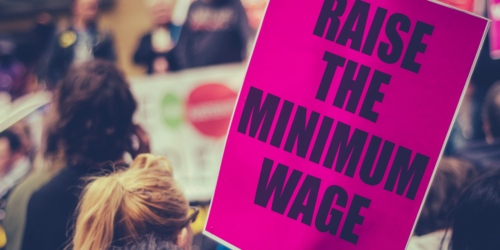
Raising Wages by Changing Norms: Work Policy for the Long Game
When Amazon announced a company-wide $15 minimum wage in 2018, the obvious assumption was that every competitor fighting for the same workers would have to match it or lose their workforce. They didn’t. Despite dramatic wage jumps at the companies that voluntarily raised their floors — and real cuts to turnover and hiring costs that made the move pay for itself — researchers find zero evidence of wage spillovers to the “poacher” and “feeder” companies competing in the very same local labor markets. The explanation turns out to say less about generosity than about just how much leverage employers hold over workers who have nowhere else to go.
How Americans Navigate Voting Information Ahead of the 2026 Midterm Elections
The Shorenstein Center’s 2026 Voting Information Trends project—developed in collaboration with the National Internet Observatory at Northeastern University, the Ash Center for Democratic Governance and Innovation’s Program on Democracy and the Informed Public, and The Civic Health and Institutions Project—provides new insights into the voter information landscape in the United States ahead of the 2026 midterm elections.
Among the resources, an interactive dashboard maps where Americans are finding voting information and learning about key aspects of the voting process—from sourcing polling locations to voter registration. Also included are a series of trends reports gauging perceptions of voting in the lead up to the 2026 midterm elections.
Raising Wages by Changing Norms: Work Policy for the Long Game
When Amazon announced a company-wide $15 minimum wage in 2018, the obvious assumption was that every competitor fighting for the same workers would have to match it or lose their workforce. They didn’t. Despite dramatic wage jumps at the companies that voluntarily raised their floors — and real cuts to turnover and hiring costs that made the move pay for itself — researchers find zero evidence of wage spillovers to the “poacher” and “feeder” companies competing in the very same local labor markets. The explanation turns out to say less about generosity than about just how much leverage employers hold over workers who have nowhere else to go.