
Policy Brief
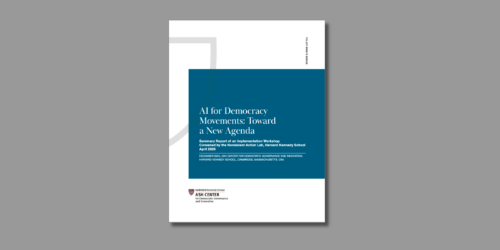
AI for Democracy Movements: Toward a New Agenda
A new report summarizes key insights from the Nonviolent Action Lab’s December 2025 convening on how artificial intelligence can empower pro-democracy movements.

Occasional Paper
In this report, Erica Chenoweth summarizes a December 2024 workshop on the specific issue of AI adoption within democracy movements and offers some key recommendations.
By:
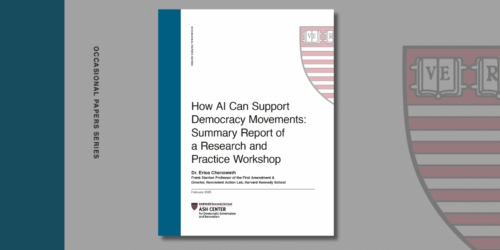
In recent years, democracy movements have experienced a historic decline in their ability to challenge autocratic governments effectively. This decline is due, at least in part, to the changing technology landscape, which has allowed autocratic governments to monopolize the advantages of breakthrough technologies to strengthen their power. The relatively slow adoption of AI tools by democracy movements may be widening the gulf between these movements and their adversaries—a gap that may grow even larger if movements do not integrate these technologies now. To explore these issues, we convened a workshop in December 2024. This report summarizes the proceedings and offers several recommendations based on the discussion.
Erica Chenoweth is the Frank Stanton Professor of the First Amendment at Harvard Kennedy School and Director of the Nonviolent Action Lab.
The views expressed in this article are those of the author alone and do not necessarily represent the positions of the Ash Center or its affiliates.
Policy Brief
A new report summarizes key insights from the Nonviolent Action Lab’s December 2025 convening on how artificial intelligence can empower pro-democracy movements.

Additional Resource
Even with Nicolás Maduro gone, the fight for Venezuela’s future is far from over. Freddy Guevara warns that Maduro’s successors are more interested in regime survival than democratic reform.

Policy Brief
Erica Chenoweth and Matthew Cebul analyze the global surge of Gen Z-led protest movements, showing how economic insecurity, exclusion from power, and corruption are driving youth mobilization worldwide.
Policy Brief
A new report summarizes key insights from the Nonviolent Action Lab’s December 2025 convening on how artificial intelligence can empower pro-democracy movements.
Additional Resource
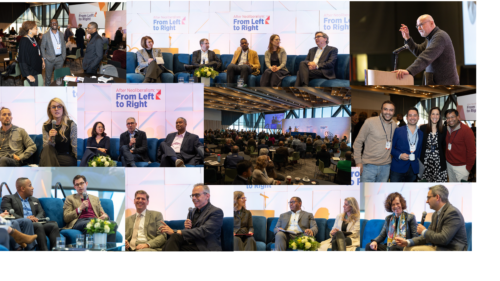
After Neoliberalism: From Left to Right brought together hundreds of leading economists, political scientists, journalists, writers and thinkers from across the political spectrum to explore and debate emerging visions for the future of the political economy.
Panel videos below.

Open Access Resource
Allen Lab authors Sarah Hubbard, David Kidd, and Andrei Stupu introduce an ethical-moral intelligence framework for evaluating AI models across dimensions of moral expertise, sensitivity, coherence, and transparency in their recently published paper, Crocodile Tears: Can the Ethical-Moral Intelligence of AI Models Be Trusted? in Springer AI & Ethics.