


Additional Resource  

Summit on AI and Democracy

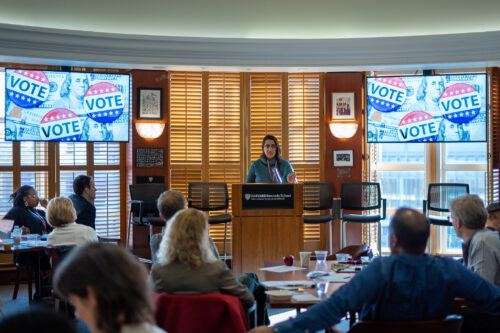
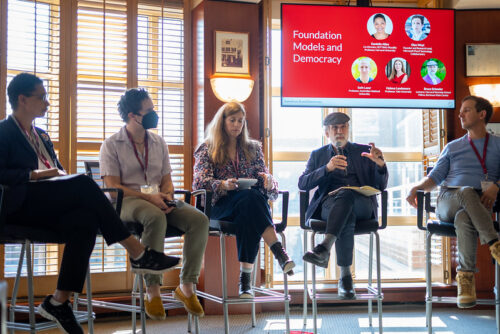
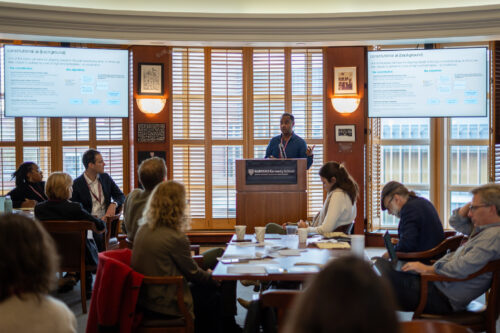
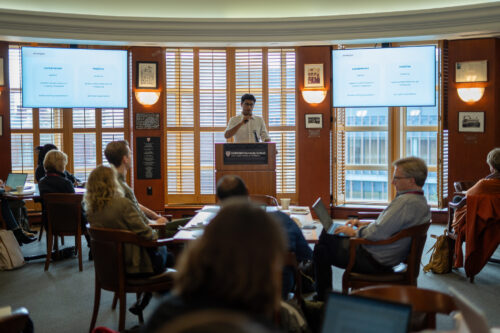
On November 7, 2023, the Summit on AI and Democracy gathered experts across multiple institutions to discuss ongoing research, policy, and development efforts related to the recent advancements in artificial intelligence.

About the Convening

On November 7, 2023, the Summit on AI and Democracy gathered experts across multiple institutions to discuss ongoing research, policy, and development efforts related to the recent advancements in artificial intelligence. The Summit was hosted by the GETTING-Plurality Research Network, a part of the Allen Lab for Democracy Renovation housed at the Harvard Kennedy School’s Ash Center for Democratic Governance and Innovation.

The Summit was composed of various lightning talks and breakout groups, with a focus on the following topics:

  • The opportunities and challenges that technologies, such as AI, pose to democracy, and how we might govern these systems.
  • Research and emerging methods for incorporating greater democratic input into the development of AI.
  • New developments and tools in support of democracy, plurality, and collective intelligence– explorations for how we might use these innovations for good.

Featured Presenters

  • Danielle Allen
  • Allison Stanger
  • Eric Beerbohm
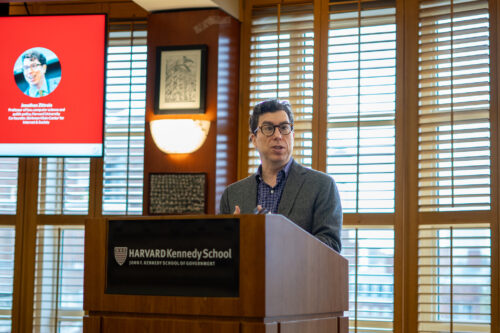
  • Jonathan Zittrain
  • Tina Eliassi-Rad
  • Aviv Ovadya
  • Shrey Jain
  • Beth Noveck
  • Divya Siddarth
  • Deep Ganguli
  • Amy Larsen
  • Kasia Sitkiewicz
  • Madeleine Daepp
  • Seth Lazar
  • Hélène Landemore
  • Glen Weyl
  • Bruce Schneier
  • Puja Ohlhaver
  • Vivian Chen
  • Wes Chow
  • Kinney Salesne
  • Nick Pyati
  • Glen Weyl
  • Luke Thorburn
  • Alex Pascal
  • Allison Stanger
  • Archon Fung

Event Photos

01 of 07

Related Resources

Allen Lab Fellow Spotlight: City Charters are Deliberative Democracy’s Friends

Commentary

Allen Lab Fellow Spotlight: City Charters are Deliberative Democracy’s Friends

Allen Lab Fellow Tyler Fisher examines the untapped potential of city charters as a vehicle for deliberative democracy, arguing that advocates should work to embed tools like citizen assemblies, participatory budgeting, and town meetings directly into the governing architecture of cities, institutionalizing deliberative democracy one municipality at a time.

More on this Issue

Work in the Age of AI: Reflections from After Neoliberalism

Commentary

Work in the Age of AI: Reflections from After Neoliberalism

Allen Lab member Charlie Covit reflects on the After Neoliberalism conference and examines the intersection of artificial intelligence and the future of work, arguing that AI forces a democratic reckoning with the meaning of labor itself and that an economy which generates abundance while stripping citizens of purpose and dignity undermines the very foundation of democratic life.

AI models appear to recognize moral complexity — then ignore it, new study by researchers affiliated with Harvard Kennedy School’s Allen Lab finds
Outstretched hands holding a graphic of a scale and the outlines of two heads.

Media Release

AI models appear to recognize moral complexity — then ignore it, new study by researchers affiliated with Harvard Kennedy School’s Allen Lab finds

New study published in AI and Ethics introduces a new ethical-moral intelligence framework for AI and finds that leading AI models mimic human moral concern while making decisions that reveal a hidden value hierarchy. 

Artificial Intelligence and Democracy: Campaigns, Elections, Movements, and Deliberation
The U.S. Capitol with a digital grid overlay.

Article

Artificial Intelligence and Democracy: Campaigns, Elections, Movements, and Deliberation

A new chapter in APSA Preprints by Archon Fung, Winthrop Laflin McCormack Professor of Citizenship and Self-Government and Director of the Ash Center, Bailey Flanigan, former postdoctoral fellow at the Ash Center and co-authors explores how generative AI is reshaping four dimensions of democratic practice—political campaigns, election administration, social movements, and citizen deliberation. The authors argue that AI’s ultimate democratic impact will depend less on the technology itself, and more on how institutions and leaders implement and regulate it.