Deborah Archer: The moment I think more than anything calls for bold and creative action, it calls for action. All of the actions that we’re seeing this administration take are connected, so efforts to challenge one piece is going to help in the collective effort to challenge all of it.
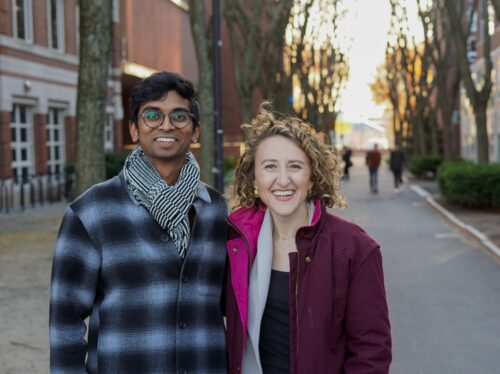
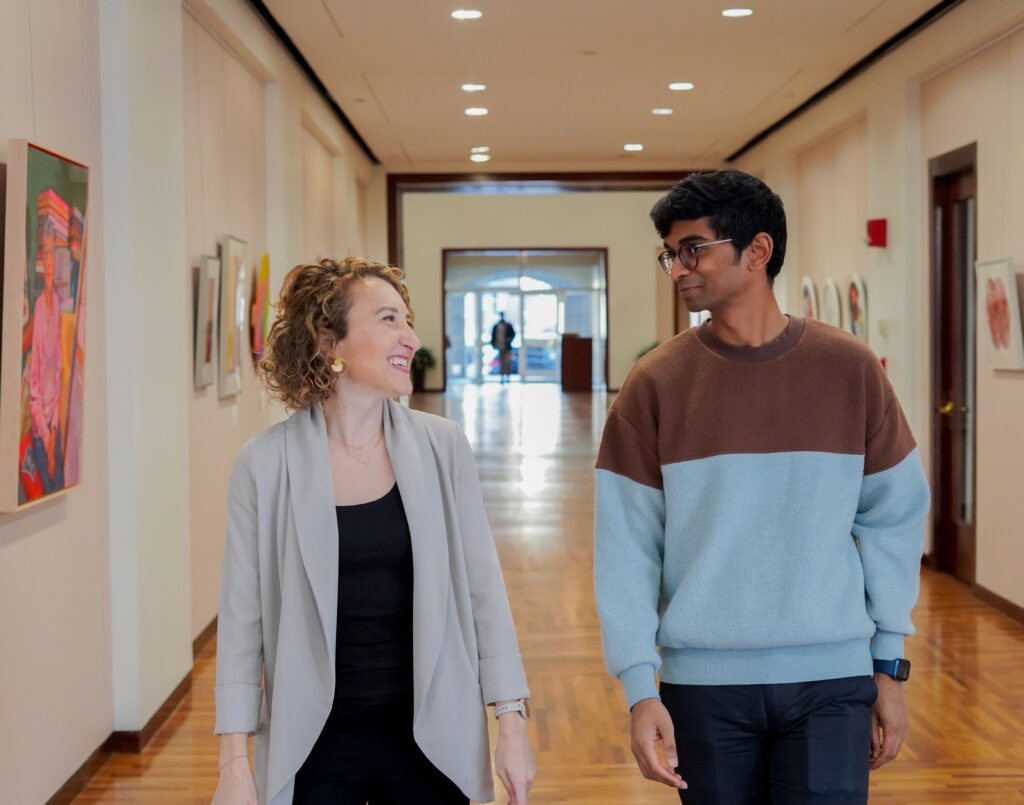
Erica Licht: Well, Nikhil, all good things must come to an end.
Nikhil Raghuveera: I know. It’s hard to believe we’ve been hosting this podcast together now for five years. And for our listeners, we’ll sadly be sunsetting Untying Knots at the end of this episode. I know it’s very bittersweet. In some ways, it feels like time has flown by, and in other ways, especially thinking back to the pandemic, it’s felt like it slowly creeped along.
Erica Licht: What a powerful and almost perfect way, in my opinion, to wrap things up again with a bookmark, not a bookend. We’ll be speaking today with one of the people leading an organization most on the front lines right now in the charge for justice and accountability in 2025.
Nikhil Raghuveera: That’s right. Today we’ll be speaking with Deborah Archer, president of the ACLU.
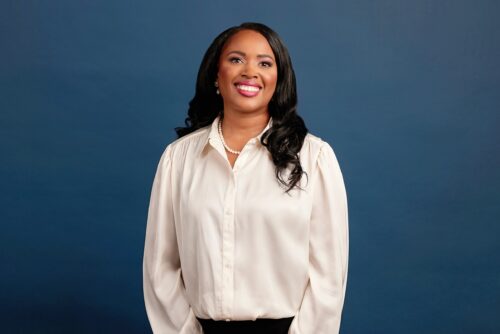
Erica Licht: So let’s provide Deborah’s full accolades, and there are many incredible ones. Deborah N. Archer is president of the ACLU, where she serves as chair of the Board of Directors and Executive Committee, which are the two governing bodies responsible for policy development, financial oversight, and mission alignment for the national organization. Deborah is also a tenured professor and associate dean at New York University School of Law and the faculty director of the Community Equity Lab.
Nikhil Raghuveera: She’s a leading expert in civil rights, civil liberties and racial justice, and an award-winning legal scholar whose articles and commentary have been featured in numerous high profile media outlets, including MSNBC, NPR and The Atlantic. And very exciting, her new book, Dividing Lines: How Transportation Infrastructure Reinforces Racial Inequality was published this April. From the publisher, “An essential account of how transportation infrastructure from highways and roads to sidewalks and buses become a means of protecting segregation and inequality after the fall of Jim Crow.”
Erica Licht: Let’s add one more stunning review from Professor Annette Gordon-Reed about the book, “Dividing Lines demonstrates with great clarity that decisions about infrastructure in the United States have been anything but neutral.” And jumping to the end here, “This is a brilliant and persuasive call to action for all who are concerned about creating a more just society.”
Nikhil Raghuveera: And I’m so grateful that we got a chance to speak with Deborah right now. To what is at stake, to what actions and movement workers responding to the attacks by the federal government, and where you and I and the average person can and should be investing their mental and emotional energy.
Erica Licht: Absolutely. I’m also thinking here just to riff a little about the way that light is refracting in so many ways off of this current moment, both in the attacks themselves on people’s lives and dignity and access to resources and healthcare and homes and food and safety for their family, but also the refractions of people and organizations like Deborah and like the ACLU leading this charge of response. So let’s get this thing started and thanks everybody for being here with us today.
Nikhil Raghuveera: Hey Deborah, thanks so much for joining us today. Really excited to have you.
Deborah Archer: Thank you for inviting me.
Nikhil Raghuveera: So to really kick things off, the first thing was what have been the most successful strategies to date undertaken by the ACLU to stand the line and fight against a current attack on civil rights by the federal government?
Deborah Archer: Yeah, I think that what’s been most important is that we have been in the fight, to not stand by and allow these attacks on civil rights and civil liberties to go unchecked. So last year, the organization took very seriously everything that Donald Trump said he was going to do if he was elected to office. And we took very seriously everything that was in Project 2025 and that allowed us to have a blueprint to be ready on day one of this administration to engage. And I think that blueprint is focused on how we can do three things, defeat, delay and dilute the actions and the attacks that we’re seeing on civil rights by this federal government. And so defeat means just that, we’re working very hard to end, to strike down a lot of the efforts that we are seeing that challenge civil rights, civil liberties, but we’re also understanding that sometimes a complete and total defeat of these initiatives won’t be possible. So sometimes we’re focused on delaying it and some people may not see that as victory, but if you can delay the implementation of some of these actions in those spaces, more people can access their rights, more people can get access to opportunities. It was something that we thought about around reproductive freedom in the days following Dobbs, where we were really focused on challenging bans on access reproductive health care using state constitutional provisions and other tools. And in doing that, for many we were able to delay implementation of bans on receiving abortion care. And in those days and weeks and months, people were able to access the care that they needed. So sometimes it’s not a complete win, but a delay can mean the protection of important rights for individuals. And similarly with the dilute, we’re trying to, if we cannot have an outright win, to dilute some of the most harmful, most egregious, most evil portions of some of these actions to lessen the harm, to lessen the impact on individuals and communities. And so to date, we are leaning into that litigation. We have about 50 cases filed that cover the waterfront of the issues that you all are seeing and that we are experiencing as attacks on civil rights and civil liberties. But we’re also leaning into everything that makes up the fabric of the ACLU. So that includes engaging in the larger advocacy efforts, it includes encouraging and facilitating individual participation, helping people who are concerned about our system, who are concerned about our rights find an avenue, find a platform, find a vehicle to be engaged in this struggle. And I think we’re supporting the larger ecosystem of organizations and individuals that are all doing this work to fight to protect our values and the promises in our constitution.
Nikhil Raghuveera: Thanks. And I actually think this was going directly to what I wanted to ask because the ACLU covers so many different issues, so many different things that are happening around in the country. And so from your view, where should Americans alarmed by all these different attacks be investing their time and energy? Because there is so many different facets, right? To some extent, it’s almost been a bit of a shock and awe campaign of just cover as many different things as possible by the current administration, and so therefore you just don’t know what to do. So I’m very curious to hear your perspective on Americans are obviously alarmed, but where do you believe they should be investing their time and energy?
Deborah Archer: Yeah. And it can feel overwhelming, right? I think that’s part of the strategy is to flood the zone, to overwhelm us, to deplete our resources, our energy, our capacity. And I think we cannot allow ourselves to become overwhelmed. The moment, I think, more than anything calls for bold and creative action, it calls for action. All of the actions that we’re seeing this administration take are connected, so efforts to challenge one piece is going to help in the collective effort to challenge all of it. So rather than have people spend time and energy trying to make sense of everything that’s going on, where the best possible avenue of intervention is for them to have the most impact, I think join any piece of it, right? Any effort you take is going to be helpful in slowing this down and shutting this effort down because it is all connected to a larger vision. It is not just about challenging immigration. It is not just about diversity, equity, inclusion. It is not just about reshaping higher education and challenging racially inclusive education. All of those things together are about really a re-ascendancy of white supremacy. And so any effort to challenge that is going to be useful in slowing down the larger effort. So rather than saying that there’s one place that is going to be most effective, I think what I think people should do is to not stand by, not stand at the sidelines, to join this fight. And that fight may be fighting the immediate attacks on our rights. You may want to get involved by helping to envision what comes next, right? Because we’re not going to litigate ourselves out of this crisis. We have to build ourselves out of this crisis. So there needs to be people who are involved in the litigation to hold the line, but there also needs to be people involved in the building that needs to come at the same time and after the litigation to help expand the circle to help build new infrastructure for civil rights and civil liberties because our current infrastructure has been so aggressively attacked and dismantled.
Erica Licht: Can you speak to the intimidation and attacks across sectors right now, from law firms to private companies to public broadcasting to universities? It’s varied and yet strewn across all of these different industries and institutions.
Deborah Archer: I think for me, all of those things are connected as efforts to undermine the checks and balances within our system. And so if you focus first on attacks on the legal community, we see this administration trying to undermine under the rule of law on both sides of the bench, right? So they’re attacking judges and their rulings and attacking their judicial independence and their authority to act in these cases. And that’s important for them to do because they’re losing in court and they need to undermine the credibility, the authority of the folks who are helping to dish those losses. And then on the other side of the bench, they’re attacking the lawyers who are engaged in bringing these cases that are helping to support the attack because judges can’t rule on cases unless they’re brought, right? The cases have to be brought in front of those judges. And so attacking law firms that bring those cases, attacking law schools and the education that they’re providing and enabling folks to bring these kinds of cases, attacking the organizations that support the work. They’re attacking First Amendment principles that give people the ability to speak truth to power and to demand better, to demand different from our government. So all the ways in which we have seen over history that there are checks and balances, and that the voices of the people can be elevated, that we can protect the rule of law, that we can stand up for the constitution. I think this administration is attacking each and every one of those pillars.
Nikhil Raghuveera: Thank you. Thank you so much for that. And that’s so critical and important for everything you just said. So you hold many incredible hats, president of the ACLU where you serve as chair of the board of directors, also a tenured professor and associate dean at the New York University School of Law and the faculty director of the Community Equity Initiative and NYU law.
Deborah Archer: It is a lot of jobs. That’s a lot of jobs.
Nikhil Raghuveera: Let’s hone in on one specific as author. Your new book, Dividing Lines addresses a role race and racism has played in transportation infrastructure from the early 20th century to present. What is necessary to understand about the enduring nature and legacy of structural racism for building more just and equitable systems today? And this is an infrastructure and across sectors in society.
Deborah Archer: Yeah. So thank you for asking me about the book Dividing Lines. I think it is really connected to the question you just asked about the broad scope of the attacks. Because one of the elements of the attacks is shutting down honest conversations about racism in this country. And in doing the work to advance civil rights and racial justice, it’s critically important that we have real and meaningful conversations about where we are and exactly how we got here. And that includes reckoning with the legacy of structural racism because it’s only then can we actually develop approaches and policies they can get to the heart of the problem. And a lot of my work broadly with all my hats is focused on challenging inequality at the intersection of race and space. And there’s often a collective dimension to racial oppression. Today, some of the most pressing civil rights challenges are those facing communities of color and the ways that we deny those communities access to all the tools that they need to live healthy and choice-filled and vibrant lives. Many of these communities and their residents are bearing the marks of decades of accumulated disadvantage, making it harder for people who live in these communities to access and fully enjoy their rights. And one of the tools that we have used are physical literal lines that run through and around our communities, lines that seem innocuous or necessary or natural, and they’re part of the architecture of racial inequality. And our nation’s transportation system is really an essential element of that architecture of inequality. Transportation, when we think of it, we think of roads and highways and public transit that were symbols of progress and connection. But the story I tell in Dividing Lines is about how these same systems have also been used as tools of exclusion and displacement, especially in black communities. Transportation and transportation infrastructure have long been tools for enforcing white supremacy. And as legal segregation began to crumble during the civil rights movement, cities across America started turning to infrastructure. Our highways, our roads, our transit systems, our sidewalks, and also with the policies that we implemented in those forms of transportation infrastructure as more permanent and more visible ways to enforce racial hierarchy. And the harm has been real and measurable. Transportation and transportation policies help to parcel access to jobs and healthcare and education and safety along racial lines. Communities of color are often forced to absorb the harms, right? The pollution, the displacement, the noise, the isolation, the disinvestment, and they get few of the benefits. So ultimately this book is about how racism adapts, and that’s the larger story of systemic inequality. Dividing Lines tells a story of how racism didn’t just survive the fall of Jim Crow. It evolved and found new tools in zoning boards, city planning departments, federal transportation funding. And I think when we look at systemic and structural inequality more broadly, one of the underlying stories, one of the foundational narratives is the way that racism survives because it evolves, because it adapts and because it’s creative.
Erica Licht: Here in Untying Knots, we featured a range of case studies of communities, organizations, geographies over the years. Is there any specific short anecdote or example from the book that you want to highlight for us?
Deborah Archer: Sure. One example that I talk about in the book is the role of highways. So everyone knows Brown v. Board of Education in 1954 indicated that we were going to have the fall of segregation writ large because the court in Brown said segregation in public education is unconstitutional. And that signaled the fall of Plessy, which was really the foundation of racial segregation in the country. So that was 1954. After that decision, folks around the country, particularly in the South, said that they were going to use every tool they had available to them and they were going to fight to protect their way of life. Because as we know, those who love yesterday are always going to fight against tomorrow, and they’re going to use every tool that they can to do that. And so we saw two years of what was called massive resistance, where they made sacrifices. They shut schools down, they made attendance at schools optional, and they were still fighting to hold onto segregation. Then in 1956, we had the Southern Manifesto where over a hundred legislators at the federal level sign on a pledge to use every tool that they can to enforce racial segregation. Two months after the Southern Manifesto, we saw the adoption of the Interstate Highway Act of 1956. And rather than build the interstate highway against the backdrop of Brown’s promise, the Interstate Highway Act was co-opted in many places to become that physical dividing line that would replace the invisible lines that they used to be able to enforce with things like racial zoning laws or redlining or other tools of racial discrimination. And so I talk about a few examples in the book. One is Birmingham, Alabama. At that time, it was known as bombing ham because as black folks started to leave the confines of their segregated communities and move into white communities, the response was racial violence as it often is, and black folks’ homes were bombed. And one of the tools that Birmingham used to enforce racial segregation were racial zoning laws, which indicated black folks could live in this zone, or white folks could live in this zone, and you couldn’t live in a zone that wasn’t indicated for your race. And when racial zoning laws were struck down and folks started to try to move, Birmingham turned to the Interstate Highway Act and used it to build a highway that became a barrier. And I-59 and I-65 became a barrier between black and white communities. And if you overlay the racial zoning map with the highway map, it mirrors it exactly in many places. And so they, as I said, replaced an invisible line with a physical line that destroyed black homes, black communities, black social institutions, but also physically locked in racial segregation in a way that continues to impact that community today.
Nikhil Raghuveera: What a moving example of these Dividing Lines. I mean, for me, I grew up in the South. I spent time in Alabama, I spent time in Atlanta. And so thank you. Thank you so much for really explaining that and walking through it.
Deborah Archer: Yeah. Well, if you spend time in Atlanta, you know that Atlanta took it to another level, and Atlanta similarly used a highway, I-20 was built in way to limit black migration and to protect a white community from that migration. But then Atlanta also layered on what we see as traditional street planning tools for segregation, but also to limit the ability of black folks to move around the city, to be able to move to or through white communities so they use one-way streets, Atlanta dead-ended roads that were through streets to make sure that it was more difficult to pass from a black community to a white community. Atlanta built what came to be known as Atlanta’s Berlin Wall, where they erected a wall in the middle of the street to try to stop black folks from entering and moving through a white community. And Atlanta would even use street names as streets when there was a through street would pass from a black community to a white community. Atlanta would have those two pieces of the street have different names, one to spare white folks the indignity of being said to have lived on a street with black people, but also to make it easier to discriminate based on the racial makeup of a community. And so Atlanta really did use a belt and suspenders kind of approach.
Nikhil Raghuveera: Wow, that’s such critical history. And it’s not talked about enough in Atlanta by any means or even around the country. Unfortunately, I think now we’re starting to run out of time, but I did want to say thank you so much for being here, Deborah. We’re so grateful for your leadership right now, especially at the ACLU, right on the front lines and your scholarship. We’ll make sure our listeners go out and get a copy of Dividing Lines.
Deborah Archer: Thank you so much for having me.
Nikhil Raghuveera: We’re back in the studio now reflecting on what a meaningful conversation that was with Deborah, and as timely as ever, especially as we see the onslaught of attacks against civil rights by the federal government. The ACLU’s ongoing work as well as Dividing Lines offer us a blueprint for national and localized response.
Erica Licht: I’m also taking away from our conversation on an individual and community level that we really just cannot allow ourselves to be overwhelmed, especially those of us with degrees of privilege. Being overwhelmed is explicitly part of this mode of attack. And on the other side, as Deborah mentioned, any efforts to challenge one piece can challenge all of it.
Nikhil Raghuveera: And be sure to check out Dividing Lines and buy your copy today.
Erica Licht: So with that, we will get ready to very, very bittersweetly sign off. To all of our listeners as well as colleagues, friends, and family, thank you so much for being a part of this community for the last five years. We’re so grateful for all of your support. We have this expression in Yiddish, Nikhil, that I just learned recently. And pardon my pronunciation here because it probably is not going to be accurate. [foreign language 00:23:48]. The sea has no shore. So may this podcast and its themes continue to reverberate. And also, may we, you and I, continue to be in powerful conversations with each other as well as with leaders making waves across our society especially and hopefully beyond a time of violence and attack when they’re needed acutely most.
Nikhil Raghuveera: And to our listeners, we hope that Untying Knots has helped you better understand the various forms of systemic oppression that we all must navigate and untangle in our lives. And we started by saying this in 2020, and I’ll say it again now. Untying Knots is about untying knots of systemic oppression and hearing from the leaders, organizations and movements on the front lines tying new knots of justice, solidarity and accountability, fighting for more just and equitable society.
Erica Licht: The world is very different today than it was five years ago, and also very similar, both in good and bad ways. So as we part ways with our audience and each other in this specific medium, just appreciating all of the learning, growing, and dialoguing that we’ve done in this period of time. So thank you, Nikhil. I appreciate you and our conversations together.
Nikhil Raghuveera: Yeah, thank you, Erica. It’s been a wonderful and incredible journey over these last five years, and all the folks we had a chance to talk to, listen to and learn from. And thank you all for everyone else listening and for being part of this with us. And with that, signing off for the final time. Untying Knots is hosted by Nikhil Raghuveera and Erica Licht. It’s a collaboration with the Institutional Antiracism and Accountability Project, and supported by the Harvard Kennedy School Ash Center. We’d like to thank Deborah Archer for her time and speaking with us. And a huge thank you to Megan Ming Francis for creating the space that sparked this podcast in the first place.
Erica Licht: Music is Beauty Flow by Kevin Macleod.