
Podcast
So, Is It Fascism?
Jonathan Rauch joins the podcast to discuss why he now believes “fascism” accurately describes Trump’s governing style.

Podcast
Co-hosts Archon Fung and Stephen Richer unpack the latest developments in the Epstein saga and explore what they reveal about shifting political alignments, growing demands for accountability, and the relationship between power and public trust.
Archon Fung is the Winthrop Laflin McCormack Professor of Citizenship and Self-Government at the Harvard Kennedy School and the Director of the Ash Center for Democratic Governance and Innovation. His research explores policies, practices, and institutional designs that deepen the quality of democratic governance with a focus on public participation, deliberation, and transparency. He has authored five books, four edited collections, and over fifty articles appearing in professional journals. He received two S.B.s — in philosophy and physics — and his Ph.D. in political science from MIT.
Stephen Richer is the former elected Maricopa County Recorder, responsible for voter registration, early voting administration, and public recordings in Maricopa County, Arizona, the fourth largest county in the United States. Prior to being an elected official, Stephen worked at several public policy think tanks and as a business transactions attorney. Stephen received his J.D. and M.A. from The University of Chicago and his B.A. from Tulane University.
Stephen has been broadly recognized for his work in elections and American Democracy. In 2021, the Arizona Republic named Stephen “Arizonan of the Year.” In 2022, the Maricopa Bar Association awarded Stephen “Public Law Attorney of the Year.” In 2023, Stephen won “Leader of the Year” from the Arizona Capitol Times. And in 2024, Time Magazine named Stephen a “Defender of Democracy.”
The views expressed on this show are those of the hosts alone and do not necessarily represent the positions of the Ash Center or its affiliates.
Archon Fung: Hey, everyone, you’re listening to Terms of Engagement, episode 21. I’m Archon Fung, a professor here at the Harvard Kennedy
School and director of the Ash Center for Democratic Innovation and Governance.
Stephen Richer: And I’m Stephen Richer. I’m the former elected Maricopa County recorder. And now I’m a senior practice fellow at the Ash Center at Harvard Kennedy School. And I’m coming to you today from Sandy, Utah,
doing a few things with the family out here. And for that reason, we are also recording a bit early. So we are not doing this one live. My apologies for that. However, we are going to answer a few questions that were emailed to us. And Archon, is this our last of the season or are we doing one more?
Archon Fung: I think maybe we’re doing one more. I think we’re doing one more and then we’ll break for the holidays, regroup, and then come back to you in the winter, in January.
Stephen Richer: And then have an amazing, totally new game plan that will revolutionize the industry as we know it.
Archon Fung: That’s in the podcast industry and democracy.
Stephen Richer: I think both would be nice.
Archon Fung: Yeah. And so as always, we’re speaking as individuals and not on behalf of Harvard or the Kennedy School. As a friendly reminder, keep things civil. We started the show to be thoughtful and have some interesting discussion, and we are continuing to try to do that.
In the news, just three quick items. Indiana legislators evidently are facing threats — physical threats — over their opposition to redistricting. And these threats are, I guess, appearing on social media and other places. At least five or six legislators — Republican legislators — have reported that. Second, a House committee is investigating —
Stephen Richer: I’m just going to pause you real quickly right there, because I think this is a little bit of an unreported, maybe just not fully appreciated, phenomenon of politics in 2025: the extent to which bullying — whether from another government office, or from another elected politician, or from an interest group, or simply from social media — can influence the decision-making calculus of elected officials.
We saw this previously in Iowa with Kim Reynolds and whether she wanted to vote to confirm certain people. And we’re seeing Indiana legislators being pressured into maybe rethinking their perspective on redistricting. It was something that I experienced while in office, and I just think it might just become part of the normal process, unfortunately, of being an elected official.
Archon Fung: Yeah, and evidently it was maybe a factor, or at least present, in Marjorie Taylor Greene’s decision not to run again. Jasmine Crockett, from the whole other side of the political spectrum, tweeted at Marjorie Taylor Greene — not very nice — so, she said, “I’ve been facing this the whole time for years, and you can’t take the heat for one week?” But it kind of goes to your point that maybe this is part of the normal condition of public life now, which is a real shame.
Stephen, You’ve faced this personally, and you know lots of people that have faced it also. Do you think we should think of it as a difficult and unpleasant part of being in public life? Or does it actually change people’s decisions and positions — that kind of bullying and physical threats and pressure?
Stephen Richer: I think it’s different. I don’t think this is akin to something that would have happened 20 years ago where maybe somebody writes a nasty article about you or you have lobbyists spend money running campaigns against you because it identifies personal features, it often identifies where the individual lives, it often talks about bodily harm, and it just seems, I don’t know, more personal, closer than maybe previously? And certainly when it sweeps in family members, as I’m sure has happened in the case of Marjorie Taylor Greene, it seems outside of the accepted rules of politics as a rough and tumble sport. Now, maybe some people would say, “Toughen up, Stephen, you know, I can recount many times in the past when politicians have suffered through worse,” but I don’t know. I do think it’s something to follow and maybe something to study.
Archon Fung: Yeah, I think it’s something really to be quite, quite concerned about. I mean, as a deliberative Democrat, you know, one of my core beliefs is we settle things through discussion. And this is the opposite of discussion. So, I’m super concerned about it.
Stephen Richer: It undermines a majoritarian Democratic norm, too, if a select few on the internet are having outsized pressure because of their willingness to go lower than almost anyone else. Now maybe someone like you would say, well, this has long been a problem that democracy has had to grapple with — the undue influence of a select minority. And maybe so, but those were usually in forms either particularly loud or particularly well resourced or particularly influential for another reason. But calculating that based on the ability to go lower than where other people go seems problematic.
Archon Fung: Yeah, I agree. I do think political violence in different periods in American history has been a quite important and present phenomenon. And I guess for the last few decades, we’ve enjoyed a relatively low level of political violence and physical threat, and now it’s jumping up again, which is a terrible thing.
Stephen Richer: Yeah. And again, we’ll have to get a historian in here sometime. We talked about this a little bit when we did the Charlie Kirk episode and talked about political violence. How abnormal is this?
And at the time we said that this likely at least rates higher in American history than usual, but not completely without precedent.
Archon Fung: Right, right. And our other two news item bullets here are about violence, but not that kind of political violence. So: the House Committee is investigating a possible war crime on the double-tap strike that killed survivors in a special operations strike on a boat in Venezuela. And one striking thing to me was that that House investigation seems to have a little bit of a bipartisan character to it. So, you know, that’s interesting.
And then, of course, there was a tragic shooting of two West Virginia National Guard members in an attack near the Capitol in Washington, D.C., last week. One has died and the other seems to be critically injured, which is horrible and tragic. The alleged attacker is an Afghan national. The suspect was an Afghan operator in a so-called Zero Unit, a special operations unit in Afghanistan. And that shooting incident has triggered sweeping immigration policy changes. And so, more to be continued there.
So those are our news updates. And we have an audience question before we get into the main subject for the day. The audience question is signed “an avid listener,” which is terrific. I’m glad we have an avid listener.
And the question is this: He writes, Democracy requires safe, free, and fair elections. How does the purchase of Dominion voting machines by a Republican election official affect election integrity? What does it mean? For example, will it make voter suppression more likely? What could happen if a partisan body acquired voting systems, and what are the safeguards?
So Stephen, I haven’t been following this Dominion story very closely. Get us up to date on it, and then your views about whether this is politically significant.
Stephen Richer: So, this is right in my strike zone, happily. And this is, as you mentioned, from something I guess named Euro — is what the email address came from — so thanks for the question.
It’s something that the election administration community spent a lot of time talking about when this first happened just a few weeks ago. But Dominion Tabulation Systems is a company in the United States that sells the equipment used to read ballots. So, if you mark your ballot and you fill in the ovals, then it would go through a Dominion tabulator that would then know how to calculate all the different contests and add up the results. It would also be used to build the different ballots — when you think of all the different types of ballot styles with all the different races on it, you could use Dominion software.
Now, I don’t think anyone knew about Dominion software and hardware outside the elections community prior to 2020, but it was really the target of a lot of theories about the 2020 election. There was especially one where it was alleged that Dominion was connected to Hugo Chávez, the deceased Venezuelan dictator, as part of a coup or a plot to rig American elections. That was not the case. Dominion sued, most notably Fox News, and they settled that defamation lawsuit for $787 million.
Dominion then carried on as a normal tabulation business until recently, when it was acquired by an individual named Scott Leiendecker. I’m not sure if that’s how you say his last name, but Scott is a longtime election official out of Missouri. And he had previously been in the elections business both as an election official but then later as the CEO and president of a company called KNOWiNK. KNOWiNK would make the e-pollbook check-in stations, so that when you go to a voting location and you scan your identification, and you check in and it makes sure that you’re registered and it knows what type of ballot to get you — Scott was in the business of making those prior to acquiring Dominion. But now he’s acquired Dominion. He made some comments; the website made some comments about how paper ballots were very important. And given the fact that he was previously an elected Republican, I think it registered on some people’s radars as potentially problematic, potentially buying into some of the false allegations about election administration in the United States.
I don’t think this has any foundation. All that he has said to election administrators since purchasing the company has been very positive, has been very pro-election strength, election operations, election accessibility. He doesn’t indulge any of the conspiracies about the 2020 election. And so, I think that for those counties that use Dominion tabulation equipment, including Maricopa County, where I’m coming from, I think it’s going to be business as usual.
Archon Fung: That’s great. So he himself — there’s nothing in his public biography suggesting that he doubted the machines or anything else about the 2020 election?
Stephen Richer: Nope.
Archon Fung: And there’s no current conflict of interest? He’s not a politician right now; he’s a businessperson.
Stephen Richer: Correct. And he has said, “I’m not an election denier.” There’s a great long article on Declare News — if you go to declarenews.org, you can look up a long article about his background and what he’s said so far. And I would just use this as an opportunity to remind people that even if there were something potentially problematic with the tabulators, most election jurisdictions have hand-marked paper ballots that then allows political parties or election officials to do hand-count audits after the votes are tabulated by the machines. So even if there were a problem with the machines, these things could be revealed in those post-election audits.
Archon Fung: Yeah. So I’m really glad we spent some time on answering this question, because I think a lot of people on the Democratic side — or maybe even on the independent side — might have similar questions about the purchase of the Dominion machines. And this is just a great account about why we shouldn’t be so concerned there, both because of the specifics of who bought it, what they’re doing, and then a whole range of safeguards. Even if they did have bad intention, there’s a whole range of safeguards around the machines and the counting process.
Stephen Richer: I think there’s going to be things to be worried about in the 2026 context, but I don’t think that this is one of them. We’ll let you know when you need to worry, but I don’t think this is one of them.
And in some ways, it’s exciting that somebody wants to actually purchase one of these companies because election tabulation equipment is notoriously a bad business. And so, if he’s coming in with some new ideas and some new capital, that could be a good thing for the elections community. And I guess you can’t blame the previous Dominion for wanting to get out of the business after all they’ve been through.
Archon Fung: Yeah, that’s great. So we’ll keep you posted on that story, and then other, maybe more significant things to worry about in 2026 and 2028.
All right. So, today’s main topic is the disclosure of the so-called Epstein files. And I must admit: up until, I don’t know, two months ago, the Epstein files just had not registered for me as a significant thing to worry about or think about in the political and democracy space. And I’ve totally changed my mind on that. I think probably a lot of people have. I think I was just wrong. I don’t know why I diminished it in that way. Now I kind of think when we look back on this moment and this era, we may well see Jeffrey Epstein — his crimes and abuses, his victims and survivors, and the many powerful people who associated with him — as a key part of the story and a signifier, a cultural signifier, for the political moment that we’re in.
A bunch of our listeners know the basics of the Epstein saga. For many years, he trafficked and abused young women — who, amazingly, number in the several hundreds, at least, maybe up to a thousand. Between 2005 and 2008, local authorities in Florida and then federal authorities investigated and eventually convicted him of exploiting minors as part of a very controversial plea bargain. He served 13 months in prison between 2008 and 2009. Then he got out, did his stuff, and later, in July 2019, he was arrested on federal sex-trafficking charges. And then, just a little bit later, in August 2019, he was found dead in his jail. His death was ruled a suicide.
But the real political impact of the Epstein saga follows his death. Many on the political right have demanded transparency about Epstein and what he did, disclosing the so-called Epstein files, which are a whole set of things that are possessed by different entities. The whole saga is weirdly consistent with a QAnon worldview: that there’s a shadowy cabal of elites who are engaged in heinous abuses, especially sexual abuses. And the amazing thing is that Epstein is the real-world mirror reflection of the false Q conspiracy theory, but many of the pillars are the same. It’s kind of crazy.
And the righteous, mostly right-side demand for Epstein transparency is a demand to expose those elites and hold them accountable. And whether or not they actually participated in abuses, the unseemly, icky Epstein network includes a who’s who of very prominent people in politics, finance, and, it turns out, higher education.
To me, maybe the most interesting thing about the Epstein saga is that it seems to be drawing a line in the social and political discourse. Ro Khanna, one of the people who sponsored the Epstein Transparency Act, said the reason he did it was that he’d been going to a bunch of exurban and rural places and talking to people. And one of the themes that kept emerging, he says, is that people were upset that there was this “Epstein class” of people who got to do whatever they want and had enormous power — and that these people needed to be exposed. So I think the Epstein litmus test is: Are you a member of the Epstein class? Do you support the Epstein class on one side, or do you support accountability and exposure of the Epstein class on the other?
So, the first part of the conversation I wanted to explore is that the Epstein litmus test seems to be driving a real wedge in the new right. Donald Trump campaigned on exposing the Epstein files, and then, when it came down to doing it, he seemed to resist it. And that made a bunch of people on the right pretty mad, it seems — Candace Owens, Megyn Kelly, Jack Posobiec, Elon Musk. All accused Trump of hiding crimes. Later on in Congress, Marjorie Taylor Greene, Lauren Boebert, Nancy Mace, Thomas Massie — all led a visible fight against Trump. And they eventually got a 427–1 vote on November 18 to release the Epstein files. We thought we’d play just a short clip of Marjorie Taylor Greene at her presser on November 18.
(Clip plays)
Marjorie Taylor Greene (clip): Women have fought the most horrific fight that no woman should have to fight. They did it standing together and never giving up. And that’s what we did by fighting so hard against the most powerful people in the world — even the President of the United States — in order to make this vote happen today. I was called a traitor by a man that I fought for five — no, actually, six …
Archon Fung: So, Stephen, do you think this whole thing draws a significant fissure in MAGA, with MTG on one side and Donald Trump on the other?
Stephen Richer: I guess it should be said that those were some of the victims that Marjorie Taylor Greene was standing in front of. Just to make you feel a little better, I felt the same way. I thought this was much ado about very little — I won’t say much ado about nothing. Obviously, Jeffrey Epstein was a criminal and a loathsome human being. But I thought that the circle of influence and the circle of people involved in this was much smaller than it seems it is. I’d been a bit dismissive of it just because it felt like it fell into so many often-heard conspiracy theories about the deep state and all the manipulation — so many things I’d seen debunked in other contexts — so I assumed this was similarly situated.
I think the part that Marjorie Taylor Greene said about this being a battle against the powerful is why this issue is dividing many on the new right, where previous issues — even some disagreements with the president — did not cause such a schism within the Republican Party, within the new right. And I think it’s because, at its core, Trumpism and the new right is anti-establishment, anti-elite. They rail against figures in the media that they see as elite: the CNNs, the MSNBCs of the world. They rail against universities they see as elite. They rail against big business, whether it’s Wall Street or whether it’s big tech.
So to reject this is not just a not going along on this particular issue. But I think that many felt that President Trump was turning his back on the core rationale, the core need for the MAGA movement which is that elites have run amok. They have forgotten about normal Americans. And as a sign of their running amok, they are so disconnected from normal Americans that they think they can have an island where they can commit crimes that the rest of us would get arrested for. And so, I guess that’s why this has stuck where disagreements previously have seemingly not.
Archon Fung: So how do you think about the MAGA leaders who really led this thing? Marjorie Taylor Greene, Lauren Boebert, Nancy Mace, and — Thomas Massie’s in a little bit of a different category, but also definitely led this thing that ended up winning by everybody in the House
of Representatives. Do you think of them as kind of earnest? I don’t know. Drinking the Kool-Aid is insulting because I think the cause is righteous of holding bad elites accountable, that that is really what their political project is in a way that kind of people on my side of the spectrum or whatever might dismiss a little too easily and quickly.
Stephen Richer: I think that though those people might not be the cup of tea of all of our listeners, I think that it was an act of political courage. Now, I don’t know if what was motivating it was an eagerness to stand up for those women or an eagerness to stand up for the MAGA base who feels like the elite needs to be exposed. But regardless, standing up to a president, under any circumstances, is something that requires an act of courage because the president is the leader of the party, and he can make your life very uncomfortable in your re-election. Or at the very least, he can simply not do anything for your re-election or not bring you into the inner circles.
But standing up against this president at this time — I don’t know that there has ever been a president that has had such a stranglehold over a political party in which you things are particularly problematic for him because he himself is implicated in at least some level in the Epstein papers, the Epstein files. And so, I was shocked that Massie and Marjorie Taylor Greene and Boebert stuck their necks out at this. I think they’re going to suffer a few consequences. Obviously, Marjorie Taylor Greene already has. But I think that they maybe have a little more purchase on this one because clearly the MAGA base is split at the worst. It might even be with them on the right.
Archon Fung: And one amazing thing is they stuck their necks out. Maybe the more amazing thing is the political accomplishment of getting the whole House on side with them, right? The whole House of Representatives in this most polarized moment in a long, long time in American history.
Stephen Richer: So President Trump, the night before they took the vote to sign this, to vote in this bill that will require the release of the Epstein papers, it would have been very interesting to me to see what would have happened if President Trump had not said that, because that obviously gave those members permission that were still on the fence. But I think it would have won even without President Trump’s last eleventh hour nod.
Archon Fung: And do you think that this will end up having substantial consequences, that this will be the first domino? Because I could see how this creates big problems for the president in terms of much of his base now thinking, “Well, he’s not as against the elites as we thought, and that he promised, and we need them to be.” And indeed, you look at David Sachs, a whole bunch of the corruption stuff, the deals with Saudi, etc. He’s actually on the wrong side of this line. He’s on the other side of this line. He’s not on our side of this line. And maybe Epstein is the first domino that kind of lifts that alternative reality and erodes a bunch of his support on other issues.
Stephen Richer: I’m pretty skeptical of any sort of full-on revolt. I think that President Trump’s standing in the base is still incredibly strong, and I think that it’s hard to go against whatever he wants. But I do think that at the margins, this might allow a little more dissent, especially where there are issues that aren’t popular with the base, or if the economy continues to maybe have some weaknesses. Then I think we could see people rebel, Republican members rebel, as we have on tariffs in particular, but maybe some other cultural issues that are particularly salient to MAGA. And I do think that this has made some, but not most, question if Trump is the champion of the everyman against the elite that they elected him to be.
But turning the tables on you, does this create a rift for the Democratic Party, for, I guess, more of the liberal movement? Or does it create sort of a calling for introspection? Or is this easy for Dems to say, “Hey, President Trump was stonewalling us. We should all be on board on this, and we should protect these women.”
Archon Fung: Yeah, that’s so interesting. At a superficial level, I think the last one: it’s easy to make short-term political hay out of this, right? Trump is on the wrong side or has been. He’s squirming a little bit it seems like. Why don’t the Capitol Democrats just pile on? And I think that they are piling on, but then underneath that kind of unity on being on the right side of the Epstein litmus test, maybe there’s some more divides. I mean, one question is why didn’t more Democrats recognize that this was an issue that would resonate of ordinary people against the elites? Maybe they were used to excusing some elite behavior of all kinds. And this is a horrific version of that, but used to excusing other kinds of bad behavior that aren’t quite so bad.
And then I think on the policy domain, we see a debate, right? I mean, even in the course of the last few months, some prominent Democrats have been saying, “Epstein is a distraction. We got to focus on affordability and kitchen table issues, not get sucked up into the culture war stuff.” And so I think that that kind of rift will keep on going. And so, on one side, it’s people who think, “Oh, there are real policy issues centered around the economy, maybe rights. Epstein is a distraction to that.” And then other people on the left, the progressive side, who think, “No, no, Epstein is a stand-in for this deeper level of elite malfeasance and misbehavior, and a big part of our politics needs to be about holding that accountable.” I think that’ll continue.
Stephen Richer: So, what about places? What about universities? What about academia? When Harvey Weinstein was exposed as a terrible human being, it caused Hollywood to sort of start airing a lot of its dirty laundry. That led to the Me Too movement and has maybe led to some serious reform within Hollywood. I don’t know. I don’t know that world, or if that was just sort of they said some things, and then it was business as usual. Do you think that given the number of prominent academics that have been named as correspondents with Jeffrey Epstein, do you think that it will prompt any sort of introspection and reform within higher education? And I’m not just talking about Harvard exclusively members who have corresponded with Epstein and seem to have had at least a somewhat chummy relationship with him
Archon Fung: A somewhat cozy relationship. Yeah, I really hope so. I think we’re on the crux of that decision. So far, I’m sad to say, Harvard has not really kind of said, “Well, we’re coming out on the reflection side,” and really reconsidering everything. I think we’re still kind of on the fence there. Harvard and MIT in particular are kind of at the ground zero of the Epstein network, right, in terms of higher ed. So MIT, Epstein supported The Media Lab, perhaps again, Institute Policies. And then recently on the Harvard side — we’ll post this in the chat, the links — but there’s been at least three kinds of developments that are striking.
One is, of course, widely reported, the hideous exchanges between Larry Summers and Jeffrey Epstein. That’s one. A second one that has been less reported, Drop Site News has a wild report that Jeffrey Epstein helped Harvard professor Alan Dershowitz in his campaign to discredit two other scholars, my colleague Professor Stephen Walt and University of Chicago professor John Mearsheimer, over their controversial book, The Israel Lobby. And then just yesterday, our intrepid student reporters at The Crimson wrote that JP Morgan exec Mary Callahan Erdos, I don’t know how to pronounce her last name, has just been appointed to the board of directors of the Harvard Management Corporation. And that’s significant because House investigators wrote that disclosed emails reveal a close relationship between Erdos and Epstein. And it turns out that she, in the New York Times report, that Erdos was this JP Morgan exec who insisted that Epstein remain a client after his initial conviction in 2008, against the views of some of JP Morgan’s compliance staff.
So I think Harvard, and on the other side of the ledger, university-wide, Harvard has promised that it will review Epstein’s connections to university affiliates. So it seems like people are going to look into it here, and I hope we get a full accounting. But so far, it’s been something less than a clear epiphany and strong institutional stance that we recognized that the Epstein thing was bad. And I don’t think anybody has really explored the wider possibility that some of our maybe not-great practices and impulses that led us down the Epstein network need to be revisited as well. And there I’m thinking, you know, private money is really important to the operation of a research university. And so maybe many faculties and administrators look the other way. That’s one.
Stephen Richer: I find that maybe even more interesting. So I think that’s interesting, and I have a measure of patience for leadership because you don’t want to launch a witch hunt, but at the same time, you want to be sensitive to the moment and you want to be responsive to the moment. But on the second point, is there something about universities and the way that they’re structured that creates almost like an incentive for these types of actors, or these types of actors have something that allows them to rise within the university system? Or is there a way that universities should be designed that would, I don’t know, better expose immoral behavior? So that to me is very interesting, and I’m certainly not the one to be thinking deeply about it because I don’t know the university world as well as you and others do, but maybe something that will be visited in the coming months.
Archon Fung: Yeah, I mean, I think hopefully the methods of fundraising really need to be revisited and how transparent we are and where we draw the lines. I think that’s one. I mean, that’s a very hard problem to solve because people are chasing money, and all sorts of incentives come into play to look the other way.
Another issue that I think is important is how much do we value character, right? So far, in the last decade or two, universities place a super high premium on candle power and intelligence and sheer IQ, somewhat less on virtue: are you a good person, do you have good character? And should we elevate character in how we think about what we ought to care about? There was a report, you know, somebody was asking, “Well, how did these people keep associating with Epstein? Wasn’t it shameful after the 2008 convictions?” And then somebody else reported, “Well, no, in this universe, the only shameful thing is being poor. And he wasn’t poor.” And so, is the only shameful thing being poor? I don’t think so. I think character is important, and we should pay attention to it.
Stephen Richer: Yeah, yeah. So how are we assessing faculty members? And if, you know, maybe 30 years ago it was entirely based off of their scholarship and their intellectual horsepower, maybe more recently we’ve been thinking about evaluating professors based off of their backgrounds, making sure we have a little bit more of a diverse background in terms of who’s standing up at the front of the class. Now we’re starting to think about that, and maybe political diversity as well. But also, like, should there be a moral threshold? How do you test that? And how do we cultivate that? I think maybe you cultivate that just by starting and saying that this is important to us, such that people at least, you know, try to sort of embrace that type of, I don’t know, living value set or at least extol it as a virtue in classes.
Anyhow, we’ve gone way over, and apologies that we didn’t get started in the conversation until a little bit later, but we did want to answer a few of those questions from our listeners, so thanks for that and apologies for taping today. That’s on me. Next time we’ll do it live, and we’ll be able to take your questions live. We always really appreciate that. And Archon, anything else?
Archon Fung: No, that’s about it. So please, as always, send suggestions to info@ash.harvard.edu. And thanks to our production team, Sarah, Dana, Colette, Evelyn, and Courtney. Hope everybody has a great afternoon.
Podcast
Jonathan Rauch joins the podcast to discuss why he now believes “fascism” accurately describes Trump’s governing style.
Podcast
Drawing on new data from more than 10,000 Trump voters, this episode of Terms of Engagement unpacks the diverse constituencies behind the MAGA label.

Podcast
As Venezuela grapples with authoritarian collapse and a controversial U.S. operation that removed Nicolás Maduro, Freddy Guevara joins the podcast to discuss what Venezuelans are feeling and what democratic renewal might actually look like.
Feature
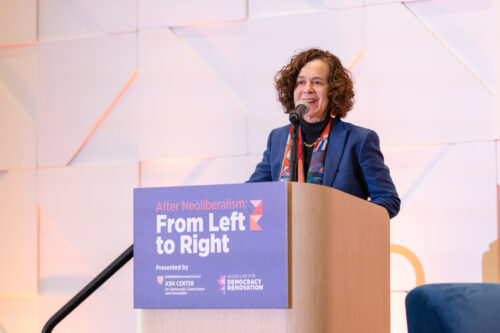
The second day of After Neoliberalism: From Left to Right continued Day One’s conversations on emerging visions for the future of the political economy. A previous article covers Day One.
Feature
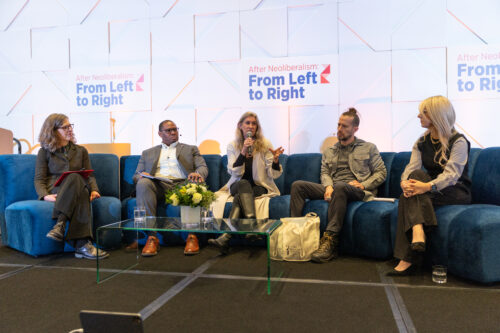
The first day of After Neoliberalism: From Left to Right brought together hundreds of leading thinkers to explore and debate emerging visions for the future of the political economy. A second article covers Day Two.

Article
Economists and policy analysts broadly agree that more housing needs to be built in order to reduce costs in America’s most expensive cities. Using a novel survey of mayors of mid-sized and large cities to explore mayors’ views on the roots of America’s housing crisis and what solutions they believe will most effectively address their constituents’ housing challenges, the authors summarize mayors’ attitudes and perceptions on key issues related to expanding the housing supply, reporting how well these views correlate with mayors’ assessments of their own cities’ supply needs.