Ritika Goel
Democracy Affiliate
Program Involvement
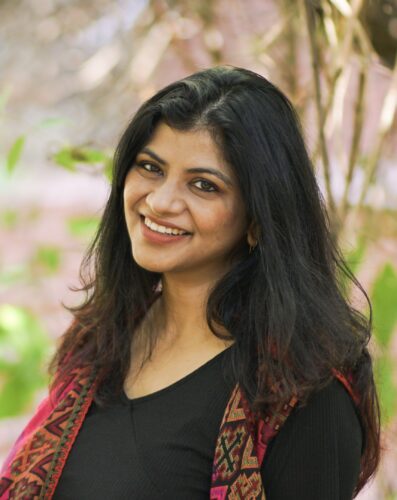
Ritika Goel is a Stone Postdoctoral Fellow in Wealth Distribution, Inequality, and Social Policy at the Malcolm Wiener Center for Social Policy at the Harvard Kennedy School. She holds a PhD in Political Science from the University of California, Berkeley, a Master’s in Public Affairs from Princeton University, and a Bachelor’s in Engineering from Delhi University.
Ritika is currently working on a book project that explores why poor and minority voters increasingly support economically right-of-center, culturally conservative populist leaders in multi-ethnic democracies. Drawing on rich multi-method fieldwork spanning three years across India, the United States, and Brazil, the book project combines hundreds of voter interviews, electoral data, survey experiments and text analyses of what these leaders claim to have done in office for the poor and the marginalized. She not only investigates the appeal of such right-wing populism in power for aspirational, low-status minorities in these multi-ethnic and unequal democracies, but also shows how non-material perceptions of performance are shaped, studying both demand-side and top-down drivers of the appeal of right-wing populism for marginalized voters in unequal societies. An extension of the project investigates how outcomes including public trust in institutions and appraisal of government performance diverge across countries depending on media business models and other institutional and structural constraints that shape the information environment.
Ritika’s broader research interests include social inequality, business and regulation, upward mobility, information asymmetries and infrastructure policy constraints in democracies. Before doctoral studies, she worked in international development and development finance in South Asia for several years, including with the World Bank Group and the UK Department for International Development.
As an Ash Center Democracy Affiliate, Ritika looks forward to contributing to and learning from multiple perspectives on improving democratic accountability and fostering debate.