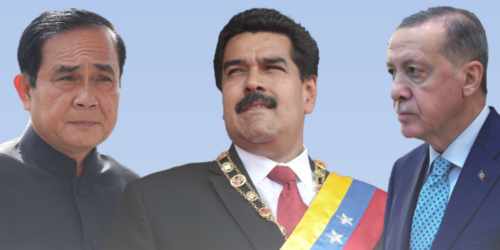
In just a few years, democracy has shifted from a likely, if distant, destination for much of the world to a far more tenuous prospect. To examine these urgent dynamics, the Ash Center for Democratic Governance and Innovation hosted the Global Challenges to Democracy Seminar Series during the 2025–2026 academic year. Co-chaired by Professors Yanilda María González and Gautam Nair, the series delved into the internal and external obstacles to building more accountable, responsive, and capable democratic systems.
Throughout the year, a diverse array of leading political scholars shared their insights, using a wide range of methodologies to identify current democratic vulnerabilities and explore paths forward. The summaries below provide a closer look at each event in the series.
Moral Vaccination: Ideas and Institutions in the Control of Contagion in China and India
On October 15, Prerna Singh, Mahatma Gandhi Associate Professor of Political Science and International Studies at Brown University, challenged the common assumption that people only follow public health directives due to coercion or incentives. By comparing how communities in China and India reacted to the world’s first smallpox vaccine, Singh showed that cooperation depends heavily on the moral relationship between government and citizens. This historical perspective offers valuable lessons for governments today as they work to overcome widespread vaccine hesitancy.
Democratic Ceilings and Nationalist Conflict in Asia
On November 19, Aram Hur, associate professor of political science and Kim Koo Chair in Korean Studies at Tufts University, examined South Korea’s sudden declaration of martial law in December 2024, with a focus on understanding how stable, thriving democracies can quickly reverse course. Hur explained that even as a democratic system matures, it can “hit a ceiling” that halts further progress. Her research shows that deep-seated nationalist conflicts leave long-lasting scars on a country’s politics. These conflicts fuel nationalist polarization that encourages political parties to break the established rules of democracy just to defeat their rivals.
Has India’s Democratic Exceptionalism Ended?
On December 3, Ashutosh Varshney, Sol Goldman Professor of International Studies and the Social Sciences and professor of political science at Brown University, discussed India’s unique political history. For decades, political theorists have viewed India as a major exception to democratic rules. Varshney explored the historical conditions that allowed India’s democracy to survive for so long and then addressed whether this era of exceptionalism has ended over the last decade, as international observers increasingly point to India as a prominent example of a country experiencing severe democratic backsliding.
A Logic of the Future: International Relations in the Age of Turbulence
On February 20, Stephen Heintz, president and CEO of the Rockefeller Brothers Fund, joined a discussion moderated by Meghan O’Sullivan, director of the Belfer Center for Science and International Affairs and Jeane Kirkpatrick Professor of the Practice of International Affairs, to discuss why current global crises cannot be solved with old ideas and past assumptions. Heintz argued that problems like climate change, technological disruptions, and democratic erosion are constantly worsened by outdated frameworks. Instead, he proposed a new approach based on shared global responsibility, fair power distribution, and democratic renewal. Heintz emphasized that today’s global instability offers a rare opportunity to redesign international governance before facing catastrophic outcomes.
Democratic Backsliding: Why Is It Happening? What Can Stop It?
On March 6, Susan Stokes, Tiffany and Margaret Blake Distinguished Service Professor and director of the Chicago Center on Democracy, analyzed the 21st-century wave of democratic decline. Increasingly, modern democracies are weakened by legally elected leaders who win fair elections and then use their power to dismantle democratic institutions from within. Stokes detailed how these leaders systematically silence opposition, take over the courts, restrict the free press, and target civil society groups. She highlighted the risk factors that make countries vulnerable to backsliding and discussed strategies to protect institutions and stop democratic erosion.
In-Person Book Talk: “A Sixth of Humanity: Independent India’s Development Odyssey”
On April 2, authors Devesh Kapur, Starr Foundation Professor of South Asian Studies at Johns Hopkins University School of Advanced International Studies (SAIS), and Arvind Subramanian, senior fellow at the Peterson Institute for International Economics, discussed India’s unique political and economic journey. They were joined by panelist Dani Rodrik, Ford Foundation Professor of International Political Economy at Harvard Kennedy School, and moderator Gautam Nair, assistant professor of public policy at Harvard Kennedy School. The panel explored how India’s recent economic growth has allowed the state to build infrastructure and deliver basic services at scale, while noting that its foundational successes are under threat. Together, the speakers examined how the erosion of core democratic principles now stands in the way of India’s development goals.
Dangerous Stereotypes: Correcting Misperceptions About Undocumented Immigrants to Promote Inclusionary Preferences
On April 21, Abby Córdova, associate professor of global affairs at the Keough School of Global Affairs at the University of Notre Dame, presented research on how rising migration in Latin America and the Caribbean has triggered anti-immigrant attitudes, straining social cohesion. Using surveys and fieldwork in Mexico, Córdova shared a surprising finding: local citizens often view immigrants who are culturally similar to them as the biggest economic and security threats. Encouragingly, her work proved that sharing personal immigrant stories to correct factual errors significantly increases long-term public support for humane policies and inclusive politicians, offering a guide for immigrant human rights campaigns.
The Life of the Lie
On April 24, Rory Truex, associate professor of politics and international affairs at Princeton University, concluded the series by exploring how the 2020 presidential election continues to reshape American politics. Drawing on new data, Truex traced how the false narrative of a stolen election became accepted as truth by millions of voters. He explained how this widespread belief creates pressure on politicians to reject valid election results to stay in office. His talk outlined how this false political narrative gained a life of its own and came to dominate the Republican Party.