Over the past 10 days, the wave of U.S. street activism supporting Palestine has accelerated. Since October 7, 2023, when Palestinian militants launched attacks on Israel that killed more than 1,400 people, CCC has logged 420 pro-Palestine rallies, protests, demonstrations, and vigils in more than 180 different cities and towns across 46 states, the District of Columbia, Puerto Rico, and Guam. Nearly 130 of those events, or about 30 percent, occurred in just the past three days (October 20–22).
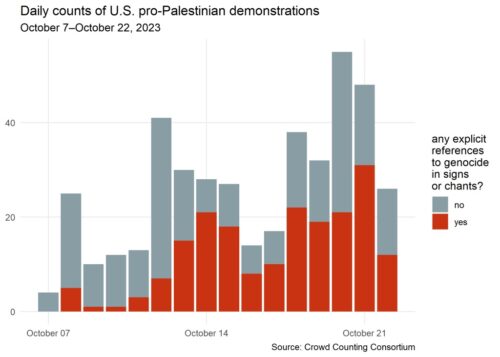
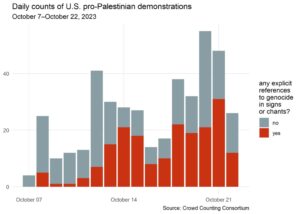
The belief that Israel is committing genocide in Gaza appears to be an important factor in the growth of this movement. As shown in the chart below, explicit references to genocide in protesters’ signs and chants were infrequent in the first several days of this wave, but they have become commonplace since October 12–13, when Israel announced it was cutting water and electricity to Gaza, issued an evacuation order to Gaza’s 2 million residents, and then accelerated its bombing campaign on the Palestinian territories. Over the ensuing 10 days, signs saying things like “end the genocide in Gaza”, “this isn’t war this is genocide”, and “there’s no two sides to a genocide” have become commonplace at pro-Palestine demonstrations in the U.S., as have references to Israeli forces bombing children, hospitals, and churches. According to the United Nations, more than 5,000 people have been killed and more than 15,000 injured in Gaza in the past two weeks; women and children comprise about 62 percent of those 5,000 fatalities; and more than 1,000 other people in Gaza have been reported missing and “are presumed to be trapped or dead under the rubble.”
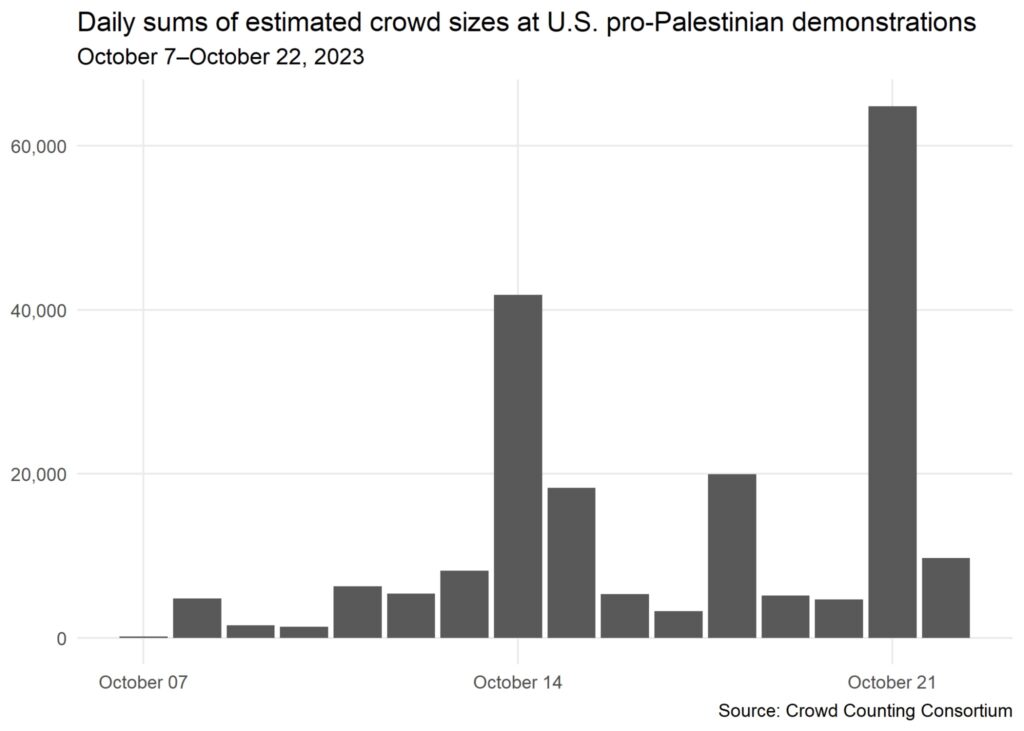
With reported crowd sizes for three-quarters of those 420 U.S. events, we conservatively estimate more than 200,000 total participants in pro-Palestine actions across the U.S. over the past two-plus weeks, with a median crowd size in the hundreds. As shown in the chart below, the peak date for participation in this wave of pro-Palestine actions so far was this past Saturday, October 21, which saw crowds in the thousands or tens of thousands in at least nine cities, including Chicago, Denver, LA, New York, Philadelphia, Portland, and Washington, DC.
Despite the rapid acceleration of this wave, appearances by elected officials at pro-Palestine events in the U.S. remain rare. We have only seen reports of local, state, or federal officials at 7 of these 420 events, or less than 2 percent. Recent exceptions include speeches by U.S. Reps. Rashida Tlaib and Cori Bush at an October 18 rally and direct action organized by Jewish Voice for Peace and IfNotNow in Washington, DC, and a speech by Colorado state representative Iman Jodeh at a rally in Denver on Saturday, October 21. By contrast, we have seen reports of elected officials at 67 of 292 pro-Israel events during that same period, or about 23 percent, including numerous governors and U.S. senators and representatives.
For more information about what kinds of events CCC tracks, how we find and record information about those events, and how we estimate crowd sizes, please see the project’s coding guidelines. For access to the data, see our GitHub repository.