How Will the Voting Rights Act Ruling Impact Redistricting?
According to Kennedy School’s Benjamin Schneer, the decision that an Alabama congressional map illegally weakened the power of Black voters has implications beyond the southern state’s borders.
The Supreme Court’s recent decision to strike down an Alabama congressional redistricting map on the grounds that it violated longstanding voting rights protections stunned court watchers and political observers alike. In a 5-4 decision, the Court ruled in Allen v. Milligan that Alabama violated provisions of the Voting Rights Act prohibiting racial discrimination in voting when state mapmakers drew only one majority minority congressional district as part of the 2020 redistricting cycle.
“The Supreme Court’s decision means that Alabama will likely be required to redraw the congressional district map to include a second district that offers Black voters an opportunity to elect a candidate of choice,” says Benjamin Schneer, assistant professor of public policy at Harvard Kennedy School and an expert on political representation and redistricting. Despite comprising nearly one-quarter of Alabama’s population, Alabama’s state legislature originally approved new congressional maps along partisan lines that packed a significant number of the state’s Black voters into only one U.S. House of Representatives district.
What does this mean for other contested congressional maps?
“This decision will also have implications for those states where it is possible to draw additional majority-minority districts while adhering to traditional redistricting criteria. This decision bodes well for vote dilution cases brought in those states,” says Schneer.
With congressional maps in states like Texas and North Carolina also in the crosshairs of voting rights activists, the ruling’s impact on the final outcome over redistricting litigation in those states is still up in the air. “It’s a bit less clear to me what this case means for the current fight in North Carolina, where the map used in 2022 has recently been thrown out.” Though states are still reviewing the court’s decision, Schneer suspects that the threat of successful legal action based on vote dilution may loom large enough that state legislators will draw additional majority-minority districts.
There are alternatives to the political and legal rancor that so often accompanies the redistricting process. Schneer has researched independent redistricting commissions as one such means.
The future of redistricting
While mapmaking in Alabama has always been a politically fraught exercise given the state’s tortured history of segregation and hostility towards the civil rights movement, the legal battles following its most recent congressional redistricting efforts hardly make it an outlier. New York University’s Brennan Center for Justice has tallied a total of 74 challenges against congressional and state legislation maps across 27 states in this redistricting cycle, including those in Alaska, Washington State, and New York.
Schneer sees partisan redistricting as almost an inevitable outcome in states where legislators themselves are charged with drawing the maps. “Redistricting is contentious because it matters so much for who wins and loses elections and for which political party holds power. Parties have a strong incentive to try to tilt the process in their favor because of this.”
But other states have shown there are alternatives to the political and legal rancor that so often accompanies the redistricting process. “My view is that steps taken to insulate the process from political interference, or to place some constraints on how far political actors can go in drawing extreme maps, is for the good on balance,” notes Schneer. “These efforts can take a variety of forms including independent commissions (comprised of non-politicians), appointing an independent map-drawing expert or geography, or even mechanisms/procedures that require opposing sides to take turns drawing and/or negotiating over the map being produced.”
Independent redistricting commissions have become increasingly popular alternatives to leaving the map drawing process in the hands of elected officials. Commissions in California, Arizona, and Michigan were responsible for creating new legislative maps following the 2020 census, which many observers credited with being largely apolitical.
But the mere existence of commissions alone often isn’t enough to keep partisan influences in the redistricting process at bay. Schneer argues that it’s critical that redistricting efforts are designed to be truly independent and are vested with the ultimate authority to draw maps.
“For example, [in this recent cycle] in states where the legislature could reject maps produced by commissions and then the map-drawing process would revert to the state legislature, that is exactly what happened.”
With control of Congress all the way down to city council often on the line, conflict over redistricting isn’t going away any time soon. Despite a number of promising redistricting reforms adopted in some states, Schneer still sees a role for the courts going forward. “Realistically, given the high stakes, many of these issues will continue to be decided through litigation.”
Terms of Engagement: Should Election Officials Be Elected?
On this week’s episode of “Terms of Engagement,” Assistant Professor Joshua Ferrer joins co-hosts Archon Fung and Stephen Richer to discuss his research and explore whether election officials should be elected or appointed.
Terms of Engagement: Should Voting Be Mandatory in the U.S.?
On this week’s episode of “Terms of Engagement,” Miles Rapoport, former Senior Practice Fellow in American Democracy at the Ash Center, joins cohosts Archon Fung and Stephen Richer to discuss universal voting in the United States.
High voter turnout is often celebrated as a sign of a healthy democracy, with election officials viewing strong participation as evidence of public engagement and political legitimacy. On Terms of Engagement, Professor Jason Brennan joins cohosts Archon Fung and Stephen Richer to examine whether higher turnout actually strengthens democracy.
Members of the Ash Center’s Executive Session on Elections and Election Administration present a comprehensive strategy to recruit, support, and retain election administrators by reducing barriers to entry, strengthening professional networks, improving workplace support, and utilizing workforce data address burnout and prevent attrition.
How Americans Navigate Voting Information Ahead of the 2026 Midterm Elections
The Shorenstein Center’s 2026 Voting Information Trends project—developed in collaboration with the National Internet Observatory at Northeastern University, the Ash Center for Democratic Governance and Innovation’s Program on Democracy and the Informed Public, and The Civic Health and Institutions Project—provides new insights into the voter information landscape in the United States ahead of the 2026 midterm elections.
Among the resources, an interactive dashboard maps where Americans are finding voting information and learning about key aspects of the voting process—from sourcing polling locations to voter registration. Also included are a series of trends reports gauging perceptions of voting in the lead up to the 2026 midterm elections.
In Appearance Before Congress, Stephen Richer Testifies on Alleged Noncitizen Voting in New Jersey
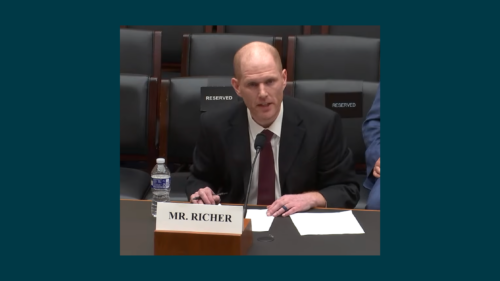
On Tuesday, September 15, 2026, former Maricopa County Recorder Stephen Richer, now an Ash Senior Fellow and election administration expert, testified before the House Judiciary Subcommittee on Oversight. The hearing examined allegations that approximately 6,600 noncitizens were improperly registered to vote in New Jersey between June 2023 and June 2024.