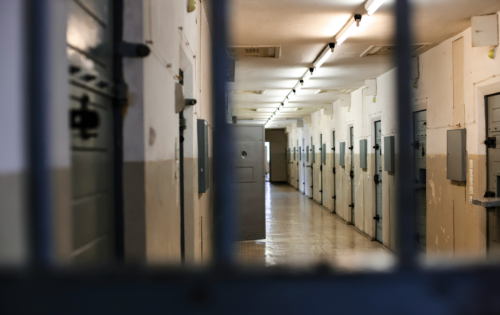
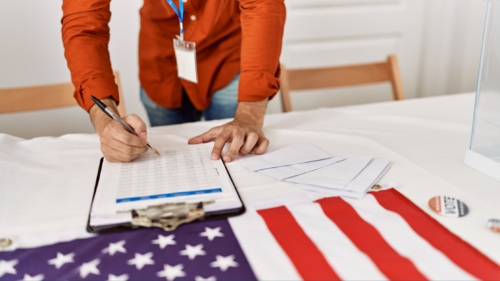
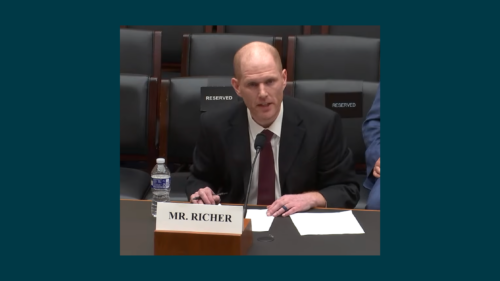
Across the United States, hundreds of thousands of people in jail retain their right to vote while being held in pretrial detention, having not been convicted of a crime. However, “this population faces so many barriers to voting while in jail that, in many places, they are effectively denied the opportunity to vote,” explains Tova Wang, director of research projects in democratic practices at the Ash Center.
In a recently published case study, Wang documents how a network of organizers, election administrators, and jail staff successfully overcame these obstacles to implement in-person jail voting in Denver, Colorado. The result, Denver’s Confined Voter Program, has boosted voter engagement in jails while balancing the needs of voters with the responsibilities of elections officials and corrections staff.
In November 2020, Denver set up in-person polling places, complete with electronic poll books, voting tablets, and ballot boxes, at the Denver County Jail and Van Cise-Simonet Detention Center. At the time, they became the fourth U.S. municipality to allow in-person voting for incarcerated citizens, joining Washington, D.C.; Cook County, Illinois; and Los Angeles County, California. Since then, Denver has continued to provide incarcerated voters with the same voting experience available to all Denver voters. Those involved have observed the profound impact this has had on people in jail. Wang emphasizes, “The focus is preparing them for life after release, including participating in the voting process.”
“As this issue draws greater attention,” she continues, “we are learning how people detained in jails are being shut out of the democratic process—and working toward ways to bring them back.” Organizers and officials have effectively resolved issues like insufficient access to educational materials, complex registration processes, and logistical hurdles, making Denver’s program a success for all involved. And because in-person voting in jails is neither difficult nor expensive, Denver’s approach can serve as a model for other jurisdictions.
Colorado’s reform efforts began years ago, spearheaded by the Colorado Criminal Justice Reform Coalition (CCJRC). Through public education and awareness campaigns, they clarified misconceptions and successfully expanded voting rights to include those on parole. The first registration drives were launched three months before the 2016 presidential election.
Following a successful effort, the Denver Elections Division (DED) and the Denver Sheriff Department worked with CCJRC and the League of Women Voters of Colorado to refine their processes and develop “a more systemic approach for registering people in jail to vote.” This progress created momentum for the implementation of in-person jail voting. For the 2020 presidential election, three elections in 2023, and the 2024 presidential primary, these groups continued to iterate and improve, sharpening processes to find the best model in terms of efficiency, safety, security, and accessibility. This willingness to adapt, invest time in testing different methods, and respond to the experiences from each election led to increased efficiency and engagement.
Denver’s success was the result of sustained community efforts and a network of strong and trusting cross-agency partnerships. “Critically, jail and DED staff genuinely support and believe in these programs,” Wang notes. Over the past few years, election administrators have continued to support voter enfranchisement across the state, while advocacy and organizing efforts have persisted.
Today, the Confined Voter Program has had far-reaching effects across Colorado. The groundbreaking Senate Bill 24-72 was signed into law on May 31, 2024, requiring every county jail in Colorado to establish a temporary polling place for in-person voting that operates for at least one day and is open for at least six hours during every general election. “Senate Bill 24-72 is the first of its kind—a statewide mandate for jail voting—and is a model for the country,” Wang writes in the case study. “Of course, Denver’s jail voting program served as both the impetus for the bill as well as evidence of its impact.”