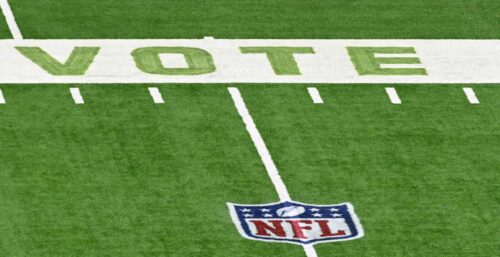
In recent years, professional sports teams have ramped up civic engagement initiatives — from voter education to get-out-the-vote drives. These civic engagement efforts took a new turn during the 2020 election when social distancing requirements during the pandemic encouraged local election officials to partner with sports teams to use stadiums as polling sites. As the country gears up for elections this November, will sports teams continue to play an important role in encouraging voter participation?
The Ash Center sat down with Tova Wang, a senior researcher in democratic practice at the Ash Center and NFL Network analyst Scott Pioli to better understand what role teams can play in fostering civic engagement.
The 2020 election first saw the widespread use of stadiums and arenas as polling locations. Looking back, how effective was the idea of using sports venues as polling sites? Did voters use them in large numbers?
Tova Wang: Stadium and arena voting was a huge success for everyone – election administrators, teams, and voters. Forty-eight professional basketball arenas, football stadiums, hockey arenas, and baseball stadiums were used as voting centers. The use of stadiums and arenas made for shorter lines, easier parking, and a more enjoyable experience. A 2022 Post-UMD poll found that 77% of Americans approved of using sports stadiums as voting sites in 2020. While we don’t know the overall numbers, we do know that State Farm Arena alone, home to the Atlanta Hawks, processed 50,000 voters in 2020.
If the benefits of civic engagement are so clear. Why haven’t more teams launched civic engagement initiatives of their own? Is there any concern amongst teams that this work might be interpreted as overly political, especially in today’s hyper-partisan political environment?
Scott Pioli: There are quite a few teams that have incredible civic engagement programs and there are also groups like RISE working with teams on their civic engagement programs! But not many have made opening the space for voting a regular part of them. Now that we know how much of a contribution doing so is to the communities these teams and facilities serve, and how good teams are at doing it, it’s an easy way for teams to give back. And the interesting thing is that athletes promoting voting is not controversial. A recent Washington Post-University of Maryland poll found that “while Americans are divided on whether athletes should speak out on behalf of social and political causes, a clear majority support them advocating for voting rights.” Nonpartisan activities to encourage voter participation are not controversial. That being said, I unfortunately think there are still some teams concerned about how polarizing this work has become – even when voting rights and access shouldn’t be.
Teams and athletes can bring attention to voting in a way that politicians and other typical voter outreach groups just can’t.
Tova Wang
Director of Research Projects in Democratic Practice
How would you recommend election administrators approach and work with teams? Are there any unique challenges that election administrators need to consider when working in a stadium or arena?
Tova Wang: Probably the biggest challenge is scheduling. Stadiums and arenas have, of course, game schedules, as well as other types of events like concerts. But they all have days they will be available when there is early voting, and in many cases setting up and taking down the machines can be done on the same day as there is a night game. Other than that, we found that teams and administrators found these partnerships easy, productive, and even enjoyable. One big part of that success was constant and open communication so that everyone involved played the roles they would be best at. Administrators and team and facility staff worked collaboratively to determine things like what space in the facility would work best, security, staffing, and outreach. And at least in 2020, they did not have a difficult time doing that.
Which sports leagues have been the leaders in civic engagement thus far? Are there any franchises that stand out?
Scott Pioli: Without having research to tell me the answer, my instincts lead me to believe that the NBA and the NFL have been the leaders in civic engagement. We’ve seen organizations in both leagues and players from both leagues give of their time, treasure and talent to lead. In Atlanta, both the NBA’s Atlanta Hawks and Atlanta Falcons made their homes, State Farm Arena and Mercedes Benz Stadium available for voting. It was an amazing partnership between the public and private sector and everyone won.
As we head into the 2024 election, it’s clear that voter enthusiasm is flagging — especially among young people. Do you think sports teams can play a role in increasing youth turnout in particular?
Tova Wang: I do. Teams and athletes can bring attention to voting in a way that politicians and other typical voter outreach groups just can’t. In the same way that people believe someone like Taylor Swift has a reach to young voters, athletes that young people admire can also draw attention to things like the need to register and the importance of voting. Hopefully, the athletes, and the idea of voting at the stadium or arena of your favorite team, can bring an added dose of excitement to being engaged in democracy. At the very least athletes and teams have much bigger TikTok and Instagram followings than politicians and political groups.
What do you hope teams will do this year?
Scott Pioli: We hope that even more teams will open their doors for voting and for more days than they have before. We also hope that teams and athletes will really kick up their efforts to advertise the opportunity to come to the arena or stadium to vote this time, including directly to their fans. As we know from the 2020 study, teams are good at producing events with big crowds – it’s what they do daily. Given the amount of public money we all put into these facilities, having voting at them is a simple way for teams and team owners to give back to the communities they play in.
High voter turnout is often celebrated as a sign of a healthy democracy, with election officials viewing strong participation as evidence of public engagement and political legitimacy. On Terms of Engagement, Professor Jason Brennan joins cohosts Archon Fung and Stephen Richer to examine whether higher turnout actually strengthens democracy.
We Surveyed 50,674 Americans. This Is What Brings Them Together.
In this opinion piece, Audrey Feldman, Todd Rogers and Ben Valenta — participants in the Sports, Democracy and Civic Health project — describe their findings showing that shared fandom can soften partisan animosity and make political opponents more willing to connect.
We Surveyed 50,674 Americans. This Is What Brings Them Together.
In this opinion piece, Audrey Feldman, Todd Rogers and Ben Valenta — participants in the Sports, Democracy and Civic Health project — describe their findings showing that shared fandom can soften partisan animosity and make political opponents more willing to connect.
How Americans Navigate Voting Information Ahead of the 2026 Midterm Elections
The Shorenstein Center’s 2026 Voting Information Trends project—developed in collaboration with the National Internet Observatory at Northeastern University, the Ash Center for Democratic Governance and Innovation’s Program on Democracy and the Informed Public, and The Civic Health and Institutions Project—provides new insights into the voter information landscape in the United States ahead of the 2026 midterm elections.
Among the resources, an interactive dashboard maps where Americans are finding voting information and learning about key aspects of the voting process—from sourcing polling locations to voter registration. Also included are a series of trends reports gauging perceptions of voting in the lead up to the 2026 midterm elections.