Read the latest news, commentary, and analysis from the Ash Center.
1
Media Release
Allen Lab launches new Digital Civic Infrastructure Initiative to help governments strengthen democracy through technology
The new initiative combines municipal partnerships, digital tools, and research to help communities improve transparency, civic participation, and public service delivery.
Towards Platform Democracy: Policymaking Beyond Corporate CEOs and Partisan Pressure
Facebook, YouTube, and other platforms make incredibly impactful decisions about the speech of billions. Right now, those decisions are primarily in the hands of corporate CEO’s—and heavily influenced by pressure from partisan and authoritarian governments aiming to entrench their own power.
Aviv Ovadya proposes an alternative: platform democracy.
Money Left on the Table: The Economic Argument for Diversity (Truth and Transformation 2021)
This video starts off with the introduction to the 2021 Truth and Transformation Conference. Then, we go into the first panel, “Money Left on the Table: The Economic Argument for Diversity.’ Does the economic argument for diversity make sense? Why hasn’t everyone already won? This panel engaged key leaders watching organizations grappling with moving toward antiracism the question: what does resistance to change look like and what drives it, from an economic, psychological, and historical perspective?
This panel discussion, which starts at minute 24:00, features:
Jarik Conrad, Equity at Work
Dana Peterson, The Conference Board
Lisa Cook, Michigan State University
Michael McAfee, PolicyLink
Levi Sumagaysay, MarketWatch
Learn more about the Truth and Transformation Conference and the Institutional Antiracism and Accountability Project online: https://ash.harvard.edu/iara
Preserving Seats at the Table: White-Dominated Boards (Truth and Transformation 2021)
This video starts with the second panel discussion from the 2021 Truth and Transformation conference, hosted by the Institutional Antiracism and Accountability Project at the Ash Center for Democratic Governance and Innovation at Harvard Kennedy School. Then, at 59:27, starts the lunchtime musical performances by The Reminders and Brown Rice Family.
The panel discussion, titled, “Preserving Seats at the Table: White-Dominated Boards” features:
Trina Jackson (Speaker) Senior Solidarity Program Officer – US Internationalist Program, Grassroots International
Samantha Tweedy (Speaker) President, Black Economic Alliance Foundation
Rebecca Shuster (Speaker) Assistant Superintendent of Equity, Boston Public Schools
Cheryl Mills (Speaker) Founder & CEO, The BlackIvy Group
Jeffrey Ginsburg (Moderator) Executive Director, East Harlem Tutorial Program
Learn more about the Truth and Transformation Conference and the Institutional Antiracism and Accountability Project online: https://ash.harvard.edu/iara
Equity Takes Time, Commitment, & Disruption (Truth and Transformation 2021)
This video starts with the final panel discussion from the 2021 Truth and Transformation conference, hosted by the Institutional Antiracism and Accountability Project at the Ash Center for Democratic Governance and Innovation at Harvard Kennedy School. Then at 1:03:00, remarks from Boston Mayor Kim Janey begin and are followed by a closing discussion between IARA Senior Fellow Erica Licht and Professor Khalil Gibran Muhammad at 1:15:50.
The panel discussion, titled, “Equity Takes Time, Commitment, & Disruption” featured:
Carmen Rojas (Speaker) President & CEO, Marguerite Casey Foundation
John C. Yang (Speaker) President & Executive Director, Asian Americans Advancing Justice | AAJC
Eric Ward (Speaker) Executive Director, Western States Center
Mary McNeil (Moderator) Ph.D. Candidate, American Studies Program, Harvard University
Learn more about the Truth and Transformation Conference and the Institutional Antiracism and Accountability Project online: https://ash.harvard.edu/iara
Change Can’t Wait: A Justice and Equity Agenda For Boston’s Black and Brown Communities
The Ash Center, Carr Center for Human Rights Policy, Center for Public Leadership, FXB Center for Health and Human Rights, and the Rappaport Institute for Greater Boston hosted a discussion focusing on urgent issues—from economic and climate justice to immigration and mass incarceration —that the next Mayor of Boston must address to rectify structural inequities and support Black and Brown communities.
Two Americas Emerging: Voting Rights in the States
In the nearly one year since the November 2020 elections, the diverging directions state legislatures took on expanding or contracting voting rights created a huge fault line in American democracy, described by some as ‘two Americas’. A Voting Rights Lab tracking report as of September 13, 2021, identified 27 states representing 70 million voters that had passed laws to expand voting opportunities, and 13 states with 55 million people that had passed sharply restrictive legislation. And state legislatures were still at work. What’s causing this divergence?
How are voting rights advocates advancing their work in such disparate political environments? What does it mean for upcoming elections and the future of American democracy? Join the Ash Center as voting advocates from two key states that have gone in opposite directions and policy experts evaluated the trends, discussed the present, and looked into the future.
Speakers include:
Mimi Marziani, President and CEO Texas civil rights project
Henal Patel, Director of the Democracy & Justice Program, New Jersey Institute of Social Justice
Randy Perez, Program Director, Voting Rights Lab
Jake Grumbach, Assistant Professor of Political Science at the University of Washington
Miles Rapoport, Ash Center Senior Practice Fellow in American Democracy, Moderator
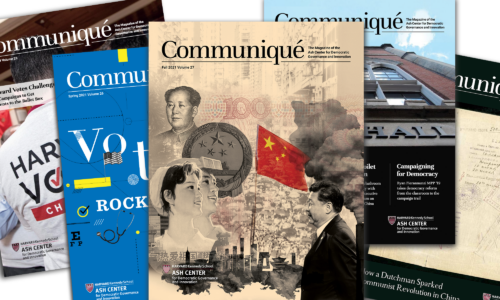
In this issue, as the Chinese Communist Party celebrates its 100th anniversary, Ash Center experts delve into the historial legacy of the party as well as what the future holds for the party and China. We share profiles of the scholars and students who make the Ash Center such a unique institution, and introduce new research and ideas from across our thirty programs, projects, and initiatives.
Book Talk — Nothing is Impossible: America’s Reconciliation with Vietnam
The Ash Center invites you to a book talk with former U.S. ambassador to Vietnam, Ted Osius, author of the book “Nothing is Impossible: America’s Reconciliation with Vietnam.” Osius was joined in discussion by Thomas Vallely, Senior Advisor for Mainland Southeast Asia at the Ash Center.