Policy Brief  

The 2024 Presidential Election: The Broken Bond Between Youth and Democracy

The 2024 election saw Donald Trump make significant gains among young voters, increasing his support among 18- to 29-year-olds by 10 percentage points. This report aims to investigate the deeper issues at stake that are causing this historical shift.

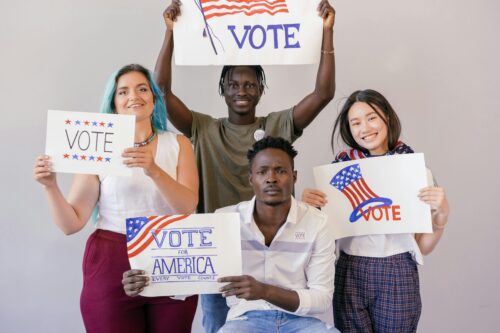
Cover photo of the report

In the 2024 election, Donald Trump made notable gains among young voters, increasing his support among 18- to 29-year-olds by 10 percentage points—the highest level of youth backing for a Republican presidential candidate since 2008. At first glance, this shift may suggest that young people are trending politically right. But that interpretation overlooks deeper, relational dynamics at the core of democratic engagement. Many young voters feel increasingly disillusioned with a political system they see as ineffective and disconnected from their lived experiences. This report explores the underlying forces driving this historic change.

Melina Geser-Stark is a Research Assistant at the Ash Center for Democratic Governance and Innovation. 

The views expressed in this article are those of the author alone and do not necessarily represent the positions of the Ash Center or its affiliates.  

Related Resources

Terms of Engagement – Behind a Bipartisan Bid to Protect Election Integrity

Podcast

Terms of Engagement – Behind a Bipartisan Bid to Protect Election Integrity

GOP lawyer Ben Ginsberg has launched a new initiative, the Bipartisan American Election Project, with former Obama White House counsel Bob Bauer to oppose efforts by the Trump administration and Republicans in Congress to impose new rules on election administration.


Before the Civil Rights Act, My Great-Uncle from Roxbury Took on Pullman in 1954 — and Won
A photo collage of some members of the Greenidge family.

Commentary

Before the Civil Rights Act, My Great-Uncle from Roxbury Took on Pullman in 1954 — and Won

As we commemorate 100 years of Black History Month, it is worth remembering that progress was not driven by headlines alone. Beyond the monuments and courtrooms, everyday people took risks to demand dignity and fairness. Among them was my great uncle, whose pursuit of a promotion became a catalyst for change.

Terms of Engagement – Can Ideological Diversity Improve Campus Culture?

Podcast

Terms of Engagement – Can Ideological Diversity Improve Campus Culture?

Professor Eitan Hersh, the inaugural director for Tufts University’s new Center for Expanding Viewpoints in Higher Education, wants create a new campus atmosphere of “robust intellectual life, where norms of curiosity and goodwill reign.”

More on this Issue

The Present — and Future — of Alternatives to Police

Commentary

The Present — and Future — of Alternatives to Police

Allen Lab Affiliate Benjamin A. Barsky examines alternative emergency response programs — arguing for a democratic model of public safety governance in which responses to nonviolent incidents are shared across government and civil society rather than dominated by police.

Allen Lab Fellow Spotlight: The Case for Building an AmeriCorps Alumni Leadership Network

Additional Resource

Allen Lab Fellow Spotlight: The Case for Building an AmeriCorps Alumni Leadership Network

In a new essay, The Case for Building an AmeriCorps Alumni Leadership Network, Allen Lab Policy Fellow Sonali Nijhawan argues that the 1.4 million Americans who have completed national service represent an underleveraged civic asset. Drawing on her experience as former Director of AmeriCorps, Nijhawan outlines a roadmap for transforming dispersed alumni into a connected leadership network capable of reinvigorating public service, rebuilding trust in government, and strengthening civic participation.