Policy Brief  

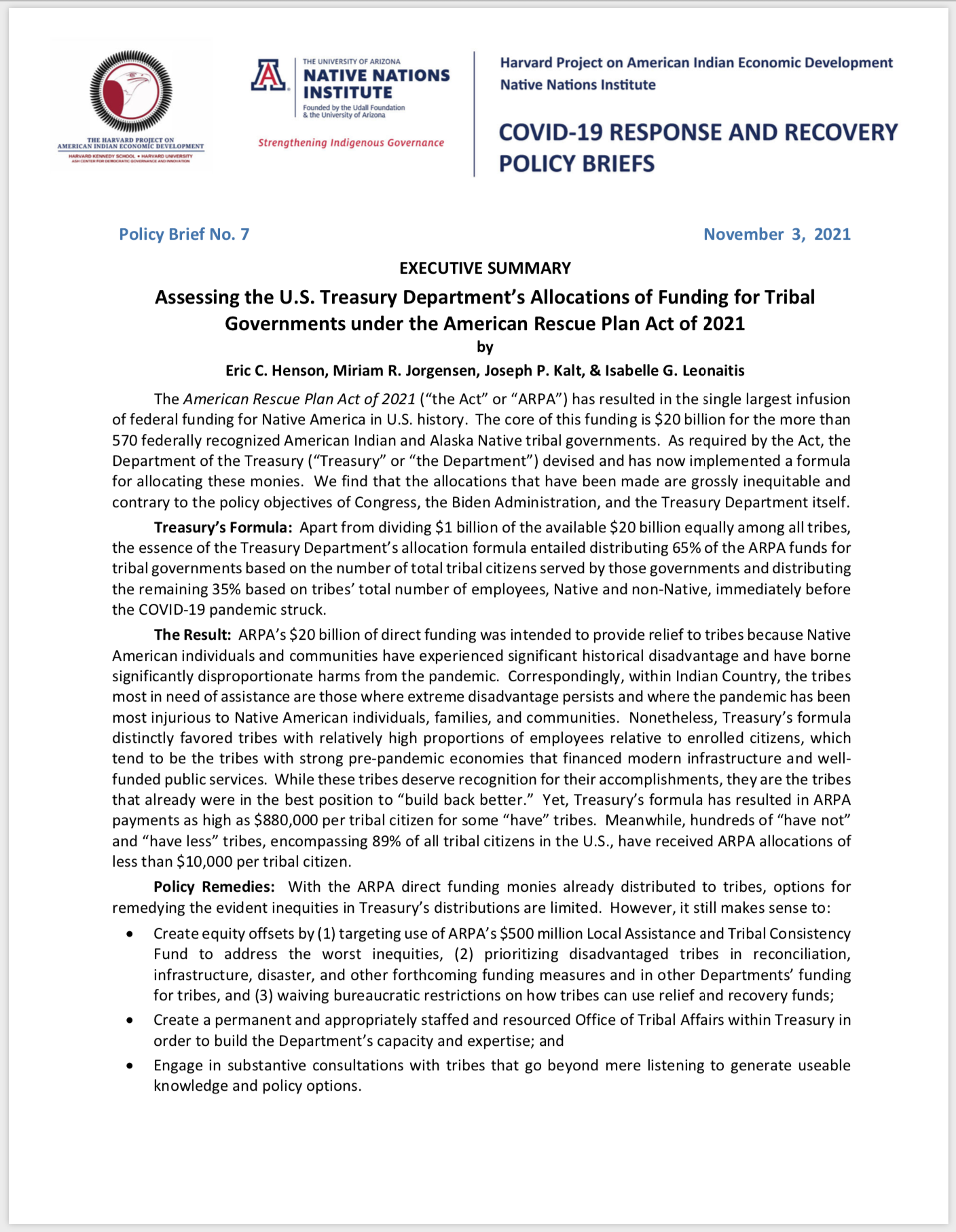
Assessing the U.S. Treasury Department’s Allocations of Funding for Tribal Governments under the American Rescue Plan Act of 2021

The American Rescue Plan Act of 2021 (“the Act” or “ARPA”) has resulted in the single largest infusion of federal funding for Native America in U.S. history. The core of this funding is $20 billion for the more than 570 federally recognized American Indian and Alaska Native tribal governments. As required by the Act, the Department of the Treasury (“Treasury” or “the Department”) devised and has now implemented a formula for allocating these monies. In this report, the authors find that the allocations that have been made are grossly inequitable and contrary to the policy objectives of Congress, the Biden Administration, and the Treasury Department itself.

This study uses publicly available information to estimate enrollment and employment counts for tribes. These figures are only estimates created for the express purpose of analyzing the appropriateness of the US Department of the Treasury’s American Rescue Plan Act allocations. Our estimates have not and cannot be verified against actual enrollment or employment data submitted to the Department of Treasury by each tribe.  We believe the estimates are as accurate as possible and reliable for the purpose of assessing the relative positions of tribes under Treasury’s ARPA allocations, but should not be extracted and used as accurate for any individual tribe or for any purpose other than how they are used here.

Related Resources

The Disproportionate Burden: Health and Economic Outcomes of COVID-19 for Native American Communities
A woman wearing a face mask during COVID-19.

Article

The Disproportionate Burden: Health and Economic Outcomes of COVID-19 for Native American Communities

A new research article by Randy Akee, Julie Johnson Kidd Professor of Indigenous Governance and Development and Director of the Project on Indigenous Governance and Development, and co-authors examines enduring consequences of the COVID-19 pandemic among American Indian and Alaska Native (AIAN) populations.

The Harvard Project Announces 2025 Honoring Nations Award Winners
An image of the awards presentation.

Media Release

The Harvard Project Announces 2025 Honoring Nations Award Winners

The national awards program Honoring Nations, flagship program of the Harvard Project, announces the recipients of the 2025 Honoring Nations Awards, recognizing 6 governmental initiatives for outstanding excellence in tribal self-governance.

More on this Issue

The Disproportionate Burden: Health and Economic Outcomes of COVID-19 for Native American Communities
A woman wearing a face mask during COVID-19.

Article

The Disproportionate Burden: Health and Economic Outcomes of COVID-19 for Native American Communities

A new research article by Randy Akee, Julie Johnson Kidd Professor of Indigenous Governance and Development and Director of the Project on Indigenous Governance and Development, and co-authors examines enduring consequences of the COVID-19 pandemic among American Indian and Alaska Native (AIAN) populations.

The Harvard Project Announces 2025 Honoring Nations Award Winners
An image of the awards presentation.

Media Release

The Harvard Project Announces 2025 Honoring Nations Award Winners

The national awards program Honoring Nations, flagship program of the Harvard Project, announces the recipients of the 2025 Honoring Nations Awards, recognizing 6 governmental initiatives for outstanding excellence in tribal self-governance.