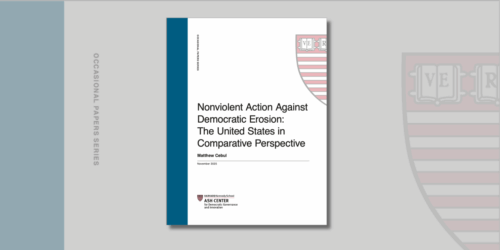
Nonviolent Action Against Democratic Erosion: The United States in Comparative Perspective
In this report, Matthew Cebul, Lead Research Fellow for the Nonviolent Action Lab, examines the effectiveness of nonviolent action movements in supporting democratic resilience globally. Identifying challenges faced by nonviolent pro-democracy movements, Cebul offers key takeaways for combating accelerating democratic erosion in the US and abroad.
A new paper by Matthew Cebul explores the logic of nonviolent pro-democracy movements, identifying nonviolent action as a key defense against democratic erosion. Cebul examines key challenges faced by pro-democracy movements given shifting politics in countries experiencing democratic breakdown, including the repression of civic spaces and barriers to effective mobilization.
Cebul considers these practical challenges in the context of the United States, finding that despite increasing barriers to nonviolent action, “the US remains a favorable environment for mass mobilization.” He concludes with a set of recommendations for activists and organizers to strengthen pro-democracy movements.
Matthew Cebul is the Lead Research Fellow for the Ash Center’s Nonviolent Action Lab, where he conducts applied research on the dynamics of contemporary nonviolent protest movements.
The views expressed in this article are those of the author alone and do not necessarily represent the positions of the Ash Center or its affiliates.
Even with Nicolás Maduro gone, the fight for Venezuela’s future is far from over. Freddy Guevara warns that Maduro’s successors are more interested in regime survival than democratic reform.
Erica Chenoweth and Matthew Cebul analyze the global surge of Gen Z-led protest movements, showing how economic insecurity, exclusion from power, and corruption are driving youth mobilization worldwide.
Erica Chenoweth and Matthew Cebul analyze the global surge of Gen Z-led protest movements, showing how economic insecurity, exclusion from power, and corruption are driving youth mobilization worldwide.
The left knows how to have huge protests. The right knows how to win elections.
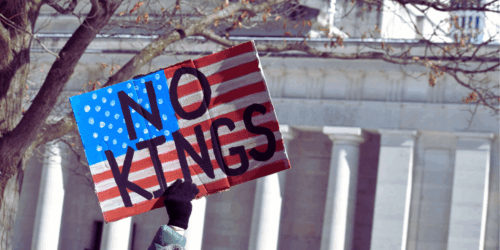
In this op-ed, Liz McKenna examines the second ‘No Kings’ protest on October 18 and offers strategies for translating successful protest movements into influential policy change. She emphasizes the importance of sustained organizational efforts alongside protest activity to engage actors across partisan lines, building a broad coalition and a durable base for the movement.