

Policy Brief  

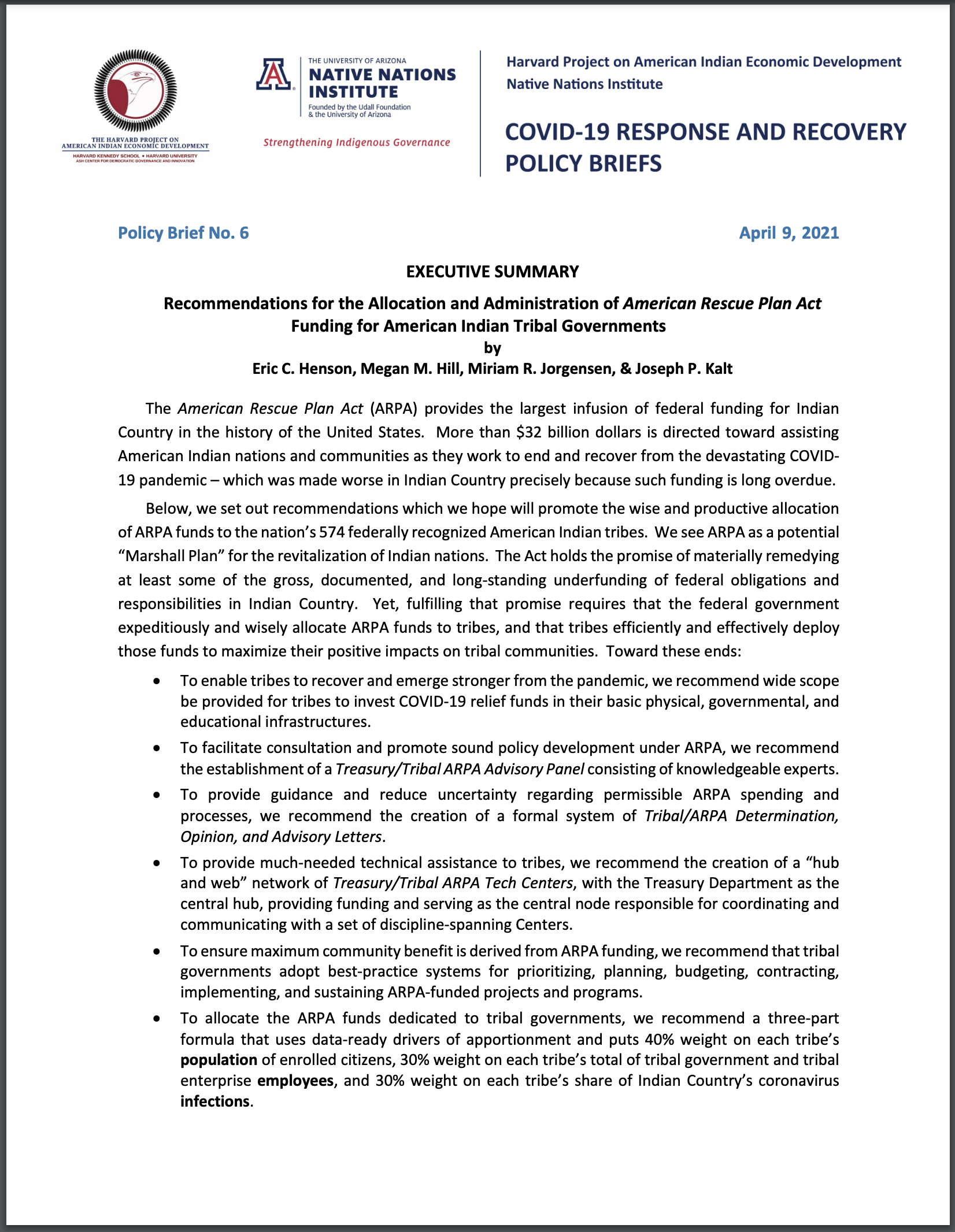
Recommendations for Allocation and Administration of American Rescue Plan Act Funding for American Indian Tribal Governments

The American Rescue Plan Act (ARPA) provides the largest infusion of federal funding for Indian Country in the history of the United States. More than $32 billion dollars is directed toward assisting American Indian nations and communities as they work to end and recover from the devastating COVID19 pandemic – which was made worse in Indian Country precisely because such funding is long overdue.

In this policy brief, we set out recommendations which we hope will promote the wise and productive allocation of ARPA funds to the nation’s 574 federally recognized American Indian tribes. We see ARPA as a potential “Marshall Plan” for the revitalization of Indian nations. The Act holds the promise of materially remedying at least some of the gross, documented, and long-standing underfunding of federal obligations and responsibilities in Indian Country. Yet, fulfilling that promise requires that the federal government expeditiously and wisely allocate ARPA funds to tribes, and that tribes efficiently and effectively deploy those funds to maximize their positive impacts on tribal communities.

Related Resources

American Indian Casino Operations and Firm Long-Run Employment and Sales
Billboard sign advertising the Desert Diamond casino.

Paper

American Indian Casino Operations and Firm Long-Run Employment and Sales

A new working paper by Randy Akee, Julie Johnson Kidd Professor of Indigenous Governance and Development, and co-authors examines the role of The Indian Gaming Regulatory Act of 1988 in facilitating sustained private-sector growth for American Indian reservations through tribal casino development.

The Disproportionate Burden: Health and Economic Outcomes of COVID-19 for Native American Communities
A woman wearing a face mask during COVID-19.

Article

The Disproportionate Burden: Health and Economic Outcomes of COVID-19 for Native American Communities

A new research article by Randy Akee, Julie Johnson Kidd Professor of Indigenous Governance and Development and Director of the Project on Indigenous Governance and Development, and co-authors examines enduring consequences of the COVID-19 pandemic among American Indian and Alaska Native (AIAN) populations.

More on this Issue

American Indian Casino Operations and Firm Long-Run Employment and Sales
Billboard sign advertising the Desert Diamond casino.

Paper

American Indian Casino Operations and Firm Long-Run Employment and Sales

A new working paper by Randy Akee, Julie Johnson Kidd Professor of Indigenous Governance and Development, and co-authors examines the role of The Indian Gaming Regulatory Act of 1988 in facilitating sustained private-sector growth for American Indian reservations through tribal casino development.

The Disproportionate Burden: Health and Economic Outcomes of COVID-19 for Native American Communities
A woman wearing a face mask during COVID-19.

Article

The Disproportionate Burden: Health and Economic Outcomes of COVID-19 for Native American Communities

A new research article by Randy Akee, Julie Johnson Kidd Professor of Indigenous Governance and Development and Director of the Project on Indigenous Governance and Development, and co-authors examines enduring consequences of the COVID-19 pandemic among American Indian and Alaska Native (AIAN) populations.