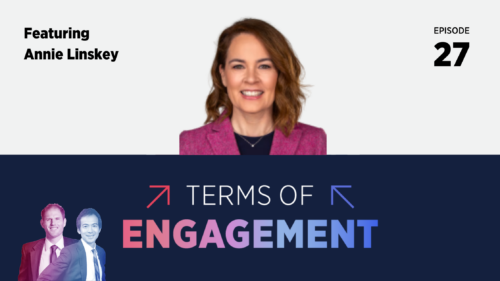
Archon Fung: Hey, everyone, you’re listening to Terms of Engagement, and this is episode 27. Today, we’re going to talk about what makes the Trump White House tick. I’m Archon Fung, a professor at the Harvard Kennedy School and director of the Ash Center for Democratic Governance.
Stephen Richer: And I’m Stephen Richer. I’m the former elected Maricopa County recorder. And now I’m a senior fellow at the Ash Center.
Fung: This is a weekly live conversation about the latest developments in democracy and American politics. We welcome your thoughts, as always, at info@ash.harvard.edu. As always, Stephen and I are speaking as individuals and not on behalf of Harvard University, the Kennedy School, or the Ash Center.
Richer: And as always, also, we really enjoy your comments. So in addition to emailing them in, please put them into the comment box. We’re monitoring that. We’ve had a lot of fun in recent weeks integrating those into some of the conversations. And hey, Archon and I don’t know everything. I certainly don’t know everything. Archon’s the full professor, so he knows a lot of stuff. But we’d love to hear from you. So drop it in the comment box and we will integrate it into our exciting conversation today, which is about some of the many developments that have happened over the last few weeks from within the White House, the players in some of those developments, the players in some of those conversations, what those developments hinged on, where they turned. And to do that, we have a great guest, and Archon is going to introduce our guest and then we’ll bring her in and we’ll start talking about a few of her recent articles.
Fung: Great. Before I introduce Annie, per user feedback, we’re kicking the news updates to the end or maybe skipping them altogether. But I just did want to say one thing. Last week, Secretary of Defense Hegseth announced that the Defense Department is cutting ties with Harvard. And if that actually happens, I just want to express my sadness about the potential loss of students from the military. In my 26 years of teaching at Harvard, students from the military have been some of my favorite students and some of the best contributors to classroom discussions. I really feel like they’ve added a lot to my own learning, and I’m sure the learning of everybody in the class from different backgrounds, and I really feel like civilian-military relations is a critical part of any democratic society, and I’m sorry to see the possibility of Harvard’s loss of that maybe around the corner.
Richer: And that has not always been the case because I know during the Vietnam War era, that was certainly not the case. And then it took a number of years until that relationship was reestablished. And I know that when I joined the Ash Center, you had a fantastic PhD student who I think has wrapped up her dissertation, who was in the Air Force, I believe.
Fung: Yeah, that’s right.
Richer: So, Mike, from the comments: yes, this will be later available online; we post all of these shows to YouTube, so you can just go to the Ash Center’s YouTube page, and you can watch all past episodes.
Fung: Great. And without further ado, I’d like to introduce Annie Linsky, who has been a White House reporter at The Wall Street Journal since 2022. Annie previously covered the White House and national politics for The Washington Post, The Boston Globe, and Bloomberg News. Her experience spans three presidential campaigns and four administrations and has taken her to four continents, because I guess presidents travel a lot. She’s received a large number of awards, including the Gerald Ford Prize for Distinguished Reporting on the Presidency, the National Press Club’s Lee Walsick Award for Political Analysis, and the New York Press Club’s, I’m sorry, that was the National Press Club’s Award, and the New York Press Club’s National Award for Political Reporting. She started her career in journalism in local news, as all reporters should at the Baltimore Sun. And then during her sabbatical, she covered the trials of the Khmer Rouge in Cambodia. Welcome, Annie.
Annie Linskey: Hi. Hi. It’s great to be with you.
Fung: Yeah. Thanks for joining.
Richer: So the Boston Globe, does that mean you lived in Boston presumably for a few years?
Linskey: I did live in Boston, but when I was at the Globe, I was in the DC office. So, it was a little, it didn’t quite work out, but I’m a huge fan of Boston. And the time I lived there was fantastic and wonderful.
Richer: And as the kids say, Annie’s had some real bangers of pieces recently. And so would recommend that you check out her writing profile at the Journal and you can see that. And then Archon and I have read a few of her most recent pieces of which we’re going to talk today. I think the one that really grabbed Archon’s attention was the piece on the 48 hours that unfolded after the Minneapolis shooting and just what went on in the White House and the number of sort of zigs and zags that went on. So tell us a little bit about how you developed that story and came to it — the process, I guess.
Linskey: Oh, yes. Well, at the Wall Street Journal, we do work a lot collaboratively. So you’ll notice that there were multiple bylines on that story, but I was the one who pulled it together. And look, when there’s a big news event, the Wall Street Journal does like to bring readers kind of like behind the scenes to get at least some sort of glimpse about how exactly some of the really dramatic events, you know, zigzags, to use your word, that occurred — like what was going on behind the scenes.
And where we started the story, I mean, we were looking at the president of the United States who has been talking about immigration and running on immigration really since when he went down that golden elevator and started to talk about immigration in ways that the political system wasn’t really accustomed to. So, you know, immigration is, I think, perhaps the issue that he is personally most associated with. And then what we had happen in Minnesota after two U.S. citizens were shot and killed by federal immigration agents is — you saw the president do a reversal on a policy area that he is personally perhaps most associated with. And so that was quite a stunning moment for us as reporters to think about and process.
And we were trying to really understand how it happened. And with this president, other presidents use things like the interagency process where they get memos that are, you know, kind of filter up through a massive bureaucracy to finally get to the president’s desk where the president gets to decide between three options and he makes a decision and puts his name on it. And that’s sort of the drama in a more traditional presidency. With Trump, he really embodies this role in a different way than most current past presidents have, where he’s really taking a lot of the inputs himself and running them through kind of his own set of values and his own thinking.
And what happened this weekend when Alex Pretti was shot and killed in Minneapolis, at the same time, there happened to be a snowstorm in Washington, D.C., and that shouldn’t really matter all that much, the weather in Washington? I think it did. You know, our reporting showed that it meant that the president was more alone than he normally is. He was in the White House and there wasn’t a lot of staff around. And of course, he was in touch with staff. You can call people. I mean, that certainly was all up and running. But it was a period of time where the president was listening and watching cable news, which he has long loved to do. He does a lot. But it was in a less filtered way because he’s just getting the cable news and he isn’t getting as many interruptions at least.
Richer: That’s very surprising to me because my sense was that the president always sort of marched to his own beat, always was a little bit unfiltered and always sort of relied most on his own assessment of different situations. But you’re saying that because of that, maybe the absence of staff, I was actually in Washington, D.C., for that weekend. And it was hard for anyone to get anywhere. And especially on that Sunday, basically everything shut down, that it was a little bit more Trump reacts to cable news reporting.
Linskey: Well, I think he was, you’re right. He’s always watching cable news, right? And he does, you know, march certainly to his own beat. I mean, that’s also true. But it was a little more, it was a little more insulated where it’s just sort of Trump, and this incoming information on the TV, he’s not being distracted from it. So he’s really seeing all of this analysis in a more sort of fulsome way. And that just happens to be one of the situations that was unfolding as he was, you know, processing whether or not to make a fairly significant change.
I’m not saying that there were not other inputs, but you had a much less sort of, you know, I want to say chaotic environment for the president. And I mean chaotic because you just don’t have a lot of people coming and going because he has just more time to sit. And really, you know, I was watching a lot of cable news that weekend for the same reason, where it was very difficult to go out. And he, you know, it was very dramatic footage because you could show what Trump’s aides were saying, what Kristi Noem had said, what Stephen Miller had tweeted, and how that interacted with these videos that were coming out. So this was also a scenario in Minneapolis that occurred on this medium of TV that the president has always responded to very viscerally.
Fung: So the conversation and your reporting relies a lot on President Trump getting signals from TV and maybe from social media that are negative. So is your assessment, there’s two things about the immigration policy, and you said this at the outset. One, it’s been an enormous part of his agenda since he came down the elevator. And the second thing in the second term Trump administration, a feature of the immigration implementation has been its aggressive and militarized kind of implementation. And so, does the reversal indicate to you that he’s like not really got so many stakes in that part of it? You know, all of the videos from Homeland Security, etc.? And that really it’s about really immigration for him, much less than how the immigration happens, as it might be for other advisors.
Linskey: I mean, I think he has a clear — he is getting briefed very, you know, frequently on all of these incidents that happen, but I think for him when he sees something it is different. Like he interacts a little differently when he actually sees something and just the significance of video in this case I think can’t be understated. I’m not sure if I’m quite answering your question there though.
Richer: So when you say you saw this changing, tell us, is that like you’re sitting there and the president’s just thinking through these things or that you’re attending sort of media moments throughout the day? For those of us who don’t know how this works because we simply see the same news channels that we just said the president was watching or we read your reporting, what are you actually seeing?
Linskey: Oh, sure. So, I mean, part of this is this is in conversations with some of his top aides, people who have been in touch with the president, but also just the president’s actions. For example, you know, when, on, I believe it was the Monday after this shooting, of course, the Monday after this weekend of wall-to-wall news coverage, President Trump called Tom Homan and they had a phone call. And I, you know, don’t quite quote me on the exact timing, but it was I think 8:00 or 7:00 hour, so, you know, pretty early in the morning.
They have a conversation, Trump dispatches Homan to Minnesota, but many of the people who typically would have been in the know about that decision were unaware of it, so it was not, you know, more typically you would have had a big meeting in the Oval Office where a lot more people would have been aware of it than were. It caught people by surprise who are sources to the Wall Street Journal, who talk to us and to talk to the president. And so there was a very kind of closely held decision. And this is kind of unlike a Biden presidency or an Obama presidency, where you would have had memos written and a more robust discussion.
Richer: Okay, and to be clear, this was the decision to replace Secretary Noem with Tom Homan as sort of running point in Minneapolis, right?
Fung: Greg Bovino with Tom Homan.
Linskey: Yes, Bovino. It was to send Homan there and say, look, Homan is going to… is going to report directly to me. And Homan then gets to take over. And I think Homan has this Republic persona as a real — and he is — a real hardliner on immigration, but his view, he comes from a law enforcement background, and his views have long been that what needs to happen is a kind of focus on the worst of the worst.
So if you have a person who, let’s say, has a detainer on them or has been accused or served prison time for a violent crime and also is not in the country, does not have documents to be in the country, that person is somebody he wants to target, somebody who has a violent history or has been accused of violence. And that’s the type of individual that Homan is interested in. And Bovino and, you know, under Kristi Noem and through the Department of Homeland Security, Bovino had had a much more expansive view about what Trump’s orders were on clearing the country of people who don’t have the right documents to be here, illegal immigrants. And Bovino was saying we want to have, you know, the larger, flashier raids that really show that we’re in the community and are intended to sort of strike fear in the hearts of communities that he is hoping will kind of self-deport, to use a word that… But Holman does not have that reputation.
Richer: Okay. So we’re going to ask, I’m going to ask Archon a question. But in the meantime, we’re going to ask you to quickly sign out and sign back in. Your audio is great, but I think we froze on your video. But in the meantime, I’m going to ask Archon about — oh, wait, you’re there now. You just needed to like magically touch it or something. So fantastic.
So Archon, on this Saturday afternoon, When you first heard about the shooting, what was your thought about how America would respond to this? Did you feel that this was like, this is a turning point moment?
Fung: Well, you know, Renee Good had been shot just a week or two earlier, and it was deeply disturbing and not – but it didn’t amount to a turning point moment. So, you know, I mentioned this really briefly in our last episode. Like, I don’t know – wind the tape forward, backward, four weeks. The Department of Homeland Security, the Trump administration is putting a lot of effort into making videos of these very aggressive militarized raids, making a big deal out of it. Some people say that’s performative. I think that’s not really the right word because it has real consequences. People die when militarized action happens in US cities. But, I don’t know whether the bulk of America ex ante is like, yeah, let’s do that. This is the way to deal with the immigration problem or whether the bulk of America would respond quite differently and say, hey, that’s not who we are with people in masks. And now I think with the shooting of Alex Pretti and the opinion poll results, I think we’re more in the second America than the first. But, you know, before I just don’t know.
Richer: I agree. I don’t know. So at first I didn’t think it was going to be as significant as it feels like it was only a few short hours later. I was thinking the Pretti killing changed something. So, Annie, like when this first happened, as soon as the White House got the news, was this like, oh, like this is a big moment? Or was it just like, hey, you know, a lot of significant things happen when you run a country of three hundred and thirty plus million people. And this is another significant one. Like, did they have a sense that this would fundamentally alter the conversation regarding law enforcement and immigration enforcement as soon as it happened?
Linskey: Well, I mean, I just sort of to back up to Good’s killing. I do think that, you know, some of the people that I was talking to in the White House were really quite unnerved by that. You know, there wasn’t the public posture of the president, obviously. I think, you know, my sense from the White House is that there’s a separate conversation about whether there’s a legal justification for that incident and what kind of legal protections the officer might have had. But putting those aside, I think there was a real recognition that that was not sort of what the outcome they were looking for was.
So I think that there was already a level of pause from policymakers in the White House about that. And then within, I think it was two-and-a-half weeks maybe, I can’t remember exactly how many days it was, to have this additional killing, where the sort of playbook appeared to be the same. Kristi Noem referring to this as an incident of domestic terrorism at first. And the footage, there was just nothing to support that. And it just raised this credibility question that I think was already beginning to percolate in the White House when this happened. So I do think those two were related. I don’t think it was like a… I do think it was… The idea was, I think the Good killing was one that if it had not happened, it created this environment of concern with many in the White House that was only became far, far worse when this happened a second time.
Fung: Yeah. You know, I wanted to ask in that article on 48 hours. There’s so much stress on how people in the White House and in particular President Trump were parsing the narrative. And what changed ultimately in your reporting is the narrative was just not going well at all. But from your reporting and other sources, I guess, was there a moment where somebody took a pause and said before the narrative analysis, an American citizen was shot and killed here? We need to kind of get to the bottom of this. And that’s the important thing.
Richer: Yeah. And sort of building off of this, Frank’s comment in the comments, like, was the president upset about sort of like, I guess, first, exactly like Archon said, the facts on the ground before getting into the narrative component of it?
Linskey: Well, I mean, the president has talked about both of these killings as tragic. He’s been asked that question a few times and his answer has been consistent. I mean, there’s not been this sort of you know, sense of like, okay, this is just the way it goes. They have certainly had an impact in how they’re looking at enforcement. And I think, you know, one of the things that also does sort of get lost here is with Tom Homan having a law enforcement background. I mean, you know, I spent 10 years covering, you know, crime in Baltimore City where there were a number of officer-involved shootings. And anybody with a law enforcement background or anybody like myself who has spent a lot of time with law enforcement knows that you have to be very, very careful about your language in the immediate hours after an incident, like either one of these. And Homan was very careful after Good was killed and said, look, I want to see what happens with the investigation. He had a much more sort of modulated response than many of the others in the administration. And I really do think that is what gave him some of the credibility to go into Minneapolis, to go to Minnesota, because he had not presented himself as some sort of, you know, as leaping to a conclusion like others had, you know, very publicly.
So his law enforcement background means that whether his underlying beliefs are aligned with Trump’s, and they are, and they certainly are, there’s not daylight between Donald Trump and Tom Homan with the overall mission about immigration, but he has more — he has been involved with this movement field for so much longer that he is aware that in incidents like this, there’s a lot of different immediate facts that come out and you really do need to understand the totality of what happened before making a presentation to the public because in law enforcement, credibility is just so important. You need the cooperation of the people that you are supposed to be protecting.
Fung: I want to make the other side of that argument and push against you a little bit on that and here, you know, some people are saying that the replacement of Bovino with Homan is cosmetic. It’s a distinction without a difference. There has been a drawdown in Minneapolis but it’s only from 3,000 to 2,300, which is still three times the size of the Minneapolis Police Department. And then, you know, living in Boston, the press moment for Tom Homan that I remember most clearly is when he said, “I’m going to bring hell to Boston.” And so that’s not really a community policing kind of police attitude. And so I just wonder, like, how different… is it going to be and how different is it?
Richer: Is this putting lipstick on a pig? Archon wouldn’t say that. Archon wouldn’t say that. But like, is this window dressing?
Linskey: Well, I mean, I can say from within the administration, Homan is viewed as having, and his, the sort of initiatives he’s pushed and the philosophy he’s had towards illegal immigration is different than the kind of Bovino, Corey Lewandowski, Kristi Noem view. He has long argued internally for a more targeted approach. But this is still an approach that politically there are many who disagree with him. But the overall idea of deporting people who are here illegally, who have… have been involved with some sort of violent crime. And that’s where Homan is, is that he believes that there should be deportations of the worst of the worst. There are going to be people who politically disagree with that and say that that is inappropriate. But that’s where he is. And the president, you know, he kind of toggles between the two and the more sort of holistic view that Stephen Miller and Kristi Noem have pushed is one of a sort of a bigger, glitzier removal. But Homan internally has always made a case for a more targeted push.
Either way, you know, that may not be what cities want. And I will say, you know, Trump, at least for the time being, has shifted on one of the biggest parts of his kind of deportation agenda, which has been, he initially was, you know, going into these cities, whether they wanted him or not. And now he’s saying, no, no, no, these cities have to ask. They have to ask and they have to ask nicely, or they have to say, please, I think is what he said. And that is a shift that kind of takes you back to where policy-wise things were under other presidents, where more typically when there’s going to be a federal intervention in a local, in a city or a state, it’s more typical that those local leaders would ask the federal government. And that’s the place where Trump is right now.
I’m not saying he’s not gonna change. I would certainly sit here and predict his behavior for the next three years. He certainly has, there has been a change.
Richer: You’re noting, okay, so a material change in policy performance on the ground since that moment.
Fung: So that is interesting for a bunch of reasons. One of the articles after the 48 Hours article that you wrote was, the headline was that the Trump administration have a well-worn crisis playbook. It backfired in Minnesota and now it sounds like it’s changing. And when I read that it was significant to me in part because one of the distinctive things about the Trump administration compared to some others is that they seem to keep doubling down in the face of unpopular moves and crisis. But here, it sounds like you think, and you know better than most, that the administration really has, at least for this two weeks after the Alex Pretti shooting, kind of changed course in response to public opinion and that feels like maybe the Trump administration, the Trump presidency is getting a little bit more normal politics in that variety, you know, where they’re more responsive. Like, what do you think?
Linskey: Well, I mean, I think a big part of this change in the president’s calculation and his policy changes on immigration were driven by conversations he was having with Republican senators who called him that weekend to say that this is, sort of unhelpful. He was looking at polling and polling data that was showing a sort of cratering of support on an issue that was his own identity. So he’s seeing a lot of different inputs there. You know, I don’t, again, want to predict where Trump is going to go on any particular issue. I think that is like a fool’s errand for even people who have worked for him for a long time. But I do think on this one, there was just so much, such an avalanche of a push that, you know, coming from people who he respects and people who have been long-time supporters of him who also are saying, look, this is a real problem and there does need to be a change. And Trump has talked a few times about his decision, as he puts it, to soften things in Minnesota and with this overall approach.
Now, saying that, it’s not like he has dismissed anybody. Homeland Security Secretary still has her job and so does Stephen Miller. So he hasn’t said, I am done with anybody that has pushed this sort of more aggressive approach but right at this moment at least he’s elevating somebody who has long argued for a much more targeted way of carrying out his agenda.
Richer: So I’ve never covered any presidents, much less multiple presidents. And I guess I’m struck by, isn’t that just politics? Don’t our political actors always acting and then getting a sense of which way the winds are blowing, how people are responding, and then they’re trimming their sails accordingly? Or is this materially different than the normal sort of course correction?
Linskey: Well, I think Trump has been kind of immune to typical politics for most of his career. He has, through force of personality and through sort of the overwhelming amount of change that he brings, has been able to survive kind of scandals that… I think scandal is really the wrong word. He’s been able to survive moments where he’s made a political calculation that the rest of the world disagrees with. Ultimately, in many cases, he has pushed the rest of the world to his will rather than the other way around. He wears the presidency very differently.
I happen to be reading a biography of Teddy Roosevelt right now. And there are some ways in which there are parallels between the two in terms of particularly a use of a presidential power and concentration of presidential power. You know, Roosevelt was pushing the norms at the time and Trump is doing the same thing. So there have been a lot of instances where the whole world has said, no, you cannot do this, sir. Trump has done it and he’s fine. But it doesn’t mean that he’s, you know, he’s invincible. And this is one of the issues where — one of the rare issues — where he has taken a step back because of the rest of the world is saying, sir, this is this is problematic. And he internalized that himself, I think.
Fung: Yeah. So Frank asks in the chat, was there any indication that Trump was upset with Secretary Noem and Stephen Miller after their comments? And I would add to that, is there any indication that Secretary Noem and Stephen Miller were upset with President Trump’s change of course?
Linskey: Well, I think people close to Trump, there were certainly senior aides in the White House and in the administration who have long been quite frustrated with, particularly with Kristi Noem, Corey Lewandowski, the two of them running the Homeland Security Department. I mean, that has created a lot of friction, and there is some within the White House. There is also some friction with regard to Stephen Miller, where some of some senior administration aides also have been blaming him for what happened.
But when it comes to the president, he has a really long relationship, particularly with Miller. And so that feels quite solid. It doesn’t feel like that has been materially impacted. His relationship with Kristi Noem is not as strong, but that’s only because Miller is one of the closest Trump aides there is, and nobody else is really going to get to that level. There was a lot of speculation in D.C., including among Republicans, that Noem would not survive. But she has. And Trump has made a point of saying multiple times that he likes the job that she’s doing and then pivots to the border and compliments her on the very, you know, the low level of crossings on the border.
So there is —Trump has in the second term. He kind of came to power as the, you know, on The Apprentice with the catchphrase, “you’re fired.” But he has chosen not to fire people.
Richer: Does that surprise you?
Linskey: Yeah, it has.
Richer: It’s very different from the first Trump administration in which a number of high-profile appointed positions were changed in the first year, certainly in the first two years. And there’s been lots of speculation. There’s been speculation about Bondi at one point, speculation still maybe to this day, speculation about Patel at one point, speculation about Kennedy at one point. So certainly I remember reading about Secretary Noem. Do you think that he feels just like these people are in more for the right reasons or just that that didn’t serve him well in the first administration?
Linskey: Yeah, I think it’s the latter. I think he sees that it was difficult in the first administration. I mean, you think about what happens when you dismiss somebody. It gives them quite a lot of license to go out and be very negative towards the person that dismissed them. And his first term was really characterized by an enormous amount of turnover and you know I didn’t cover all of his first term but I imagine a lot of those people, you know, continuing to tell stories about what they were seeing in the administration, and so by keeping everybody within the tent, I think that’s been it’s been a different strategy and it’s been working quite well from him in that it has meant that there’s been a lot fewer leaks in this administration. I’m not saying there are none, but there have been a lot fewer than there were the first time. And the president and his chief of staff, quite frankly, have done a better job at creating this sense of a team. So there’s not, you know, there’s less of the over-undercutting. Now, that’s not to say there’s none of that. I mean, it still exists.
Fung: Right. Well, it seems like another personnel difference is that this cabinet and set of advisers and internal White House staff is just much more on the same page as the president than in the first term. And so he can count on alignment, but also a great deal of loyalty, right? When I first read the 48 Hours article, my first reaction is, oh, this feels like a very familiar situation in which there are people in the White House with very sharp elbows and they’re trying to buy, you know, different factions vying for the president’s attention and to get him on side with them. But now talking to you and thinking about it a little bit more, maybe it’s not that at all. I think Carolyn Leavitt said, you know, there’s only one page and that’s the president’s page. And it feels like maybe he turned the page in that 48 hours and everybody is like turning with him. I don’t know. What do you think? Is it more the faction view or the one page?
Linskey: I mean, I honestly think there’s a little bit of both. I mean, certainly within the immigration enforcement. I mean, that that moment did reveal factions which had been simmering for a long time, but they became kind of really impossible to paper over in that moment. And I think that exists across the administration and it exists across every administration. But Trump’s first term was just so characterized by those disagreements exploding onto the public, into the public, so much more frequently than they have this time. But and I think a lot of that does have to do with having this unusual presidency where he had four years to be president and then four years to think about exactly how he would do it if he got the chance again. And that enables you to really like …
Richer: Come in with a plan.
Linskey: Come in with a plan. Yeah. Come in with a plan and with the people in place. I mean, as Elizabeth Warren has always said, you know, personnel is policy. And he sort of employed that sort of philosophy in the second term. He didn’t inherit this sort of like fractured Republican group of staffers like he did the first time. They were really, really, truly his people the second. So there he he has shown an increased measure of loyalty to them than the first year.
Richer: I do think that that’s something to be said about sort of maybe to the president’s credit is that, you know, people consistently say he’s disloyal, that if you fall in the field, he’ll abandon you so on and so forth. But look, a lot of these secretaries, cabinet members have had their bumps along the road over the past year and the president at least publicly has always said I support whomever it is. He is doing a great job. She’s out there because I want her to be out there. And then it takes reporting from you guys, sometimes the occasional text message that was supposed to be a text message actually through social posts. And so, you know, that sort of marks a difference. But you said, time to plan. And so, you know, the president is tackling so many things of great momentum, whether it’s Venezuela, whether it’s, you know, immigration, whether it’s, you know, we were talking about Greenland being a thing before, like a great significance, global significance.
And then we get to your other recent article. And it’s about putting your name on the Kennedy Center and reforming the Kennedy Center. Why does this seem to be of great interest to the president? What’s going on here? This is not Venezuela. This is not Maduro. To my knowledge, the Kennedy Center has never been a house for the illicit drug trade or something like that. And please don’t repeat that. That’s not a thing. But you get why someone would dig into Venezuela. Why the Kennedy Center?
Linskey: You know, I’ve talked to a lot of people about this. So Trump, he doesn’t have as many hobbies as, you know, many people play bridge or they do mahjong.
Richer: He golfs!
Linskey: He does golf. But he has — there’s been this sort of like menagerie of projects in Washington, D.C., It includes the ballroom, this art she wants to build, he’s taking over the municipal, well trying to take over the municipal golf courses in D.C., and the Kennedy Center and he looks at them as almost, like this is time off for him. Like this is a different part of the brain to use. Like, for me I like to read fiction, and and when I get to read fiction, it’s great because there are just no facts involved, it just brings you into the story and you just almost can like feel a different part of your brain being used. So the way this has been described to me is that he sort of sees these projects in some ways — and I think some of his legacy to be sure — but some of it is like he does get very curious and interested in the very minute details of these projects, and like, you know, to talk about the ballroom, for example, he’s very clear on what type of marble he wants, he’s very clear on the type of like this not that, you know, the finishes are quite important to him, and it’s just his way of having a different sort of set of problems to focus on. It’s almost like his way of relaxing a little bit. So there’s part of that.
And then the other part I think is more obvious, which is like, this is legacy for him that he can leave D.C. and have put his mark on the city. Like quite frankly, making some of these institutions in his own image.
Fung: That’s so interesting because my read of it, my thought was, oh, this is consistent with some of the new right thinking — Andrew Breitbart and others — who think culture is upstream of politics and you’ve got to change American culture to change politics, but you’re saying, no, it’s not that at all. He just likes building stuff and picking out faucets and marble, which is, I mean, that’s great, I love it.
Linskey: I mean, I think it’s a little bit of both. I mean, I think they certainly recognize, and there’s sort of the programming at the Kennedy Center. And I was sort of speaking to sort of like the actual building of it and the renovation of it, which he’s taken a very, very close interest in. And the same thing with the ballroom, where he’s taken a very personal interest in how to do this construction, or even, you know, the golf courses in D.C., like what they can be and like sometimes he does talk about it publicly. He’ll talk about the grass, how he’s a grass guy, he knows grass. So, I think that yes, with the Kennedy Center there is an aspect of it that does get to the larger issue of culture and the sort of programming but it’s also just, you know, he likes to wrestle with the problems of a builder.
Richer: But what Archon said is how it’s being justified or even celebrated online, that the Kennedy Center had gone woke. Trump putting his name on it is indicative of the fact that bigger changes are happening and the Kennedy Center isn’t going to be run for them. It’s going to be run for people like us that are going to better reflect American values. So I had assumed it was always that. Is this?
Linskey: And I don’t think that’s wrong. I think it’s just that plus he is actually just quite interested in it.
Richer: By the way, I don’t even when they asked what knobs I wanted at my house for the bathroom fixtures, I was like just the normal knob. So hats off to President Trump for being able to be on top of all that. Is this helping or hurting his presidency? Or is it just noise that people like Archon and I care about and no real American cares?
Fung: Or the base might care, right? I mean, the culture change for the base. I don’t know. It’s a good question.
Linskey: I can’t imagine. You know, the polling that I look at really shows that what Americans care about is, you know, prices. Yeah. Immigration is another one. Health care. It is hard to imagine that this is something that is going to convince somebody to vote for Trump. Of course, he’s not on the ballot again, but it’s not going to help his favorability ratings is having taken over the Kennedy Center or having taken over the municipal golf courses. I mean, so it is about something other than like an electoral response. And in fact, you know, there are some on his staff who want him to be spending more time on these other issues like prices, like getting around the country doing more events around the country, which is something that he is starting to do more of as we get into this election.
Richer: Some of his signature events —the big arena type.
Fung: We just have a couple more minutes left, I wanted to ask you where you think this is going and in particular, you know, your well-worn playbook article. It seems like the well-worn playbook is altering with Greenland. The military is no longer on the table with immigration. As we spent a bunch of time talking about, it’s Homan rather than Bovino and Lewandowski’s kind of harder-edge approach. The recent video, the 62-second video with the Obamas depicted as apes was not apologized for but was taken down. And so, are we going to see a different playbook in year two than we did in year one?
Linskey: I think it’s a little too early to come to that conclusion. He has faced in this year, I mean, we think about this year, he started with this Venezuela raid that he viewed as a giant success. So he kind of came into this year on a big high. And then he has, even for him, had quite a bit of turbulence in the opening month. And all of those items that you mentioned have been part of that. But I don’t see… Or it’s hard to predict. But it would be hard to imagine Trump changing this playbook that has, for the most part, served him extraordinarily well in his, you know, in his years in politics.
Fung: And before, right? It’s a decades-old habit so I imagine that would be pretty hard to change. And this month, there have been a lot of zigs.
Richer: Okay, my last question before we let you leave is what’s next? What are you working on? Preview us any exciting stories. The Wall Street Journal, as I was saying before we began the show, has been breaking a lot of big stories.
Fung: Excellent reporting.
Richer: Can you tell us about sort of any topic or field that you’re working on that you’re excited about?
Linskey: Well, I could. There’s a story that I’m working on right now that I think will be of interest to you, but I can’t say anything about it yet because it hasn’t been published and I’ll get into a lot of trouble if I do.
Fung: Well, we don’t want that.
Linskey: I might alert some of my competitors about what I’m working on because this is a very competitive beat. But the Journal has been great. It’s a really good moment for the journal right now. We have strong leadership and our White House team is not only amazing reporters, but they’re really good people, too, and fun to work with.
Richer: That’s interesting and delightful to hear. Obviously, the last week that we didn’t mention in the news section was, it was a hard week for one of your peer papers, where the Washington Post lost a whole bunch of people. And I think it re-upped all the conversations about what is the future of news media. So I’m glad to hear that one newsroom is really strong and people are happy. And as I would wish to anyone, may you continue to be happy, whatever the challenges be of the world.
Linskey: Thank you. I appreciate it.
Fung: And keep up the reporting. It’s like helping us all understand what’s going on in this administration. And as that news organization once said, democracy dies in darkness.
Richer: Yes. And sometimes when the Harvard stuff was going on, you know, sometimes we’d read about it before, like, apparently the school’s negotiating with the White House administration, although some of those were like, yes and then no and then yes and then no, but anyhow, so anyway, thank you so much for joining us today, Annie, thank you to those of all of you who joined us online. This will be archived, this will be on YouTube, this will be on our social media streams. And of course, thank you very much to the Ash team that produces this. Archon, anything else?
Fung: Nope. Just again, send your suggestions to info@ash.harvard.edu. We do listen and we hope you’ll tune in again a week from now, Tuesday at noon Eastern time. Thanks everyone. Thanks, Annie.
Linskey: Great to be here.