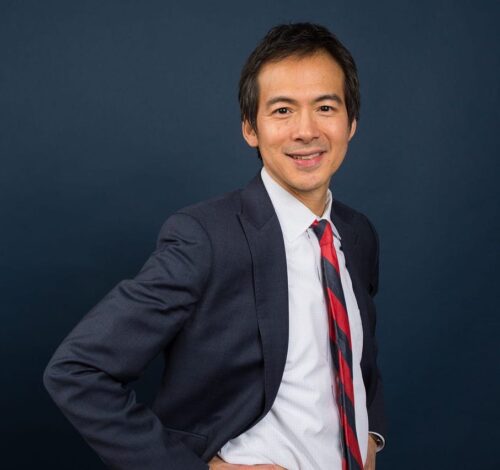
Archon Fung: Hey, welcome to Terms of Engagement. We’re at episode 19. My name is Archon Fung. I’m the director of the Ash Center for Democratic Governance and Innovation here at the Harvard Kennedy School.
Stephen Richer: And despite having only made it 19 episodes, but we’ve made them consistently. We got these sweet new sweatshirts from our production team.
Archon Fung: This is actually embroidered.
Stephen Richer: Yeah, and it’s really soft, so really appreciate that. I’m Stephen Richer. I’m the former elected Maricopa County recorder, and I’m now a Senior Practice Fellow at the Ash Center at Harvard Kennedy School.
Archon Fung: And as always, we’re speaking as individuals, not in any way for the Ash Center or for the Kennedy School, certainly not for Harvard University as a whole.
Stephen Richer: And as always, we welcome your comments, so put them into the chat. I’ll be looking at that throughout the program, and we would love to hear from you.
Archon Fung: Great. And this was another big week in news. I think all 19 weeks have been very big weeks in news. The shutdown is shut down. So the federal government is restarted with a continuing resolution. 222 House members voted for it. 8 of them Democrats, the rest Republicans and 209 voted against. So that was one big thing. We’ve been talking, I had a couple of discussions of the shutdown so far. And the other big news is the Epstein files. In an eleventh hour shocker, President Trump urged Republican colleagues in Congress to vote in favor of a bill to release the investigatory files on Jeffrey Epstein. To my mind, this is a rare, maybe the first big reversal of a dug-in position for the President. It feels like a political victory for Marjorie Taylor Greene and Thomas Massey and Ro Khanna. Thomas Massey and Ro Khanna are the Republican and the Democrat who sponsored the legislation. And to my mind, much more importantly, it’s a moral victory for the many hundreds of survivors of what Jeffrey Epstein and his associates did. Was this a surprising development for you?
Stephen Richer: I guess there was some pushback regarding the FCC statement. Ted Cruz had pushed back, but this is the first time that I think on such a public topic that the president has reversed his position. after facing resistance from within the party. I think there’s been a little bit of popular resistance to, say, the bombing of Iran or the strikes on Venezuelan ships within the internet class, but in terms of a sustained resistance from members of Congress, Republican members of Congress. This has probably been the most prominent.
Archon Fung: Yeah, I think so. And it feels like that’s been the case because the release transparency about the files has just been such a core issue.
Stephen Richer: Core issue, very much an issue with the online world that they hear from a lot, very much an issue that a lot of them campaigned on, including President Trump, of course, campaigned on this in 2024. And so, yeah, for whatever reason, this has not been one in which he’s been able to sort of just get his way and run away from.
Archon Fung: Right. And so we’ll see what the consequences of that are.
Stephen Richer: We’ll wait, we get the, like, is there just going to be a document release?
Archon Fung: Well, I think that’s a, there’s going to be a house vote today, I think. And then the Senate may amend it and may modify it, may vote it down.
Stephen Richer: I’m just imagining us all going into a share file and just being like clicking.
Archon Fung: Yeah. Searchable, you know, search for your friends and associates.
Stephen Richer: Or will it just be a static PDF?
Archon Fung: Yeah, probably. Yeah. Or I guess there’s some debate about maybe there won’t be a release because the justice department will say it’s an ongoing investigation.
Stephen Richer: Well technology questions still exist for this but speaking of technology—you see that segue into there?
Archon Fung: Yeah very good.
Stephen Richer: We’re talking about technology.
Archon Fung: From PDFs to mobile voting. So today is, the main topic for today is mobile voting or internet voting or voting on your phone. Stephen will introduce the guest in a moment. I’m just going to be an interloper in this because Stephen has administered elections with various versions of this. And then we have our guest who’s certainly an expert. As somebody who has a little bit more distance from the real meat of the topic and the details of it, I’m particularly interested for two kinds of reasons. One is…we talked about this a little bit. I can’t see in twenty or thirty years that we’ll be voting by filling out those little Scantron ballots like how we were taking standardized tests in the 1980s. I just can’t see that happen. Maybe I’m wrong. My wife said, yeah, but we still vote on Tuesday, which is a good point.
Stephen Richer: Yeah, but a lot of us vote early or vote by mail.
Archon Fung: Yeah, that’s true. That’s true. That’s changed a lot. And then the other reason is for those of you who aren’t really in the voting discourse, internet voting is kind of like the red-haired stepchild of the voting community. That is, people are really polarized about it. Many people in the mainstream voting community really are highly, highly critical. And personality-wise, I’m one of these people who at the dinner party, I like to speak last because I want to figure out where everybody is on a topic and take the opposite position. So that’s why I’m really interested in this discussion.
Stephen Richer: Okay, so you want to court the controversy, which is why you already mentioned redheaded stepchild, because that is a little bit of a sensitive one for me whenever people get to that. But we’re going to bring in as our guest, Michelle Feldman, who is the political director for Mobile Voting, the company Mobile Voting. And mobile voting is set to roll out in Juneau and Anchorage, cell phone based voting, this spring. And it prompted a very significant story the past weekend or just a few days ago in the New York Times. Prior to joining Mobile Voting, Michelle worked in a number of different roles as a political strategist, and she is a graduate of University of Michigan. So go blue and welcome aboard, Michelle.
Michelle Feldman: Thank you so much. Great to be with you.
Stephen Richer: Okay, so this New York Times piece by Nick Corisanti, and I really recommend it. It’s from November 13th. He says the largest city in Alaska is about to undertake an experiment that feels both inevitable and impossibly futuristic. Is that how it feels to you? Does it feel inevitable? I would imagine a lot of work has gone into this.
Michelle Feldman: A lot of work has gone into this. So we as the Mobile Voting Project, we’re a philanthropic organization. Bradley Tusk really was the driver behind the tech innovation. And we’re not making a penny off of it. He just wanted to do this because he thinks this is the future. This is the way that we save our democracy. And it feels like it is inevitable. I mean, we do our banking online. We do our healthcare online. I met my husband online. So what aren’t we doing online? And this new tech, it is secure. It’s really gold standard in terms of making sure that elections are safe. So it feels inevitable and it feels also, it’s exciting.
Stephen Richer: Well, so one, which dating platform was it?
Michelle Feldman: I won’t even say it because I don’t think it exists anymore. That’s how long ago it was.
Stephen Richer: When you walk into rooms of election administrators or into city halls or into county offices, does it feel inevitable? Do people say, well, yeah, duh, why haven’t we been doing this considering we’ve been banking by cell phone for 20 years? Or is there significant resistance?
Michelle Feldman: There’s…it’s mixed. There’s definitely, you know, an openness that I don’t think we’ve seen before. And, you know, now that we have the tech really up to gold standard, as I said before, there’s more interest. I think election officials do see this as the way of the future. It’s also more efficient and in the long run will have cost savings, which is a huge, you know, deal when people are having trouble, you know, balancing their budgets, cities are having trouble doing that, they’re having trouble finding poll workers so this is, you know, a problem that we’re solving, but again, it’s, you know, tech and change is difficult, it’s, you know, we’re always going to kind of be up against the status quo and it’s like, if something is working for the system, that’s, you know, people don’t want to rock the boat so this is rocking the boat.
Archon Fung: Good. Michelle, so a couple of the arguments that you and, Mobile Voting have made in favor of mobile voting are, one, you think it will increase turnout. And I think probably most of our listeners know average turnout in local elections is very, very low, maybe fifteen percent in a lot of places. And that it will make it easier, especially for some populations to vote. Now, what I want to ask you is, is that kind of prospective, as you’re imagining, once this is diffuse, those good things will happen? And so it’s a little bit of a leap of faith. Or is there are there some data and evidence already, even though mobile voting is not in not very many places, that some of those good things will happen?
Michelle Feldman: There is evidence that it works. So we actually, mobile voting’s not, or electronic ballot return, is not a new concept. There are 32 states that allow for electronic ballot returns for specific groups of voters, typically military folks who are overseas and citizens who live overseas. So, you know, we’ve seen results. There was a program in Denver in 2019 with military and overseas and disabled voters that allow them to return their ballots electronically. They saw a big boost in turnout for that, you know, those populations. There is a conservation district in Seattle, Washington that had such low turnout that, you know, they, it was basically in the single digits turnout for their elections and once they started doing mobile voting and they continued to use it to this day, um you know, their turnout first doubled and then it tripled.
Archon Fung: So a particular special district said, oh we’re going to change the way that you can vote for us in the special district?
Stephen Richer: Because some special districts administer their own elections yes.
Archon Fung: OK, gotcha. It’s like a water district or something.
Michelle Feldman: Yeah, this was a conservation district. So, you know, small, but, you know, really showed results.
Stephen Richer: So Bradley’s thesis, as I understand it, is that our American democracy is suffering because of lack of participation. Internet voting, cell phone voting makes it infinitely easier to participate and therefore our democracy will be healthier if we if we allow cell phone voting. Is that the gist of it?
Michelle Feldman: Yes. I mean, that sums it up pretty well. The more participation we have, the more average voices will be heard. We are in a time of extreme partisanship and we want more people to be able to have their voices heard. And that’s really what smartphone voting allows us to do.
Stephen Richer: So you’re the democracy scholar. Are the ills of today’s society solved if we just have more participation in our elections?
Archon Fung: Not all of them, but some of them. I believe that some of them will be. I mean, especially in low turnout elections, the people who feel most strongly about the issues tend to show up. And so you’re not getting an even view of the whole population. Now, some people think that’s a good thing because you’re getting more high information people who are paying attention. But then take an average zoning issue, a NIMBY issue in a city, then you get very lopsided participation from kind of homeowners and people have pretty special interests.
Stephen Richer: So this is what’s baked into a lot of the rank choice voting advocates, the top two voting advocates, the Condorcet voting advocates, is that the design of the electoral process is warping the outcomes. And in part, that’s who’s allowed to vote. And in part, that’s two people are choosing not to vote because either they just don’t care enough and it’s maybe inconvenient.
Michelle Feldman: Yeah, exactly. I mean, we see that I think the special districts are such a great example. In Colorado, one of the states that we’re working in, there are 2400 special districts throughout the state. So there it really is a part of life there. And they have just such low turnout. And these are issues that impact people’s day to day lives, whether it’s their water or, you know, there’s just so many different ways that it impacts. If you want to make a difference in someone’s daily life local government is where it’s happening.
Stephen Richer: Okay so brass tacks. I’m a voter in Anchorage and I’m excited for the upcoming spring election. How will this work? I understand-
Archon Fung: On the front end and the back end.
Stephen Richer: Yeah, I understand that they will not be required to vote this way, but say they want to vote this way in the in the upcoming spring election.
Michelle Feldman: Sure. So, great point that this is not a replacement for any form of voting. This is just an added method of voting. What happens is that you would download your, you would download the app from the Board of Elections. It would say, you know, is Michelle a registered voter in Anchorage? Then the question is, is Michelle who she says she is? So there are multi-factor authentications, just like if you had, you know, lose your Google password, you would get an email, you know, with a code. Jurisdictions can put in biometric screening if they want. That is a feature of the app. So even more security, then you get the ballot. It’s very straightforward. What’s really nice about it is that if in a rank choice voting scenario, for example, it would tell you if you overvoted or undervoted. And if you skip a race or question, it’ll just prod you and say, hey, did you mean to do that? So that’s one way that it really is advancing participation because so many down ballot races are just simply forgotten. And then-
Stephen Richer: Can I pause you though? So this is, I still register to vote per usual before participating in the process. And while registering, I somehow link it to what my, my account or something like that? How will it know that I am a registered voter?
Michelle Feldman: It’s just, like you would, so I live in New York City and we have, you can look up, like there is a New York City Board of Elections app and you could look up to ensure you’re a registered voter and in some states you can register to vote online um so it’s it’s really just a continuation of-
Stephen Richer: But I would enter some personal identifying information?
Archon Fung: In the voting portal, I guess, right? Yeah.
Michelle Feldman: Exactly. Right. It’s the multi-factor authentication. You would, you need an email address to do this. And I think most people that have a cell phone, which is most people, have an email address as well.
Archon Fung: So the voter ID crowd should really like this slice of it. Cause I got to imagine, biometric authentication and, if you want, is like way better than-
Stephen Richer: It’s way more robust than flashing a photo ID.
Archon Fung: Yeah. And then way, way more robust than signature verification, if you’re voting by mail, I mean, it has to be, it has to be.
Michelle Feldman: Right. Absolutely. And, you know, we are not, we support all forms of voting. We’re not knocking any form of voting, but the mail-in ballots, like just to have the signature there, it’s not only time consuming for election officials to have to verify those signatures, but it’s, you know, you have voters in the same household who could sign somebody’s ballot who isn’t that person. So there’s just risks that this helps to mitigate.
Stephen Richer: So I can extol the merits of a potential mobile voting system. It’s some of the things that Michelle said already. It’s about access. It’s about not having to recruit thousands of poll workers. It’s about not having to spend the money on that. It’s about being able to tabulate ballots faster. It’s about reducing costs. It’s about having more information, et cetera, et cetera, et cetera.
Archon Fung: It’s also about the franchise, in that some people don’t get their ballots. Some people sit on them and mail them too late for you and other people to count.
Stephen Richer: Potentially higher participation, people with mobility issues, all of the above. Got it. Get it. David Becker in the New York Times article says, quote, David’s an elections expert. I can’t imagine a worse time in American history to be rolling it out. Imagine what it would be like if we made the conspiracy theorist jobs that much easier, end quote. And now I’ll say that the security community loves having a paper ballot marked by hand because it produces an auditable paper trail that can’t be hacked. What do you say to those folks?
Michelle Feldman: So our technology actually does have an auditable paper trail. So once the ballot, the digital ballot gets to the election official, they print it out and they mix it in with all the other ballots. So that answers that question. As to a worse, I can’t imagine actually a better time to roll it out when trust in our system is so low and participation in especially local races is really low. We can’t always play defense. We have to play offense and we have to offer people more ways of participating.
Archon Fung: Are you, it’s interesting, I mean, so David’s objection there, there’s a bunch of pieces to it and different ways to read it. One dimension is: will people trust or distrust more the mobile voting just as a subjective matter? So I can imagine, as you’re rolling this out in Anchorage, have you thought about like partnering with people from other places to just do a study is like, OK, you voted by paper. I voted on my phone. Is there a difference in just trust there that my ballot is going to be properly counted?
Michelle Feldman: That’s a really interesting question because, as I mentioned, the Denver pilot program, which was done a few years ago at this point, but they did a survey after of the military and overseas voters to see what their experience was. 100% said that they preferred voting on their phones and electronically. Not surprising, you know, it’s better to do that than have to go somewhere or have to deal with your mail, so the voter experience has been really positive. In the Times article, they talk about people doing selfies, you know, showing that they voted, you get a little “I voted” sticker, so it’s, you know, it has. I think new things, new technology is always scary and it’s always gonna have detractors, but it doesn’t mean, you know, we don’t pursue it anyway.
Stephen Richer: Yeah, I want to push on the security issue just because that’s going to be the main hang up for most election administrators. So I appreciate that it ultimately produces a paper trail that can be recounted if needed. But tell me about the transference from somebody’s phone to the election office where then they print off the ballot. How do you ensure that that transference isn’t interrupted and corrupted?
Michelle Feldman: So it’s a process called air gapping. So once you fill out your ballot, you press submit, it then goes, it’s coded, it’s encrypted, you get a tracking number and it’s anonymized. It goes to the election official, the election official then takes it offline so then it can’t be tampered with and it’s decoded, decrypted and printed out and mixed with the other ballots. So it’s really the process of the encryption or coding, however you want to say it, that ensures privacy, ensures that it can’t be tampered with throughout the process.
Archon Fung: So, yeah. So it’s that electronic transmission. I just don’t know. I’m not enough of a cryptologist to know what the vulnerability is in that electronic step. But that’s where a bunch of the skepticism is, is like, you know, the Russian hacker, whoever can can modify, you know, I vote for Stephen, but, you know, they change it. So I vote for Colette or something like that in that transmission before it’s printed out.
Michelle Feldman: Right. That is where the concern is. But the good thing about this system is that it’s auditable and you can see if it was tampered with. You could see where in the process that happened. And it’s also open source, so it could be checked by anyone so you can make sure that it was all done correctly. There’s a lot of vulnerability. I mean, there’s a fair amount of vulnerability in any voting system. I, you know, in New York City here, like there were bomb threats in polling places. There have been mailboxes on fire, you know, drop boxes set on fire. So there’s always a little bit of a risk.
Archon Fung: Yeah. Yeah.
Stephen Richer: Now, one of the things that I most frequently heard as an election administrator is I want to see the record of whom I voted for. I want to be able to go in and say, okay, I voted for this candidate, I voted for that candidate, so on and so forth. Does this allow the voter to see how his or her ballot was recorded even after it’s been transmitted?
Michelle Feldman: So you get that tracking number so you can see throughout the process. It’s basically like a sealed ballot. This whole process is a mail-in ballot, but over the internet without the mail. So I know that sounds funny, but it’s exactly like you said, like you can see that your ballot was cast, you just, and you could also do a test on your ballot um it’s called the Benaloa test, which I am not going to get too in the weeds, because that’s, that gets really nerdy, but you can make sure that your ballot was cast and recorded correctly.
Archon Fung: Oh, that’s interesting. So I think the answer to your specific question must be no, right?
Stephen Richer: So not if it’s like a mail ballot that’s sealed. So then you do not check it again.
Archon Fung: Right. Because some of the voting people worry, and this is a public policy question, is you shouldn’t be able to publicly verify who you voted for. Because then I could buy your vote for $20.
Stephen Richer: Yes. Right.
Archon Fung: And so that’s—there has to be this level of non-transparency.
Stephen Richer: So that can be a feature. I just know that also that a lot of people ask.
Archon Fung: Yeah, right.
Stephen Richer: And they ask me to tell them. And I always remind them that I actually can’t tell them who they voted for.
Archon Fung: And it would be a big problem if you could.
Stephen Richer: It would be a big. Yeah.
Michelle Feldman: Yes. Privacy is important.
Stephen Richer: I want to point out, as Michelle said earlier, that this is not wholly foreign to how we are doing even federal elections right now, because, for instance, in Arizona and every other state for military and overseas voters, they have often the option to transmit that digitally or through some other means that is not simply mailing back a hand marked paper ballot. So in Arizona, you can even fax back your ballot and then it’s received by the election office and it is put onto a new paper ballot by a bipartisan team. So there is an electric electronic transference in some limited capacity, even in states like Arizona right now.
Archon Fung: Yeah, yeah. 20 or 30 states, right, is what you’re saying?
Michelle Feldman: 32 states, yeah. So it’s, you know, really popular. But it’s hard if you’re overseas in the military. You know, if you’re in California and faxing is the method, where do you find a fax machine? I mean, it’s pretty outdated. So that’s why, you know, we need to modernize and really meet people where they are.
Archon Fung: So a different dimension of pushback that’s related. So one is, can it be hacked? Right. Easier or harder to hack than just mail ballot or in paper ballots. A second one has to do with timing. And this is in David’s comment as well, is this, is that I think he might say, others I know would say this is the worst time to go mobile voting because of bad foreign actors are attacking our voting system. And so to introduce changes that might make it more hackable, you know, this might have been fine 20 years ago or 20 years from now, hopefully. But right now, no, because there’s so many adversaries who are trying to chip away and break the thing. What do you say to that?
Michelle Feldman: I mean, that’s why we’re starting really hyper local with these special districts, with municipal elections, school board elections. You know, I don’t think that Putin is going to be attacking those level of elections. It doesn’t seem like the best use of his time and resources. And we want to show proof of concept. We want to show that it’s safe. You know, that it’s accessible and, you know, then we can talk about going to state and federal elections. But that’s really kind of the strategy behind what we’re doing.
Stephen Richer: Michelle, tell us about the coalition. Who’s in support of this right now?
Michelle Feldman: Yeah, we have a really diverse coalition from veterans and active military who have really had trouble returning their ballots and often tell stories of having their ballots come in December, be received by election officials in December. We have a lot of disabled voters who face barriers to getting to polling places, or if you’re a blind voter, you lack privacy in filling out your ballot. Our system’s really meant to address that. We have civil rights groups who just see this as an access issue, marginalized communities who have many barriers to either being getting to the polls, whatever it may be, they are, you know, really supportive. We have young voters, that is our probably biggest constituency right now. Because young people just don’t understand why this doesn’t exist right now. They do everything on their phones, they live on their phones, like why shouldn’t voting be on their phones, and many more. So we have, you know, we’re building a movement to really demand this.
Archon Fung: Yeah, so I started reading a little bit the book by Tusk, and David Hogg writes the foreword to it, right? I was kind of surprised. Why does David Hogg care?
Stephen Richer: Tell everyone who David Hogg is.
Archon Fung: David Hogg is one of the activists who is a member of the class in Parkland, Florida, where there was that horrible school shooting, and that got him into politics, and he’s really kind of advocating for gun control.
Stephen Richer: Was he a DNC co-chair for a minute?
Archon Fung: He was. He was for about a minute and a half before yeah.
Stephen Richer: And he went here right?
Archon Fung: Uh he did yeah, and he still remains engaged in some things at the Ash Center.
Stephen Richer: But he’s very much the newest generation to voting talking about that, interesting. Okay, yeah, I have not read the book but the book is sort of the, what, Bradley’s book is the reason for why you guys are doing this or does it get into the technical components as well?
Michelle Feldman: It does both because we can’t separate, you know, the tech from the experience of voting and the why. And his book really outlines, you know, his reason for going into it, which, you know, is really interesting. You know, I will save it for readers.
Stephen Richer: What’s the title again?
Michelle Feldman: It’s Vote on your Phone.
Archon Fung: Vote on your phone. Great title. Do you find in your advocacy, is there a partisan difference in receptivity to voting on your phone?
Michelle Feldman: It’s more of the special interests and the groups that the system works for, I think is more resistant. You know, progressives see it as a way to increase voter participation and help groups that are left out of the process. We’ve seen, you know, more Republican groups be interested in the security features. But, you know, if the system’s working for you, which is not working for many people, people are really resistant to change that.
Archon Fung: Oh, so maybe it’s an insider outsiders.
Michelle Feldman: That’s what I would describe it.
Archon Fung: Yeah. Yeah. Okay.
Stephen Richer: So Michelle, I get into the elevator with you and I say, I don’t even think that hand marked paper ballot should be tabulated by a machine. And you’re telling me about cell phone voting. What’s like the 15 to 20 second invitation or pitch. Well, let’s start with a pitch and then where would they go to sort of become more comfortable potentially with the technology?
Michelle Feldman: So mobilevoting.org, I will make a plug for that. That’s our website, has all the information. That is a great question that we hear and I could go on and on about why it’s safe, why it’s reliable. And, you know, some people would say the only safe way to do voting is a hand mark ballot where we’re all in the same room looking at each other doing it. And that’s, you know, not the world that we want to live in either. So, and people make mistakes on their hand mark ballots, too. So there’s always that risk.
Stephen Richer: Okay. And Has it been used yet in any municipalities? I know that some municipalities throughout the United States have experimented with cell phone voting, but I don’t know that they’ve used your product before, right?
Michelle Feldman: No, ours just was released last week. So it’s on GitHub. It’s open source. Anyone can take a look at it. Anyone can make sure it’s working correctly.
Stephen Richer: So Archon can go through the code this weekend.
Michelle Feldman: That’ll be your homework assignment go through the code and make sure everything looks good.
Archon Fung: Yeah, great.
Stephen Richer: I think I would say just because Sean’s been asking about it in the chat, this was largely just somebody who had done well in business, Bradley, putting in millions of his own dollars being joined by people like you who are driven by this mission because you feel that this is necessary to improve American democracy, correct?
Michelle Feldman: That’s exactly right. And I could go into Bradley’s history about, you know, he led the fight to legalize Uber, which led him to realize, you know, there are so many people that don’t even know their city council members that they’re contacting right now. What if people could vote on their phones? You know, you’re getting your cabs on your phones. Why not vote on your phone?
Stephen Richer: I think regardless of where people fall on this particular issue, we got to salute you and Bradley for spending a lot of your own money to try and better democracy. And I know that Archon believes as firmly as anyone that we should have lots of ideas in the pot and that we should be mixing them up and testing them.
Archon Fung: Absolutely. And I think this is on both sides of the debate, however you feel about this, people on both sides are definitely committed to making our democracy as good as it can be. So it’s huge respect for what everybody’s doing in this space, even though it’s highly, highly contentious. And we’re really happy to be able to have this conversation to try to help be part of the discussion about how to improve voting and democracy in the United States.
Michelle Feldman: Thank you so much.
Stephen Richer: Yeah, we’ve come to our thirty minutes, but please keep us posted again. This is Michelle Feldman from Mobile Voting. And thank you all for being here. This was episode 19. We hope that you’ll join us next Tuesday at noon Eastern for episode 20.
Archon Fung: A milestone episode.
Stephen Richer: Yeah. As long as we’ve got the sweatshirts now, we’ve got to keep doing it. So please come back. And thanks as always to our production team for all the work that they did and anything else.
Archon Fung: And if you have any ideas about themes that you’d like us to talk about or feedback about the show in general, just email info at ash.harvard.edu. Thanks a lot everyone, have a great afternoon and hope to see you next week. Bye.