Archon Fung: Hey, you’re listening to Terms of Engagement, episode thirty-one. I’m Archon Fung, a professor at the Harvard Kennedy School and director of the Ash Center for Democratic Governance and Innovation.
Stephen Richer: And I’m Stephen Richer. I’m the former Maricopa County recorder and I am now a senior fellow at the Ash Center. Great, so Terms of Engagement is a weekly live conversation about American politics and democracy. We welcome your thoughts and comments in the chat or on email. If you do it in the chat, we scan it and we’ll try to engage you in the conversation. And as always, Archon and I are speaking on behalf of only ourselves. We are not speaking on behalf of Ash Center, Harvard Kennedy School, or Harvard University.
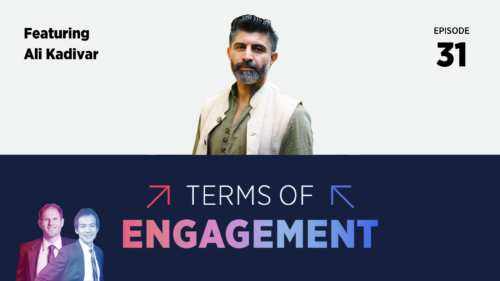
Archon Fung: Great. And so today’s topic is the war, the special military operation. I think Tom Tillis said it was a temporary situation, maybe is what he said. Whatever the thing is that’s happening in Iran. And this is not a show about military strategy or foreign policy. We’re a democracy program. So we’re going to limit this conversation. Limit. It’s still a vast. topic, but the prospects for democracy in Iran. And we have a great, great guest, Mohammad Ali Kadivar, who is a fellow at Harvard Radcliffe Institute for Advanced Studies this year.
And he’s also an associate professor of sociology at Boston University. And he studies the dynamics of social movements. He himself is Iranian. He grew up in Iran and participated in student movements in university there before leaving and doing his scholarship outside of the country. His work grows out of his experience as a participant observer of the pro-democracy movement, which is decades long, which we’ll get into. And his first book, Popular Politics and the Path to Durable Democracy, was published in two thousand twenty two by Princeton University Press. He’s published many articles. He has a Ph.D. in sociology from the University of North Carolina at Chapel Hill. Go Tar Heels. So welcome, Ali.
Ali Kadivar: Thank you for having me.
Archon Fung: Yeah, great.
Stephen Richer: I’m I’m just surprised to learn that Archon is not a military expert. He’s a man of many talents and knowledge. And so I’m disappointed that’s not one of them.
Archon Fung: Well, I love to talk to people who are military experts because war seems to be a permanent part of the human condition.
Stephen Richer: Yeah, too true. Ali, do we call ourselves Iranian or Persian? Important to get at the outset.
Ali Kadivar: It’s… I mean, they could mean the same thing or not, because Persians could just refer to one ethnic community within Iran. There are Arabs that would not identify as Persian.
Stephen Richer: Well, we really appreciate you joining us today and trying to make sense of everything that’s going on and what the future for Iran holds. And I think just to jump out of the gate, is democracy going to blossom now in Iran? Are we going to see elections in the next month?
Ali Kadivar: Probably the more accurate question to ask is that, is the autocracy going to blossom? In Iran with the war, there will be elections in Iran as elections have been before, but it’s going to be like those previous elections. Competition is controlled and it’s not free for everyone to become a candidate and to run.
Stephen Richer: So this is sort of the central thesis that you’ve been writing about lately. It’s just a lot of people like me, they see the removal of the Ayatollah in Iran. You see the removal of Maduro in Venezuela. And you’re very hopeful that this can lead to a democratic revolution and new liberties for the Iranian people, for the Venezuelans.
But you wrote in one of your recent pieces that this is why, quote, this is why the fantasy that external war will liberate societies from authoritarian rule has repeatedly proven misleading. War tends to reproduce the political conditions in which new forms of authoritarian power can arise, end quote.
So I hope I’m not putting words in your mouth by saying that you’re a bit pessimistic about what the most – what the American military intervention, I guess we’ll call it, the American military intervention will accomplish in Iran, right? Yes.
Ali Kadivar: So, yeah, I brought two possibilities. One is that the military, I mean, it’s a war. The war would lead to the collapse of the Islamic Republic, the incumbent government in Iran. And the other possibility is that they will survive this war under external assaults. And either scenario is not promising for democracy at all. In the first scenario that the government collapses, first of all, it’s unlikely that the government collapses without boots on the ground, just aerial bombardments.
They can decapitate the regime, damage infrastructure, military infrastructure, kill civilians, military personnel and so on. It does not mean that regimes or the state’s network of coercion throughout the country, police, Revolutionary Guards, Basij and all the ministries that are delivering goods and services would collapse. That would need a scenario like Iraq or Afghanistan, where America brings troops. Even if that happens, it will be highly costly, obviously more for Iranians, but also for American troops. They will have disproportionate casualties from both sides.
But what we see in this scenario over and over is that it oftentimes leads to fragmentation It damages statehood. It would increase the chance of civil war. We have seen this in Libya, in Iraq, in Afghanistan. And Iran has previous histories of armed insurgency. It’s a multi-ethnic society. Some of these ethnic groups experienced exclusion. Political science compared to politics tells us this could lead to civil war. So to have a functioning democracy, you need a functioning state first. The issue with military intervention with war is that it damages the statehood. Then when you don’t have central government, we can’t really speak of democracy. The best thing you could have is just a polyarchy of warlords, which means you wouldn’t have, that’s the best, the closest thing you can get to democracy. is that there are multiple warlords here and there. One example is Libya. Iraq is more functioning in that sense, but Iraq is also not a state when the use of violence is monopolized. You have more militias associated with different political factions, so the civil liberties are not as protected as democracy. That’s the scenario one, and I can…
Archon Fung: Yeah. I think it’s really helpful to draw out regime collapse is one scenario, regime persistence is another. Let’s talk about regime persistence. Help us understand why you think there’s a decent probability that the regime, that the bombing will harden the regime because it has decapitated the regime. The leader of the regime, Ayatollah Khamenei, is dead. His son has grown into power. But my understanding is that the regime itself is extremely unpopular in Iran itself. And so given the unpopularity of the regime itself, why do you think that persistence is a decent possibility in the timeline?
Ali Kadivar: Because popularity is not what leads to the collapse of authoritarian regimes this is not iranian regime in the past have been more popular that is for sure and now it’s the least popular in its life when we look at its inception from nineteen seventy nine but there is a difference between the regime is like we can and that the regime is at the verge of the collapse.
But what are the pillars of power of Islamic Republic or any other political regime or authoritarian regime? So we should pay attention to the origin of this regime. In my work about democracies, I make the opposite argument, that the democracies that are rooted in long-term unarmed mobilization have more solid foundation and would be more durable. The opposite is true for authoritarian regimes. This has been documented in research by Stephen Levitsky, looking away also by other work, for example, by Martin Heisenberg, which says these autocracies that are rooted in episodes of mass violent upheavals make the most resilient authoritarian regimes you have ever seen.
What are the other? I mean, Iran is clearly one example. It’s not. It’s the 1979 revolution and then eight years’ war with Iraq that ensued. So from 1979 until 1988, we have this episode of mass upheaval. Other examples are Soviet Union, China on their mouth, Algeria, Mexico and so on. So why does this matter? It creates a cohesive violent conflicts. It creates a robust repressive apparatus, Revolutionary Guards, Basij, the Ministry of Intelligence. It basically undermines and flattens other centers of power in society. And when we look at the case of Iran, it generates also a high level of pro-government mobilization. The Iranian government over the last decades, have been developing institutions and organizations of pro-government mobilization in Iran.
So, when the regime that has emerged out of these conditions, now we recreate that similar condition for it, we should expect for those mechanisms to strengthen. Yes, the idea was that Kiel, Ayatollah Khamenei and it would collapse. I think people who were familiar with the system already said this is not going to happen. The decapitation did not work at all in the direction that some of the policy makers were thinking. Their system has been working without the head because, yes, the leader has most power, but this is not a one-man rule type of system. It’s been called by other analysts as a diffuse autocracy. There is a head, but there are all these other institutions that are working under the leader, which they have kept working.
Stephen Richer: So reminder to put your questions in the chat if you have any. We appreciate your input as always. Archon, is this consistent with, I guess, one, the democracy literature generally, the position that Ali is taking, and then two, was this, like, were you immediately skeptical? Because I’ll admit some measure of hope when this first happened. And I think that if you told the average American that removing this leader who has become a larger than life figure wasn’t going to destabilize the regime there would be some maybe natural skepticism towards that, I mean understandably, so I appreciate the reasons that Ali has articulated why that wouldn’t destabilize the regime but you can understand also how somebody’s saying you know you just took out the main guy who’s been the main guy for a while and is a pretty big guy that seems like it’s going to have some change
Archon Fung: Yeah, well, certainly I didn’t shed a tear for Ayatollah Khamenei’s passing. I guess I thought I think that U.S. military intervention of this kind seldom generates or advances democracy.
But it’s interesting, Ali, you think it might harden their regime and eleven, ten days in, that seems to be the effect. I guess I kind of expected it to weaken the regime and kind of tear its head off or create the conditions for infighting. which it doesn’t seem to have done so far. And then so I expected something like Ali’s first scenario of regime collapse, but then some sort of really bad situation, civil war or internal discord afterwards that doesn’t lead to democracy. I mean, it’s early days yet, so we don’t know how this is going to play out. But I think the hardening the regime, I didn’t think about. But what you say makes sense.
You know, let’s show the clip from Donald Trump in which he’s arguing that. Well, why don’t you play the clip and then we can talk about it and see what people think.
Donald Trump (on video): Finally, to the great, proud people of Iran, I say tonight that the hour of your freedom is at hand. Stay sheltered. Don’t leave your home. It’s very dangerous outside. Bombs will be dropping everywhere. When we are finished, take over your government. It will be yours to take. This will be probably your only chance for generations. For many years, you have asked for America’s help, but you never got it. No president was willing to do what I am willing to do tonight. Now you have a president who is giving you what you want. So let’s see how you respond. America is backing you with overwhelming strength and devastating force. Now is the time to seize control of your destiny and to unleash the prosperous and glorious future that is close within your reach. This is the moment for action. Do not let it pass.
Stephen Richer: So it’s very, very complimentary towards the Iranian people. But what do you make of that? This is the moment.
Archon Fung: I think he’s sketching a whole theory, right, is you take the layer off of the regime that creates opportunities for. popular uprising and then ideally self-government. And then I guess maybe the hopeful part as a very distant observer is we did see the popular protest, large protest just a few weeks ago. So doesn’t that indicate some energy for self-government if the cap of this horribly repressive regime is taken off?
Ali Kadivar: I mean, the cap is, Yeah, I mean, was taken off or the top man was taken off. But it’s that one man was not going to the street shoot at the protesters.
Archon Fung: Yeah, there is the whole structure of the Iranian armed forces that is in place. And if you just decapitated, it doesn’t destroy the whole structure. And they have been prepared for this. I mean, how many was no, he was going to be targeted. And some of the accounts suggest that he kind of stepped into it. So they were preparing for this. I think for each position, they were at least four replacements that were thought through. And the other thing is that this system also has this discourse and institutions of martyrdom. So when you kill their personnel, they turn it into political capital.
We talked about hardening, how much that will come in Iran. Yeah. The son of Khamenei is now the leader, his chances have declined over the last two years for the obvious reason that this is hereditary, he had no public profile, and his father was increasingly unpopular among his protesters. But when Khamenei was killed, and the whole family was not just him, like Mustafa Khamenei’s, I think, wife, child, nephew, sister, mother.
Stephen Richer: Oh, wow…
Archon Fung: I didn’t know that.
Ali Kadivar: Yes, bombardment. So this has now elevated him from someone, a candidate that came with political cause, with someone with a charisma rooted in, like, now he’s the son of this leader that was killed during a war in a country, in a regime that has cultivated this discourse of martyrdom. And now he’s not a liability. It’s like bringing some credit political capital to the system. So this is one example. And even the, I mean, one robust finding in social movement studies is that when the level of repression depends on the level of threats that the protest poses to the established government or structure. And With military intervention, the level of threat is to the roof. I think people know that if they come out, well, they could be bombed by American-Israeli bombs. Also, Iranian government just showed that they’re willing to kill. They’re not just going to go away. Their survival is most important for them.
So when the cost of participation is so high, obviously people were not going to participate. And one reason they participated in such large numbers in January was that in the like ten, twelve days that led to that instance of really large participation, the repression was restrained. They were not shooting at people like they did on those last eighth and ninth of January. The government thought they could control this, but the stakes were raised by Trump intervening, Israelis saying we have operatives on the ground. If they kill the protesters, we are going to attack. And also this message from protesters and Iranian opposition figures that this is to destroy the regime and you’re just going to finish them. This all raised the level of threat. And when we think of the regime, again, this is not just one man at the top and also the armed forces.
Archon Fung: Yeah. Yeah. Ali went over this quickly, but some of the reporting is that the top people in the regime were all asked to specify individually four levels of secession down because in case of American and or Israeli attack. Right. Which is a remarkable thing. planning exercise to see your own demise and three levels.
And then also, Ali, one thing that you just said that I didn’t quite get from the public reporting is that that Khamenei’s son was not the obvious successor, that he was kind of like probably not going to be the successor. So this that’s a pretty good piece of evidence for your regime hardening case, I think.
Ali Kadivar: Yeah. So I was speaking about the social base of the region. So in the last presidential election, there were about thirteen million people that voted for Jalili, who was a hardline candidate. So this is unpopular, yes, but it also has a committed minority of thirteen million. That’s not a small population. The regime has leadership, has ideology, has organization. has the willingness and capacity to repress, but it also has a social base. Since Khamenei is killing, they have been filling the streets in Tehran and elsewhere to a level they haven’t done before. At one AM, they come out in residential streets and they chant to intimidate.
Archon Fung: Do you think Khamenei intentionally martyred himself?
Ali Kadivar: I mean, I cannot read his mind, but it was obvious that there was going to be attacks on that day. I knew it, and I’m sitting here just reading the news. And in the accounts, I read that the institution that is in charge of his safety asked him twice to go to the compound that is the lower level, but he didn’t want to go and he wanted to go in his… usual office. I can think of why, I mean, I cannot prove this obviously, because I don’t know what went in his mind, but I can think of what would have gone into his mind or in his subconscious that his political project was at an impasse.
His geopolitical strategy was in some ways collapsing. He was widely unpopular and this was a gift to give to the system. Now from unpopular leader, For his supporters, he was popular, but the image in Iranian society was an unpopular, corrupt, repressive leader. Now he’s like the martyr at the top of the states. The Islamic Republic didn’t have this before. They had martyrs, soldiers, commanders, so on, but now they have a supreme leader that has been martyred, which creates a political gain for them.
Stephen Richer: Wow. So, if American democracy-building in the 2000s was signified by the Iraq war boots on the ground, and the new Trump thesis, whether premeditated or whether by accident, is this sort of removal of the top layer and then hope that the people of the country will claim their democracy. Obviously you don’t agree with that. What would you say to the United States if they wanted to instill a more liberalized democratic Iranian regime, short of recreating the fifteen-year-plus engagement in Iraq.
Archon Fung: Right. I mean, in Afghanistan, it was twenty years to replace the Taliban with the Taliban. So this kind of goes to Sean’s kind of question a little bit is to Stephen’s like, if you could wave a magic wand and say the U.S. could be helpful to democratic forces in Iran, what would the U.S. do if you had that magic wand?
Ali Kadivar: I don’t. In general, I would say there is no shortcut to democracy for Iran and elsewhere. If I think U.S. wants to do something for democracy in Iran or somewhere else, that has to be started at home in the United States, which we have problems with. I think U.S. is also a hybrid regime. It’s a different hybrid regime than Iran, but we have anti-democratic elements within American politics.
The current war, for example, is not a popular war. A majority of Americans are not supporting this war. It is still happening. I mean, this type of thing happened in democracies, but we see over and over this has been happening. And in general, I don’t find American policies in the Middle East conducive to democratization for the, I mean, for the last few decades, at least. So I don’t think we, America can democratize the Middle East without democratizing itself first and all of the other autocratic authoritarian clients that it has in the region. We can’t be supportive of autocracy in Egypt and Saudi Arabia and then have whatever magic thing we have.
Stephen Richer: I guess let’s take the premise that America is a democracy, a premise that I think most Americans would say is in fact the case. I understand your points to the contrary. But are you saying that there is no rule, that there’s no positive? I guess I find that Yeah, I find that dismaying.
And I find it sort of fatalistic in that we just have to wait for the Iranian people to accomplish this. And in the meantime, I mean really your mass murder in Iran and of course other regimes some of which the United States is more supportive of definitely. But like is there, I guess I want to pin you down on that, is there any role for the United States in facilitating iranian liberalization
Ali Kadivar: I think yes there is but it’s not the same way that we imagine that they go and like take out one regime, install another regime. One obvious path is to just strengthen the international community, the rule of law. Yes, Iranian government has killed protesters. This is a violation of rule of law in the international system. But the US has not been upholding rule of law in the international system. You cannot violate it or exempt Israel from doing it and then try to keep the Iranian leadership accountable. That’s pretty much what has been happening. I don’t see a way of unilateral action by the United States. Democracy is based on rule of law. We understand this very well within the US. This is what we expect from American politicians to uphold rule of law here. But when it comes to the international system, we somehow then support unilateralism.
And the whole approach that is based on pressure, constraints, has not been, it has not worked in Iran. Like we talked about, Archon said he was expecting to see infighting within the system. We can look at different periods. At periods when the external threat has increased, which is basically the United States taking certain positions, or other like Iran-Iraq war, the infighting within the system has decreased. During Iran-Iraq war, when it started, there was intense infighting between the nationalists and Islamists. The Islamists used the war context to basically repress the whole civil society and purge political system. During the reform period, when Mohammad Khatami was Iran’s president, during his second term after Afghanistan war, that Iran cooperated with the U.S., George Bush put Iran as part of the axis of evil.
Then we saw that the reformists and conservatives closed rank because they were facing existential threat. Iran made the nuclear deal with the United States. And at that period, we saw open disputes between President Rouhani and Ali Khamenei. But as soon as Trump, I mean, withdraw, violated the deal and stepped out, we saw the close ranks. We never saw that kind of open in fighting between Rouhani and Khamenei. So in general, sanctions, military interventions and threats have unified the Iranian elite and the Islamic Republic, which is a repressive and autocratic regime throughout all period. But it has been most repressive under situations of existential threat. keep doing this. I mean the whole rise of the Islamic Republic goes back to the nineteen fifty-three coup when for short-term gains United States supported a coup that toppled the popular secular government of Mohammad Mosaddegh in Iran. So all of these actions which is based on pressure, whether military war or sanctions, this has backfired It has created unrest and bloodshed. It has not led to Iran taking a step towards democracy or more open governance in Iran.
Stephen Richer: Do you believe that is two months from now? You think, are we in a two months ago versus two months from now? Is Iran’s position better, the same, worse?
Archon Fung: Iran as a country or the regime? Maybe both?
Stephen Richer: I guess I would say sort of the norm. I was asking more from an individual citizen well-being.
Archon Fung: Oh, okay. So Iran as a whole, maybe.
Stephen Richer: Yeah.
Ali Kadivar: I mean, I don’t see signs of any positive. I mean, there was an acid rain on Tehran from the oil depots that Israel bombarded. in Tehran. So we’re talking about a country that is now dealing with environmental degradation already that is resulting from this war.
Stephen Richer: So how do you how do you How do you process then that you see a lot of people who are celebrating, a lot of people who believe that this is a moment, a lot of Iranians who feel like, oh my gosh, this is what we’ve been waiting for. Do you think that’s just unfounded, unrealistic optimism? And I assume you interact with some of those people. What do you say to them?
Ali Kadivar: Yeah, I understand that they think, oh, Khamenei is gone, the dictator is dead, or something good is coming. But Iraqis celebrated also when Americans arrived in Baghdad. But go talk to Iraqis now, twenty years later, about that invasion. Two out of three Iraqis think it was a terrible idea, and it was just devastation for their country. Iranians also celebrated when Mohammad Reza Shah left Iran, and when his father Reza Shah was deposed by the Allied who occupied Tehran. So yes, we do see this momentarily senses of joy and happiness.
And just looking at the Iranian history, look at the region, I do see these moments of joy. To me, it’s not reassuring that something good is going to come after. Lots of the time, this is just moments of desperation. This is just one thing they can celebrate for now until seeing what is going to happen tomorrow. So, I mean, we see a lot of celebrations like this throughout the history. No, I need to see signs that there are some social and political forces that are taking us towards something positive. And it’s about building. Yes, it’s killing the leaders now with all the AI and technology is not so difficult. But democracy emerges from building democratic institutions, having people cooperate.
When you look at the Iranian opposition, there’s a lot of infighting. The opposition is very fragmented. You do not see language of persuasion between different segments of opposition. You see language of accusation. Different factions call each other traitors. Even if the regime collapses or in like a hypothetical, magical situation, we just somehow erase Islamic Republic and all of its followers, then you don’t have a unified set of opposition. We have seen this in Egypt, in Tunisia, that even if the state stays together, when the opposition is fragmented, that could lead to democratic collapse on emergence of different forms of…
Stephen Richer: Yeah, Archon, is there any optimism you can bring to this?
Archon Fung: Well, I mean, this is a I get the optimism in a moment. I want to ask about that. But I guess what I’m learning from the conversation is that’s changing my mind and that I have to think a little bit more about is I guess my standard kind of going in position is that U.S. military action is pretty good at toppling regimes. And you saw that with the Taliban. As you say, you saw that with Saddam. etc. But what you’re saying is, at least in the Iranian case, and you know more about it than most people, fair to say, is that U.S. military action is likely to make the regime harder and strengthen it.
Or that’s one possibility, which I need to think about more because I thought, oh, yeah, probably this may succeed in removing the Islamic Republic government as it is in the IRGC, etc., The kind of hopeful part, which I want to hear you talk more about, which I think you and I agree, most, I think, social scientists agree that democracy is a longstanding internal process that requires the development of civil society and space for pluralism. And opposition and organization, which may be different from the kind of person who doesn’t who’s not a social scientist of democracy, who thinks, OK, once you take the lid off and you have one or two elections, it’ll be OK. I think most of us think, no, it’s a more organic thing. A longer deeper process and so that’s what I want to hear you talk a little bit more about is what are the the seeds of that process.
What is civil society in Iran? I just don’t know. Like what is civil society in Iran and how’s it doing and how can it do better?
Ali Kadivar: Yeah, so we have some independent worker unions such as the syndicate of Tehran bus drivers we have teachers’ associations we have retiring groups, and all of these groups have been staging different forms of protests in Iran. This is the protest usually doesn’t come to the attention of international media. But this is something that almost happens every week, every day in Iran in some different districts. People demand, have specific demands. It’s not just the fall of the regime, but improvement of work conditions, salaries, and so on.
But sometimes they also demand political things, such as teachers asked for release of imprisoned teacher, their right to have free association, or just after the massacre, the retirees had come out to ask for their unpaid pensions, but they were also saying no to the massacre. So these civil society organizations, during about two weeks of protests in late December, January, Later on, they released statements, they supported the protest, they even said they will participate and so on. After the massacre, they condemned the massacre, they condemned the authoritarian rule in Iran, but they also condemned the war and they said they do not welcome any type of military intervention.
What happens under the war conditions is that any I mean, the space for civil society was limited in Iraq, but these groups still operated. And even though their members was in prison, they released the statements, they went on protests and so on. But under war conditions, the space contracts, I mean, right now people are just sheltering in places trying to save their lives. It’s not the under the war time that you would see like flourishing of civil society or just people coming out and take action. It would be after the war, but unfortunately, post-war situations in a case like this, in the case that Islamic Republic survives, it will be a repressive era. I mean, already the post-protest was repressive. Tens of thousands in prison, people about to receive like death sentence or receive it. So we already had that condition.
Now we have this war. And after that, it would be the post-war period. Usually post-war periods are these dark periods of repression. I am sure when this war is over, civil society groups will come out, activist groups will come out. We are going to have intense debates in Iran about what to do next, about the cost of war. And yes, the fact that some Iranians favored it, some Iranians didn’t favor it. All of these also are creating more and more divisions within Iranian society. Iranian society currently, I see it as a polarized, divided society. Some groups deeply hate the government, and there are many of them, and there are also supporters of the government. They are not a majority, but they are a significant minority. So any path we have for going forward towards pluralism and democracy has to account for all of this. We cannot imagine that all of the supporters of Islam will disappear and will not. We have to think in that society how these groups have to think with each other, lead with each other.
Stephen Richer: Is this then maybe a criticism as in your writing of this notion of Iranian exceptionalism, that Iran has a different history, has a different cultural past, has a more educated population than many of its neighbors, and therefore Iran will be anomalous and it won’t follow the path of some of the places that we’ve named? do you not buy the the predicate or do you not buy any of that like do you do you accept the the predicate but then you don’t think that translates into any different outs results or you you don’t even accept the predicate?
Ali Kadivar: So any single country that you take is exceptional in some ways and share similarities with other countries nearby and elsewhere I think Iran is not an exception in that sense. I mean, I don’t think in social science we don’t have an exception to see that this country doesn’t know that a theory applies to this country, for example. I mean, yes, always there are deviant cases, cases that refute a theory. Certainly, there are particularities about Iran. But I think we can read Iranian history.
And also Iran is in the Middle East, Iran is a global South country, is an oil producing country, of course, post-revolutionary regimes. All of these provide heuristics for us to understand the dynamics within Iran. The Iranian exceptionalism argument has been recently presented is that, OK, dismiss Iraq and Afghanistan. We are not like them. There are two successful examples of regime imposition from outside. Germany and Japan, and we are going to be just like that. That’s the, I didn’t discuss that part. But yeah, some Iranians believe that since regime imposition was successful in Japan and uh Germany
Archon Fung: I think those cases are pretty distant.
Ali Kadivar: Yeah, I don’t think, this is not, I mean we can discuss what is different or similar to Iran now in like Germany and Japan. I don’t think at least in the us we don’t take this as a serious discussion Cold War, the United States was heavily invested in developing those countries versus the communists.
Archon Fung: It’s total war, right?
Ali Kadivar: Both of them were also superpowers. They had strong state institutions. They had a strong economy before the war. None of it is the case for Iran. Also, none of them had this multi-ethnic characteristic of Iranian society, previous history of armed insurgency, being next to countries like Iraq and Afghanistan, instability can spill over. So we can talk about this, but even in the Western circle, this is not brought up. No one has the illusion that no, we’re going to do like Germany.
Archon Fung: So I’m kind of reading through the chat and I wanted to part of what I’m hearing. I’m going to structure it a certain way. I don’t know if anybody in the chat would accept the structuring of what the discussion is. But so part of it is, OK, the existing regime of the Iranian Republican is so bad you guys are talking about democracy which is up here we might not be ever get there for a long time but the Iranian regime is so, so bad. You must favor eliminating that regime because whatever follows is likely very likely to be better so what do you think about that?
Ali Kadivar: I think Middle Eastern recent history or long history just tells us that there is also always the worse…
Archon Fung: Always worse.
Ali Kadivar: It can get worse. And that’s civil war and fragmentation or a different version of Islamic Republic. I’m not saying that it is going to get worse. I mean, there are signs that it could get worse. But we cannot just sit in this type of wishful thinking that because this is so bad and because we hate this so much, The next thing is going to be better. Syria with this type of, yeah, Bashar al-Assad was even, his regime was worse than Islamic Republic in some ways, even more repressive. But what ensued in Syria after two thousand and eleven was ten years of devastating civil war ending in what another form of authoritarian government is probably going to be some sort of Sunni Islamic Republic. I mean, no one has an illusion that Ahmad al-Shara is going to… I mean, even on the paper, the division of branches and power and so on is not leading Syria towards… So yeah, maybe that’s a better… Okay, ten years of civil war in Iran and then another ethno-nationalist autocratic government. Is that a better thing? I don’t think I can give a definitive answer.
Stephen Richer: Real, real quickly here what do you think this means for the United States in terms of our engagement and the duration of our engagement because if you say it’s very unlikely that we’re all of a sudden going to have a a leadership and a regime that is much more amenable to professed american values then then there’s no obvious endpoint unless the endpoint is something that would have to then be designed in military terms rather than in political or governing structure terms.
Ali Kadivar: I think, first of all, I think U.S. has to make its own Middle East policy and its own Iran policy rather than just outsourcing this to Israel. Israel is acting based on its own national income. but listen to realist analysts of American foreign policy that believe this is not in America’s national interest to go to this war with Iran. I don’t think it’s in… American national interest would have been and is to just stay on the diplomatic engagement route and to have reasonable goals about what we can do and what we cannot do with Iran. not thinking that, okay, we have the biggest military in the world and we can just use this hammer to just solve all of our problems around the world. I mean, we did have a nuclear deal with Iran. And in the last negotiations, Iran pretty much gave up on its nuclear capacities just hours before the war started.
Stephen Richer: Okay, so Archon, are we talking weeks or are we talking months here?
Archon Fung: Well, I believe the president yesterday said that the war was nearly complete. And then a journalist said, well, your secretary of defense or secretary of war, excuse me, says that it’s just beginning. And then I think the president said, well, yeah, it’s a little bit of both. So I’m not sure whether it’s nearly complete or just beginning. I guess my hope is that the president would simply declare victory in two days and leave.
I think he’s unburdened by the liberalist international US sentiment, if you break it, you lose it. I never agreed with that sentiment. I think if a toddler is playing with your grandmother’s china and he breaks two plates, You take the rest of the plates away. You don’t say, oh, glue those plates together and see what you do with these others. So I think that that would be probably, in my view, the best outcome for Iran because wars are so, so destructive and probably best for the United States because the next steps are young men and women on the ground.
Stephen Richer: So you would say the United States says: We got the Ayatollah, we maybe further damaged their nuclear weapons program, and that’s success. Time to go home?
Archon Fung: That would be my best case scenario. I don’t know. What about you, Stephen?
Stephe Richer: I don’t know. I guess I’m a little more optimistic or at least a little more hopeful. I never sort of blush at the notion of removing a truly evil person, but I haven’t thought deeply about the prospects for a future Iran and I am cowed by past American experiences and I came a political age during the Iraq and Afghanistan war, so i’m certainly sort of sensitive to that and I think the American people are similarly sensitive to that but that being said I just Gosh, I don’t know. I guess I want to believe that.
I think what would be nice is just a definition. And that’s what we asked for during the George W. Bush administration. The Obama administration is like, let’s define success.
Archon Fung: What does victory look like? Success look like?
Stephen Richer: Yeah, because we’re pretty good as Americans and certainly the American military at achieving a stated outcome if it’s a military objective. If it is to make Iran a democracy, I think a lot of people in the United States are going to be like, whoa, now, I don’t think we signed up for that. And, you know, according to what Ali’s saying, like, you better strap in because that could be a 10-, 20-, 30-year process.
Archon Fung: Yeah. Ali, what is the best case for you, especially with regard to the U.S., but also in Iran for the next, I don’t know what, two, three weeks, one month?
Ali Kadivar: I think the war just has to end. That’s just the first thing. There will be suffering after the war. With Mojtaba becoming Iran’s new supreme leader, I have very little hope. Usually when the decapitation happens, the new person comes, there would be some elite reshuffling. Sometimes it opens some space. This could have happened, but because it happened under war condition, I think it would be much less than what could have happened under just peacetime condition. I mean, I would love to see democracy, peace and prosperity in Iran. Unfortunately, right now, I just I’m having a hard time.
Archon Fung: Yeah, this is a really sobering conversation. I think it’s really valuable for Americans thinking about the war. I mean, obviously, a war is the most consequential decision a democracy can take. by a lot, I think. And so we have to deliberate about it. Seriously.
And I think there’s a strong temptation for us, certainly for me, to think this dictator or that dictator is so, so bad that eliminating them, taking them out of the game, killing them can only be positive even if you don’t achieve democracy. But then, Ali, what you’re saying is, well, there are worse things. And civil war… is oftentimes for society a worse thing even than a horribly repressive dictator who has torture dungeons and represses the political opposition and everything else. And so I think it’s incumbent upon those who wage war to think about the full range of consequences.
And I really appreciate your conversation with us to help us think through that.
Stephen Richer: Yeah, and I’ll echo that. So thank you, Ali, very much for spending your time with us today. Ali is a prolific Substacker. And so you can search his name on Substack and you can come across some of his work. I assume you’ll continue to be writing as events unfold. And I suspect that as with Venezuela, we will have the opportunity to talk about this again in future months. And hopefully you’ll be very surprised in a positive way.
All right. Well, thank you all very much for being here today. And thanks for the production team, as always, that makes this happen. We’ll be back next Tuesday at noon Eastern time, as always. And if you have any suggestions, questions, comments, recommendations, then you can email them to us. We’ll put the email down there, info at ash.harvard.edu. And Archon, take us home.
Archon Fung: Thank you very much, everyone. And we look forward to talking with you next week as the next week is sure to bring many new questions in the democracy picture here and around the world. Thanks, everyone. Have a great week.