Archon Fung:
Hey, everyone. Welcome to Terms of Engagement, episode 31. My name’s Archon Fung. I’m a faculty member at the Harvard Kennedy School and director of the Ash Center for Democratic Governance and Innovation.
Stephen Richer:
And I’m Stephen Richer. I’m the former elected Maricopa County recorder, and I’m now a senior fellow at the Ash Center, and happy St. Patrick’s Day, and happy also primary election day in Illinois-
Archon Fung:
in Illinois.
Stephen Richer:
… which is an interesting concurrence because Illinois in Chicago is one of the biggest St. Patrick’s Day festivals, maybe the biggest, maybe Boston and Chicago, I would imagine, and they die the river green, and I guess all that’s going to be going on and people are going to be drinking while going to the polls, I suppose.
Archon Fung:
Which is an old tradition in the United States, especially in the 19th century. So bring it back.
Stephen Richer:
Yeah. So hopefully we’ll see some good photos online from people casting a ballot and then grabbing a stein of beer or something like that.
Archon Fung:
Or the order might be reversed. We’ll see. Yeah. All right, so-
Stephen Richer:
Interestingly, is there any state at which… So for instance, you can nullify a contract if it was made in a state of inebriation. Can you go contest somebody’s vote and be like, “Surely they’re too drunk to be casting a ballot right now. This invalidates their votes on that now-”
Archon Fung:
Challenge a vote because… Yeah. Maybe it’s a kind of citizens challenge or poll worker challenge. Or I suppose it could endanger some poll workers depending on if somebody was inebriated.
Stephen Richer:
Well, we wish them a safe and secure election as always.
Archon Fung:
As always.
Stephen Richer:
Anyhow, to the topic at hand.
Archon Fung: Yeah. So just the usual caveat, Steve and I are talking as individuals, not on behalf of Harvard University or the Harvard Kennedy School. And we are live, so please type in your chat, comments in the chat, and we’ll try to get to as many questions and comments as we can.
Sunday was Oscars night, Stephen. In the pre-show, you said you watched a little bit of it and-
Stephen Richer:
A little bit. Yeah.
Archon Fung:
… you must have been thrilled when Anne Hathaway and Anna Wintour showed up to present the Best Costume Award, being the diehard Devil Wears Prada fan that you are.
Stephen Richer:
Yeah, absolutely thrilled. I don’t know if they do midnight releases still. I remember growing up, that was a thing. But if they do a midnight showing for the Devil Wears Prada 2, I’ll be there. Was very excited, and hats off, pun intended, to Anna Wintour for sort of embracing the self-censure, the poking fun at yourself a little bit. I did watch it. I was rooting, as I mentioned, for F1. That was probably my favorite movie of the year. And then I was rooting for Golden from KPop Demon Hunters for Best Song of the Year.
Archon Fung:
Yeah. Great. Great. And I think both Anna Wintour and Anne Hathaway, their dresses were amazing, as appropriate. I’m glad that One Battle After Another won. It wasn’t a huge surprise, but I liked the movie. And here’s a still from the film to bring a little bit of joy to your day, if we could show the picture. That’s Leonardo DiCaprio and Benicio del Toro wishing you a very happy day.
Stephen Richer:
So I get often a lot of comments on social media about my hair, or lack thereof, and I feel like if Leonardo can get away with that type of hair in that still, then ease off a bit, people, okay?
Archon Fung:
That’s right. And a bathrobe. He’s wearing a bathrobe. Great. So today’s topic is not the Oscars, but rather media and government and what that means for democracy and how the relationship is changing and whether it’s changing.
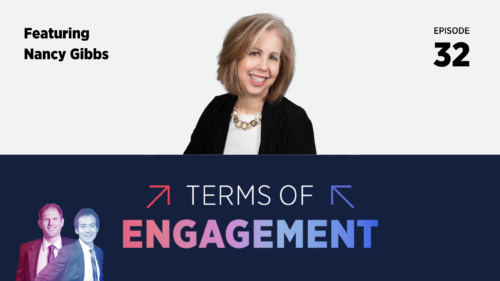
We have a fantastic person to help us understand those huge questions today, my friend and colleague, Nancy Gibbs, who is the director of the Shorenstein Center and the Edward R. Murrow Professor of the Practice of Press, Politics, and Public Policy. Her research and teaching explores many, many aspects of the changing media environment, economic, social, political, and of course, technological. Until 2018, she was the editor in chief of TIME magazine, TIME, just TIME; they do a lot of things. She was the first woman to hold that position, and during her three decades of time, she covered four presidential campaigns, and she’s co-author of two bestselling presidential histories. She holds a BA in Yale and a degree in philosophy and politics from Oxford, where she was a Marshall Scholar. Welcome, Nancy.
Nancy Gibbs:
Nice to be with you guys.
Archon Fung:
Great.
Stephen Richer: Marshall Scholars, for those of you who don’t know, was one of the many things that I applied for that I didn’t get, and so be very impressed with Nancy.
Archon Fung:
Nancy is very impressive. No doubt about it.
Stephen Richer: And we’re excited to have her here and we’re excited to welcome your comments too and work them into the show, so a reminder to post your comments in the chat box.
Archon Fung:
Great, great. Okay. So in just the last week, we’ve seen a remarkable number of high officials in the Trump administration remark on their perceptions of media bias and what they’re going to do about it. Secretary Hegseth on criticism of war reporting said he looks forward to David Ellison’s control of CNN when Skydance acquires it, presumably because CNN may offer more favorable reporting.
And if we could show the second slide, this is from President Trump’s Truth Social account from last week, just about three or four days ago, that shows his post about how his efforts to control the media are succeeding. And on the top panel there, the top third, is operations that he considers gone, such as defunding of PBS and NPR and the Colbert Show and Lester Holt on NBC, et cetera, and then he looks at some reformed organizations, like X and Disney and CNN, which presumably have gotten rid of a bunch of their woke coverage.
And then also last week, Brendan Carr on his social media posts about the media bias that he perceives and how the law requires reporting and coverage in the public interest, and so if you could show the third slide…
Stephen Richer: So I’ll say, in President Trump’s defense, he says reshaping, not controlling, in that post-
Archon Fung:
Reshaping.
Stephen Richer: Reshaping. I don’t know if there’s nuance there.
Archon Fung:
Yeah. Absolutely. And so Chairman Carr says, “Broadcasters that are running hoaxes and news distortions, also known as fake news, have a chance now to course-correct before their license renewals come up. The law is clear. Broadcasters must operate in the public interests, and they will lose their licenses if they do not.” I think what’s novel about this is Chairman Carr’s pretty distinct and fixed view of what public interest coverage requires.
And so we’ll talk about a lot of things in this show. I think one question, big question for me is whether this is actually new. I’ve been a long-term, decades-long critic of the media, and I think it’s always been too friendly to government and the status quo. Nancy, you’ve been working in news at the highest levels for a long time. In the course of your career as a journalist and editor, a manager of journalists, you’ve encountered many administrations who do not like what you do, who think that news media are hostile and unfair and try to get you to change the way that you cover them. This feels like basically what the Trump administration is trying to do. So kind of an opening question, do you feel like it’s any different, or basically the same? And if it is different, what’s different about it?
Stephen Richer: Is it just more honest?
Archon Fung:
Yeah, right.
Stephen Richer:
Because of the system?
Archon Fung:
Yeah. Maybe that’s it.
Nancy Gibbs:
That’s a great way to put it. Over the years, I’ve interviewed five American presidents, and I wouldn’t have said any of them viewed the press as particularly friendly or an extension of their administrations. Yeah, there’s always a tension. In fact, the Obama White House was famous for being pretty aggressive in leak investigations. But I think there is a crucial difference with this administration, and it’s actually something of a paradox. On the one hand, Donald Trump is a creature of media. He has an extraordinary understanding of the new attention space. And in fact, during the 2016 primaries, when he would be traveling from state to state, on the plane he would flick between cable networks. And he said to one of our reporters, he said, “Look at this. It is all Trump all the time. This is what the other candidates don’t understand. It’s not the polls that matter. It’s the ratings.” And this concept, which we then heard him manifest many times, “I could shoot someone on Fifth Avenue and not lose any voters,” this idea that there’s no such thing as bad publicity, that is very different.
And so on the one hand, he is amazingly attuned to traditional media. I’ve certainly felt that as the editor of TIME when he would let me know in no uncertain terms what he thought about our coverage, but we’ve seen just in the last couple of weeks of him dialing up reporters from the most hardcore mainstream news outlets sort of testing different messages about the rationale for the Iran excursion, as he’s calling it. So he’s very, very attuned to traditional media. In some ways, he’s a creature very much of sort of 1980s media. And at the same time, he has been extraordinarily successful in navigating the landscape of new media, of independent media, of news influencers, of podcasters, and of the attention economy. And so I’m fascinated by the fact that both of those two things coexist in the same, almost 80-year-old figure.
Archon Fung:
Yeah. So his adeptness is, I think, terrific from a small D democratic perspective. If you’re good at media and good at getting the messages out, then more power to you. It’s the controlling aspect that I’m more concerned about. And maybe we should be concerned about both aspects, but I guess-
Stephen Richer:
But on the small D democratic side, I think it was Kaitlan Collins or someone from CNN who said he’s the most accessible president ever. And so acknowledging that component, but then, of course, turning to the second half of Archon’s statement, which is there a control component, or… And I guess-
Archon Fung:
Oh, is there even? Good. Yeah.
Stephen Richer:
I would add to that is, is it okay for a president to say what he thinks of the news media, or is that in and of itself exerting undue pressure that is democratically problematic? Or is it only actions like FCC Chairman Carr’s where it’s like, “We’re going to regulate you into non-existence if you don’t shape up”?
Archon Fung:
Yeah. And just one more thought on that, if you could, if you were managing TIME or the people that you’re talking to in media, are they more concerned about the first or the second? Are they more concerned about the president’s Truth Social posts and calls that they get? Are they more concerned about regulation, like Brendan Carr?
Nancy Gibbs:
Well, so the tricky thing about what we’ve been seeing from Brendan Carr, that fortunately was one worry I didn’t have. The FCC only regulates broadcast media, so TV, radio stations that use the public airwaves. And the rationale for that was that that is a scarce public good, and so that it was appropriate for a government if you’re licensing the spectrum, which is a very valuable thing, to require certain public interest value in return. And so that’s what you were seeing in the tweet that you showed from Brendan Carr. That does not apply to print, newspapers, satellite radio, cable television, streaming services-
Archon Fung:
Social media. Yeah.
Nancy Gibbs:
And so, in fact, his regulatory power directly is over a much smaller swath of the news and information landscape than it was back in decades past. And so that has a really fascinating result of the nature of the threat and the intimidation. So he raises the challenge to Stephen Colbert about equal time, and the CBS lawyers get squirrely about this, and so famously Colbert cancels his broadcast of his interview with James Talarico, the Senate candidate from Texas. But one, by Colbert calling attention to the pressure from the FCC, it drew enormous amount of attention to the issue of what this administration was doing regarding the press, and then by posting the interview on YouTube, it got way, way, way bigger audience than it ever would have on his show. So that’s kind of classic Streisand effect.
And so these dynamics between what it’s possible to control and what it’s not possible to control in this environment, it’s not that the regulatory tools aren’t really important. It’s very expensive if a station is going to have to be in litigation with the FCC if owners who are looking to conclude a merger, which we’re seeing a lot in the media space, are worried that an administration is going to give them heartburn in that process.
So it’s not that the regulatory and the control tools aren’t significant, but in this information environment, using them can have a lot of unintended consequences.
Archon Fung:
Yeah, good. Well, on Stephen’s question, do you consider President Trump’s jawboning reporters and media owners, and then also the Truth Social slide about reshaping the media, do you consider that attempts to control that should be out of bounds, or is it just like fair play and the give and take between politicians and reporters and journalists in a democracy?
Stephen Richer:
Not like, “Nancy, we’re not going to let TIME merge or acquire something. We’re going to regulate that,” but just, “Nancy, I think your coverage stinks, and I think it’s woke nonsense-”
Archon Fung:
Failing legacy media.
Stephen Richer:
Yeah. And you have no viewers or readers.
Nancy Gibbs:
The president has free speech rights too, so I have no issue as a matter of democratic responsibility of him saying the coverage that he likes and doesn’t like. I think it is interesting the conversation that you at the Ash Center, I’m sure, are hearing about, are there kinds of speech that are potentially anti-democratic, like for an elected official to say that an election was stolen? And there are countries that have pretty robust free speech traditions that outlaw certain kinds of speech that is related to coverage, that is related to how politics is written about and broadcast about. I think that is different. I think a president saying that an election was stolen without being able to provide evidence of that, that potentially has a different democratic valence and potentially could have a different legal valence, as it does in some countries. But I would distinguish that, Stephen, from your point about just talking about the coverage he likes and doesn’t like.
He was very, as with all things, no thought goes unspoken. He told Lesley Stahl after he won in 2016 about fake news, fake news, fake news. He said, “You know why I do it? I do it to discredit you all and demean you all so that when you write negative stories about me, no one will believe you.”
Stephen Richer:
Has that worked?
Nancy Gibbs:
Well, if you went only by a kind of Gallup declining trust in media, that is largely when you disaggregate that number, which has been declining for 40 years, so it didn’t start in 2016, the fall-off has been far more dramatic among Republicans than among Democrats. When you dissect the trust in media collapse even further, you also find that it’s actually… Most people trust the media that they consume. They don’t trust the media that you consume. And so it’s similar to people hate Congress, but incumbent law-
Stephen Richer:
They like their congressmen. Yeah.
Nancy Gibbs:
… get reelected, right? So we see lots of versions of that. And so I’m always a little wary about what works or doesn’t work in terms of trust in media. People trust the media that they engage with directly.
Archon Fung:
Yeah. That’s good. As always, we have a very lively chat. A bunch of the political spectrum is represented. I want to kind of push on you from Brendan Carr’s perspective. In the last part of his tweet, he says that one of the things he’s doing, I think, pretty much, is trying to counterbalance the woke media that are left journalists, many of them coastal, and we know that that media model or that media set of perspectives isn’t working because, as you said, the decline of trust, the decline of viewership. And so what do you think about the case that what the president and Brendan Carr and some other people are doing is acting to correct a big set of biases in reporting and perspective in the media?
Stephen Richer:
Yeah. So, I mean, I’ll just say that I’m a little bit sympathetic to that. I know that we framed in the email that we sent out for this program, the Washington Post has been purchased by somebody who’s sympathetic to the president, and now the editorial board is producing editorials that are more sympathetic to the president. Well, what about just the Washington Post has a diversity of thought, or it has some more right or center thinkers? How do we parse that, I guess, between what we would say as an outlet’s ability to course-correct or even shift political positions versus becoming an arm of the administration?
Archon Fung:
Yeah.
Nancy Gibbs:
So these are really good and important and long-standing questions. Charges of media bias have been with us forever. In fact, I think one of the reasons why, going back a hundred years, people on the right tended to be more effective at using alternative forms of communication and being really entrepreneurial around messaging was because famously, stereotypically, the press, Hollywood, the Academy were so left-leaning that they needed to figure out the workarounds, and that could be pamphlets in the 1920s or direct mail in the 1980s or talk radio in the 1990s. There’s a long tradition of figuring out very effective ways to work around this feeling of a mainstream media that is stacked against the interests of conservatives. And I’m reluctant to use that language because it’s hard to know what anything means anymore, what counts as a conservative, but just broadly speaking of the right.
I think that there are ways that bias has long been manifest. It’s easy to look at the composition of our biggest newsrooms and see a disproportionate number of Harvard graduates, of highly educated people who live in cities on the coasts who are less likely to be regular attendees at religious services of any kind, less likely to have military experience, less likely to have ever been on public assistance, grown up in rural areas, pick your identity, that it is a more homogeneous kind of cohort. And so there’s a natural assumption that that therefore is a driver of this kind of bias.
I think one place where you see bias isn’t so much in how stories are covered, as in which stories are covered. And one of the best examples of this was probably the way immigration and the border was covered in advance of the 2024 election, where there was far less coverage of the sheer scale of illegal immigration that was happening, the number of people crossing the border illegally if you were watching MSNBC than if you were watching Fox. If you were watching Fox, that was every night. If you were watching MSNBC, you very rarely read anything about that, which you could argue had extremely negative effects for Democrats who I think greatly underestimated how important an issue that was for voters. And so arguably there, if that represented mainstream media bias in what they chose to cover and not cover, was not something that necessarily ended up benefiting Democratic candidates versus Republican candidates.
So, again, all of these things tend to be really complicated, but one of the reasons why I have my students rotate in their media diets, and if you’re watching CNN or the BBC tonight, then tomorrow night you’re watching One America News or Al Jazeera, and the next night you’re watching Fox or Newsmax, it’s not just how are they talking about Iran, how are they talking about oil prices, but what are they even addressing at all? And I think this is the hardest thing for people trying to communicate effectively now is there is no Walter Cronkite in the 21st century. There is no ability for a single trusted figure, whether at a network or on a podcast or at a newspaper, to be able to lay out information and analyze a situation, and then the public could debate it, could agree or disagree, but everyone basically had the same baseline set of facts. We don’t have that anymore, given this incredibly atomized, splintered information environment.
So what fascinates me is when things break through. The president’s reaction to Rob Reiner’s murder clearly broke through. The demolition of the East Wing clearly broke through. Alex Pretti’s shooting, the video of Alex Pretti’s shooting in Minneapolis broke through. I haven’t seen the metrics yet, but it’s easy to imagine that the jump in gas prices has broken through, partly because that’s a story that is literally advertised on every street corner, but all of which is to say that bias… I think everyone benefits from way greater diversity of sources and viewpoints. That’s what makes us smarter. Reading someone who disagrees with you and thinking, “Oh, I think that person’s wrong, but I don’t know how I would answer that,” that’s when you realize you haven’t really figured out why you believe what you believe about something.
Stephen Richer:
So I’m impressed that your students jump from Newsmax to Al Jazeera to the BBC-
Archon Fung:
She makes them do it. That’s part of the-
Stephen Richer:
But it’s still impressive that-
Archon Fung:
Oh, but that you can do it. Yeah.
Stephen Richer:
Susan shares your sentiment in the chat regarding Walter Cronkite. Sort of picking up off of that MSNBC, MS NOW example in George’s question in the chat, to what extent can MSNBC say, “Well, it was our editorial discretion to not cover the wall as much or not cover the border crossings as much in 2024 because we thought we had told that story, and quite frankly, we’re a private organization,” which to Frank’s point, “We have a business to run and we’re making a business decision and moving forward”? Is that a professional breach of ethics, a professional moral failing to choose what to, in that sense, to choose not to cover it as much?
Nancy Gibbs:
So, one, you’re entirely right. It’s their right to decide what they cover, just as it’s any news organization’s right to decide what they cover. And it’s the right of the audience to determine whether they think that their interests are being well-served. And so if, for instance, people felt during the pandemic that they determined at some point that their regular news sources were not providing them information that they really needed, then they go looking for other news sources. So both sides of the transaction, what do we show, what do we watch, have agency, right? So in that sense, I think MS NOW has the right to decide what they’re going to cover.
Your point about the breach of ethics is a really interesting one. If that decision is being made based on, I think, an ideological preference where we want to help this side win and this side lose, and therefore we’re going to choose stories that are going to help our side and not cover stories that might help the other side or cover stories in a way designed to help the other side, that’s easy for me to say is a breach of the ethics if your job as a news organization is to make your best effort to provide people information that they need to know to live successful, productive lives.
But the flip side of that, think right now; if you were the programmer of ABC World News Tonight, if you were the executive producer, and you have a war in Iran; you have the extraordinary economic disruptions domestically and globally; you have the ongoing, astonishing revelations week by week from the Epstein files investigation; you have unprecedented questions about who is benefiting, what investors, what countries, from these events, you can be a good faith, trying to prioritize, use your news judgment, and still really struggle to know how much time in my 23 minutes do I allocate to each of those stories? So those are two different things.
Stephen Richer:
Archon and I have this discussion every single week. There’s no shortage of things to talk about. There’s no shortage of major world events, major events pertaining to democracy, and it sometimes is challenging to choose one.
Archon Fung:
We can only pick one. So I want to make a distinction. I think absolutely, I agree, it’s within the rights of an editor and news organizations to pick what they’re going to cover, but I guess I think ethically, democracy doesn’t work unless people in the news business try hard to do what you just said, Nancy, to try hard to use their resources and their capacities to tell the stories that are important for Americans to figure out what’s going on so that they can do their job as citizens. And so if they’re making decisions in order to pump up one side rather than the other, I think that’s unethical. If they’re making, and now I want to move to the billionaire part of the discussion, if they’re making coverage decisions in order to advantage one part of the business rather than… or just advantage the business, regardless of whether or not it’s good for Americans’ understanding, I regard that as an ethical lapse because we need the news to be better for democracy’s sake.
And so I wanted to tee up the billionaire question this way for you, Nancy, is I think that major news organizations have been owned and operated by very, very wealthy people for a very long time, beginning with William Randolph Hearst and moving forward, and I have this romantic idea that we benefited in the 20th century from owners who really cared about the news in owners of the families that owned the Washington Post or the New York Times or others, or the Chicago Tribune. They had a commitment and they didn’t need to make as much money as they possibly could from those news operations. And now I feel like something has changed in which the business prerogatives are more important in the coverage. But do you think that’s right or wrong? Is my view too romantic or too critical of the present? What do you think?
Nancy Gibbs:
I think your view is pretty romantic. I think it’s very much case by case. Obviously the case I know best was Henry Luce, who founded an enormous media empire basically right out of college. And on the one hand, Henry Luce, as you say, definitely cared about the news, was a deeply curious person. On the other hand, he was a pretty staunch Presbyterian Republican to the point that Joe Kennedy was not in the hall when his son gave his acceptance speech in 1960. He was sitting with Henry Luce watching it because he understood how valuable it would be to bring Henry, if not on side, then at least not have him be rooting too hard for Richard Nixon.
I’m not sure that we have seen something fundamentally different in human nature or the behavior of wealthy media barons. I do think that the environment in which they are operating is dramatically different, where the Chandlers and the Sulzbergers and the Luces and the Paleys of the 20th century in some ways were way more powerful. Their dominance, the dominance of their institutions over the media environment, the power of gatekeepers in that environment when there were basically three broadcast networks and two news magazines and a handful of major newspapers were enormously powerful. I think now the power… The thing I worry about is less whether the Ellisons own both CBS and CNN, although I understand why that’s important, but realize that the total viewership of CNN in primetime is a tiny fraction of the audience of some of the most influential voices on podcasts and Substacks and TikTok and YouTube, especially YouTube, which is now dramatically more powerful.
So the thing, I think, to pay attention to is not the owners, it’s the algorithms. And so Nature just published a story last month about how after Elon Musk took over Twitter, how measuring how much the For You feed started to feed much more conservative content. If you were getting a chronological feed, it didn’t change, but if you were getting an algorithmic feed, it absolutely increased the amount of conservative information that you were seeing. If on any given day, the owners, which now include the Ellisons in the case of TikTok or of YouTube or Mark Zuckerberg with Instagram, certainly, and Facebook, decided to put a thumb on the scale through the algorithm of what voices get amplified, what voices get suppressed, now you really have a much more consequential intervention, which would be invisible compared to the fireworks that we’re seeing around Paramount Skydance, Netflix-Warner Brothers, or any of these other major public battles over ownership. We don’t see how the algorithms are being engineered, but if you really wanted to change what people are able to find out, that’s where the intervention would be consequential.
Stephen Richer: So I want to get to the morals of that social media, I think manipulation would be sort of a pejorative way of putting it, but before we get to there, so you say that the Luces were doing this 30 years ago, 50 years ago actually, and you say that traditional media, CNN is now not what it used to be and that YouTube is much more important potentially. And so is all the hand-wringing overblown? Are we worrying more than we should? Is the freakout that I see from many of my friends at The Bulwark or something like that over the FCC statements, over the purchase of CNN, is this not as big of a deal as some people are making out to be?
Nancy Gibbs:
No, I don’t think it’s overblown but, and you’re going to hate this, but it’s complicated. And here’s what I think is really tricky. A healthy information environment still needs people who go out and find stuff out. We need people who are on the ground covering what is happening in Iran or in Ukraine or in Lebanon right now. You need people who are filing the FOIA requests and digging into the data sets coming out of different agencies of government. You need people who have the time and the resources, and in some cases, the security infrastructure, the legal infrastructure, the research infrastructure to go find things out. And increasingly, those resources to actually do that primary reporting are more and more concentrated in a handful of newsrooms and a handful of nonprofits like ProPublica. But the rest of this information environment sits on top of them doing that work. Every podcaster and Substacker who is commenting on the rationale for Iran and what an end game would look like is depending on-
Stephen Richer:
Gets their news from…
Nancy Gibbs:
…that are providing the information in the first place, right? You can’t have an opinion unless you have something to anchor it in.
And so think of this as like a flywheel, where you’ve got this shrinking group of robust news organizations that are still trying to do the reporting and sending that reporting out, and then more and more and more creators of content in all sorts of forms are depending on that. The attention and the revenue is going to those creators, but the costs and the risks still sit in the newsrooms. And that’s the dynamic that concerns me from the point of view of a healthy democracy. We have never been inclined in this country to like the idea of public media too much. I mean, we’ve just obviously defunded public media, but even before, we have never had anything like as fully funded a public media environment that was sort of somewhat walled off from these business and economic pressures as some other countries have.
So we are really depending on those remaining newsrooms that have the resources to send reporters out into the field to do the reporting for the whole rest of the information system to operate, and the revenue models, unless you’re the New York Times… And remember, the New York Times is only succeeding because they became a lifestyle brand very successfully with games, recipes, Wirecutter recommendations, and the athletic to subsidize the fact that they have reporters in the field who are not a profitable… In fact, that’s an expense.
Stephen Richer:
And you’re worried that those few outlets are increasingly controlled by just a few people who might be in it for political reasons or might be manipulated by political forces.
Archon Fung:
Or yeah, and then also economic pressures, right?
Nancy Gibbs:
Right. So that’s what concerns me when you see one of these news organizations, whether it’s a sort of legendary newsroom… I mean, I’m the Edward R. Murrow Professor. CBS News and its history, the Washington Post and its history, CNN… And CNN became very much a household name during the first Gulf War in 1991, where it’s like, “Oh, there’s Peter Arnett in Baghdad as bombs are falling.” What worries me with Paramount Skydance as much as anything, before you get to the ideological possible influence, is just they’re going to have a massive debt coming out of this deal. And so the obvious thing is to merge CNN and CBS and dramatically cut back on the costs, and those costs are pretty directly connected to the ability to go out and gather the news in the first place.
Stephen Richer:
So your concern isn’t the politics, per se. It’s just fewer reporters.
Archon Fung:Yeah, fewer news getting generated, and then maybe the opening of our little show here put the kind of eye on the wrong place, as we were focusing on the opinion level… And, Nancy, I think the picture that’s emerging from what you’re saying here, which is really illuminating, is at the opinion level, that’s just much harder to nail down in any particular dimension than it’s ever been because there’s so much of it. And as Clinton said, maybe it’s a little like nailing, Bill Clinton, like trying to nail Jello to the wall, which may be what Brendan Carr and President Trump are trying to do with their Truth Social tweets.
But then also you said, “Look, if you really wanted to shift public opinion, the opinion news sphere, you’d pay attention to the algorithms, not to these particular stories that are visible.” And I feel like maybe some months ago there was more attention to the algorithms, particularly with Elon Musk at X, but then before that in the Facebook algorithms and Mark Zuckerberg’s kind of effort to open things up or be less content-restrictive, but we’ve heard less about the algorithm tweaking, manipulation, opening, whatever your word is than a few months ago, so maybe that discussion will be coming back as we’re trying to figure out which way the opinion sphere is going.
Nancy Gibbs:
I mean, this is where the… I’m very interested in some of these court cases that are working their way through the system that are addressing… In these cases, it’s about the harms of social media on adolescents, right? But they’re not focused on the content. I feel like that ship has sailed. Content moderation is not terribly effective. The focus is on the design. And once you get into the design question, now there’s a vulnerability that even Section 230 doesn’t necessarily protect the platforms from. And so I think we’re going to see some really, really interesting potential tectonic shifts depending on how some of these court cases unfold.
To me, it will not shock you to know as someone who, in trying to manage the budget of a global newsroom, the fact that I needed to have lawyers and fact-checkers and copy editors and all of this infrastructure, because I was legally liable, not just morally and ethically liable to try to get it right, but I was legally liable for it, whereas Facebook and the platforms have a liability shield, to me, I completely understand why Mark Zuckerberg can’t be responsible for what three billion people post at any given time. But the minute an algorithm chooses to amplify something, that to me is an editorial decision. You are now monetizing a piece of content that you think is going to drive engagement. And to me, that it seems like a very obvious case for some legal responsibility to enter into the mix. It’s like, “Okay, go ahead. You can design an algorithm to promote certain kinds of content, but if that content is harmful, and millions of people saw it who would not have otherwise, now there should be some culpability.”
Stephen Richer:
I like that. I like that distinction between being liable for anything anyone says on your platform, can’t do that-
Archon Fung:
Can’t do that.
Stephen Richer: … versus being liable for the algorithm that you created leading to tortious harm.
Nancy Gibbs:
Right.
Archon Fung:
Yeah. And so for some people listening might not know what Nancy’s talking about when she says 230. 230 is Section 230, I think of the Communications Decency Act, which way, way, way back when was a liability shield for what becomes social media companies because the thought was if people could sue them for libelous damage, then those companies would never, ever even get off the ground and society would benefit a lot from them getting off the ground. They’re no longer the small operations that Section 230 was meant to protect. And as Nancy and Stephen, the little exchange, it’s probably worth thinking through what sorts of liability and responsibility are appropriate now, and that number is probably not zero.
Stephen Richer:
So if Archon writes an article for the Boston Globe that defames me, I can sue both Archon and the Boston Globe. If Archon posts to Facebook and defames me, I would probably only have action against Archon in that instance, assuming he made it under his real name and a whole bunch of other things.
Nancy, we’re running short on time, but I’m going to ask you a question that’s kind of a bigger question. Hopefully that’s okay. Do you have any red lines for the president’s interference with media?
Archon Fung:
Oh, interesting. Because we have those red lines thinking about elections, for sure, and some of them have been crossed. But on media, great question.
Stephen Richer:
So just as we come upon the midterm elections, it sounds like nothing so far has been like, “Oh my gosh, we need to pull out all the stops because this is fundamentally breaking news journalism.” Do you have any of those?
Nancy Gibbs:
Sure. He announces he’s nationalizing the New York Times.
Stephen Richer:
Okay.
Archon Fung:
Yeah. Okay.
Nancy Gibbs:
Arresting journalists and putting them in jail preemptively as national security threats. Red line.
Archon Fung:
Yeah. Okay. That’s more imaginable than nationalism, but maybe I’m just failing in my imagination.
Nancy Gibbs:
How dark do you want to go? I mean, we know what true authoritarianism does to a free press. There are journalists who have been killed all over the world for reporting stories that regimes did not like. So it isn’t a matter of messing around with their ownership structure. It’s a matter of messing around with whether they are alive the next day. So this is not to in any way diminish the very reasonable concerns about everything that Donald Trump… I mean, to be fair, in that poster of the things he’s taking credit for, many of those changes were either happening anyway or would’ve happened, but it is definitely true that we are seeing the chilling effect.
On the other hand, I just judged… We do a major journalism award every year, the Goldsmith Awards, and we’re judging that a couple weeks ago, and the kind of hardcore accountability reporting of weeks or months of investment of time and resources into finding things out that are in the public interest that need to be revealed, whether it’s about how nursing homes are being run or how lead paint is or is not being safely removed from schools or… I mean, you name it-
Stephen Richer:
It’s still happening, right?
Nancy Gibbs:
It’s still happening. And it’s not just happening at the big newsrooms. It’s happening in newsrooms that have like two-and-a-half full-time employees who are still finding a way to really do that critical pillar of a free society and a strong society of holding powerful people to account. Is it hard? Sure. On the other hand, you don’t have to own a newspaper or a broadcast license or a movie studio in order to reach hundreds of thousands or millions of people. And so there are people who are subject area experts who have built up tremendous audiences on these platforms because they use their expertise to explain how things work and give people a kind of information that people are trusting even more than they are trusting, in many cases, what was coming from traditional news sources.
And so this terrain is changing really quickly. A lot of the kind of conventional ways of measuring and weighing apply less and less. And I think this is the reason a huge area of research for us at Shorenstein is on independent media on the one hand and on the audience. Not just the source of the information, but the demand for it. How are people deciding where to go? If they want to find out about the election or they want to find out about their school district’s new vaccination rules or they want to find out where they can go to get job training, how are they doing that? And when they go looking for information, what are they encountering, and what are they deciding is worth paying attention to or not? There’s so little we aren’t able to see because of how little information the platforms share, and yet those are the questions that I think if we really want to understand what’s going to help build a stronger society and a healthier democracy, we have to have the ability to understand not just where’s the information coming from, but who’s looking for it and what are they finding?
Archon Fung:
Yeah.
Stephen Richer:
We don’t always end on an optimistic note, so I appreciate you highlighting that a lot of that very serious, very in-depth journalism is happening still at national news media outlets, as well as many local, small news media outlets. And so I guess I’m supposed to put in a plug at this point to subscribe to a broad range of news outlets-
Archon Fung:
Broaden your media diet.
Stephen Richer:
… local and national and international, of different political stripes, of different topics. So do it all.
Archon Fung:
Yeah. And I mean, Nancy, part of your, I think, optimism is this is the best moment in history to do that. There’s more diverse sources and perspectives that are easily available than ever before. And then, like you say, it’s complicated. We do have to be very attentive to these economic forces, either shrinking the capacity of news organizations and firing journalists or pressure for business decisions and then governmental pressure on the other hand, but it is kind of a half-empty, half-full thing. Fortunately the American news, information, media, social media ecosystem is very, very diverse, which hopefully that will be a source of robustness for the information environment that democracy really needs.
Nancy Gibbs:
Right.
Stephen Richer:
There’s a few questions in the chat that we won’t be able to get to, but we do appreciate them. Virginia asked, for instance, about the disappearance of local newspapers, which is a whole topic in and of itself that I’m sure Nancy could talk about for a while.
Nancy Gibbs:
Let me just say one thing about that is think about your local newspaper as civic infrastructure. If you donate to your volunteer fire department, because you wouldn’t want to live in a town without a volunteer fire department, subscribe to your local paper, because you don’t want to live in a town without a local news source.
Stephen Richer:
Yeah. All right. Well, thank you all for being here. Again, Nancy is the former managing editor of TIME magazine, and she is now the director of the Shorenstein Center. Archon and I really appreciate Nancy being here, and we always appreciate all of our guests who are here. We will see you back next week, same time, noon Eastern on Tuesday. I’m sure we’ll have something else that will be very significant that will have unfolded in the intervening week, and so we look forward to discussing it with you. As always, you can write in at info@ash.harvard.edu with any questions, comments, or suggestions. And thank you very much, and thank you again, Nancy.
Nancy Gibbs:
Thank you, Stephen.