Erica Chenoweth and Matthew Cebul analyze the global surge of Gen Z-led protest movements, showing how economic insecurity, exclusion from power, and corruption are driving youth mobilization worldwide.
In this essay, originally published in the Journal of Democracy, Erica Chenoweth, Academic Dean for Faculty Development and Frank Stanton Professor of the First Amendment at Harvard Kennedy School, and Matthew Cebul, Lead Research Fellow for the Nonviolent Action Lab at the Ash Center for Democratic Governance and Innovation, explore why youth movements have become such a powerful force in recent years. The authors find that mobilizations led by Gen Z (comprising young people between the ages of 13 and 28) are often decentralized and leaderless, allowing protests to spread rapidly while complicating bargaining, leadership transitions, and engagement with formal political institutions.
Drawing on cases including Tunisia’s 2010 uprising, anticorruption movements in Nepal, Indonesia, Serbia, Peru, and the Philippines, and more recent protests in Sri Lanka and Bangladesh, the authors trace how youth-driven movements unfold during moments of political volatility. They find that decentralized, youth-driven movements can spread quickly and exert real pressure on those in power but often face repression and struggle to translate protest energy into lasting political and institutional change.
Erica Chenoweth is the Academic Dean for Faculty Development and the Frank Stanton Professor of the First Amendment at Harvard Kennedy School, Faculty Dean at Pforzheimer House at Harvard College as well as a Susan S. and Kenneth L. Wallach Professor at Harvard’s Radcliffe Institute. Chenoweth studies political violence and its alternatives.
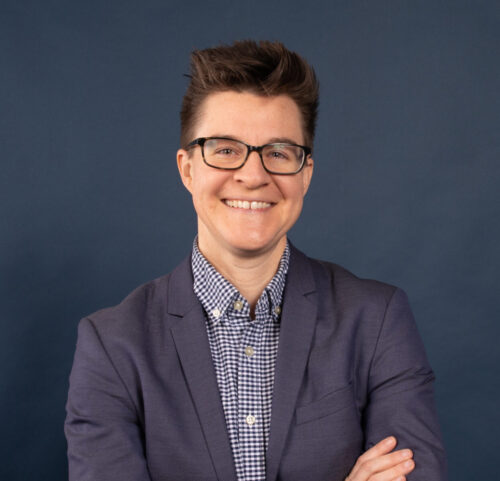
Matthew Cebul is the Lead Research Fellow for the Ash Center’s Nonviolent Action Lab, where he conducts applied research on the dynamics of contemporary nonviolent protest movements.
The views expressed in this article are those of the authors alone and do not necessarily represent the positions of the Ash Center or its affiliates.
Even with Nicolás Maduro gone, the fight for Venezuela’s future is far from over. Freddy Guevara warns that Maduro’s successors are more interested in regime survival than democratic reform.
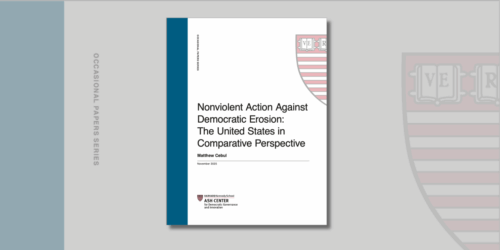
Nonviolent Action Against Democratic Erosion: The United States in Comparative Perspective
In this report, Matthew Cebul, Lead Research Fellow for the Nonviolent Action Lab, examines the effectiveness of nonviolent action movements in supporting democratic resilience globally. Identifying challenges faced by nonviolent pro-democracy movements, Cebul offers key takeaways for combating accelerating democratic erosion in the US and abroad.
The Present — and Future — of Alternatives to Police
Allen Lab Affiliate Benjamin A. Barsky examines alternative emergency response programs — arguing for a democratic model of public safety governance in which responses to nonviolent incidents are shared across government and civil society rather than dominated by police.
Allen Lab Fellow Spotlight: Why a People-Centered Approach to American Democracy Matters Now
Allen Lab Policy Fellow Christine Slaughter makes the case that democracy must be understood through people’s lived experiences and agency, not just institutions.
Allen Lab Fellow Spotlight: The Case for Building an AmeriCorps Alumni Leadership Network
In a new essay, The Case for Building an AmeriCorps Alumni Leadership Network, Allen Lab Policy Fellow Sonali Nijhawan argues that the 1.4 million Americans who have completed national service represent an underleveraged civic asset. Drawing on her experience as former Director of AmeriCorps, Nijhawan outlines a roadmap for transforming dispersed alumni into a connected leadership network capable of reinvigorating public service, rebuilding trust in government, and strengthening civic participation.