
Lessons from Venezuela: Electoral Resistance to Popular Autocrats (2007–2013)
You are invited to a webinar examining how opposition actors navigated electoral politics under conditions of increasing authoritarian consolidation in Venezuela between 2007 and 2013.
Online Event
Zoom Webinar
11:00 am – 12:30 pm EDT
Related Programs
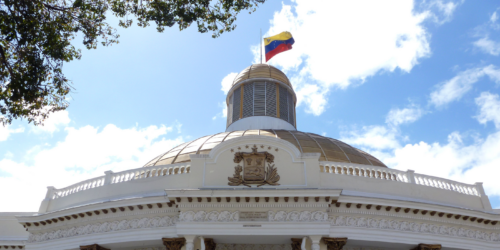
You are invited to a webinar examining how opposition actors navigated electoral politics under conditions of increasing authoritarian consolidation in Venezuela between 2007 and 2013. Focusing on a period marked by both competitive elections and accelerating institutional erosion, the discussion explores how electoral arenas became sites of resistance, coordination and strategic adaptation under a popular autocrat.
At the center of the discussion are five key milestones:
- The 2007 Constitutional Referendum
- The creation of the opposition coalition Mesa de la Unidad Democrática (MUD) in 2008
- Subsequent participation and coordination across several local, regional, legislative, and presidential elections
- The opposition primary elections of 2010–2011
- The 2012–2013 presidential cycle
Together, these moments illustrate how electoral processes were used not only for contestation, but also for coordination, organizational strengthening and political signaling under increasingly uneven conditions.
The webinar advances three core analytical insights. First, opposition strategy during this period reflects a process of pro-democratic learning. The defeat of the constitutional reform in 2007, followed by the institutionalization of coordination through the MUD and the adoption of primary elections, reveals an evolution toward more unified and strategically coherent forms of engagement.
Second, elections in hybrid regimes can function as tools for containing authoritarian advances. These milestones demonstrate how opposition actors can use electoral arenas to build unity, mobilize constituencies, and impose constraints—however partial—on authoritarian consolidation.
Finally, the Venezuelan case highlights pro-authoritarian learning by the regime. As opposition actors improved coordination and electoral competitiveness, incumbents adapted in turn—deploying institutional, legal and coercive mechanisms to manage and limit opposition gains. This dynamic underscores the iterative nature of strategic interaction between authoritarian regimes and their challengers.
Bringing together political leaders, practitioners and scholars with direct experience of these processes, the conversation will reflect on the strategic dilemmas of participation, coordination and resistance under authoritarian constraints. The discussion will also consider the broader implications of these lessons for contemporary cases of democratic backsliding.
More About the Speakers:
- Paola Bautista de Alemán is a Venezuelan political scientist, journalist and opposition leader. A national board member of Primero Justicia party and director of the Institute of Political Studies FORMA, she has dedicated her career to analyzing authoritarianism and fostering political capacity-building in Venezuela. She is currently in exile, serving as a Visiting Fellow at the Kellogg Institute for International Studies at the University of Notre Dame, where her research centers on political resilience and democracy under authoritarian pressure. She has a bachelor’s degree in social communication from Universidad Católica Andrés Bello in Venezuela, and a Ph.D. in political science from Rostock University in Germany.
- Julio Borges is a Venezuelan lawyer, opposition leader and former president of the National Assembly. He co-founded the opposition party Primero Justicia and served as president of the National Assembly in 2017. In exile since 2017, he has faced political persecution, arrest warrants and physical attacks for his opposition to the Maduro regime, while continuing to advocate for constitutional order and a united political front to resist authoritarianism in Venezuela. He holds a law degree from Universidad Católica Andrés Bello, a master’s degree in philosophy at Boston College, a public policy degree from the University of Oxford and a Ph.D. in Philosophy from Universidad Santo Tomás in Valencia, Spain.
- Freddy Guevara is a Venezuelan politician and democracy advocate who served as the first vice president of the National Assembly. A co-founder of the Voluntad Popular party, he has endured years of political persecution, imprisonment and exile for his leadership in nonviolent civil resistance against the Maduro regime. He is currently a Democracy Fellow at the Ash Center and a researcher with the Nonviolent Action Lab, focusing on pro-democracy movements worldwide. He holds a bachelor’s degree in social communications from Universidad Católica Andrés Bello in Venezuela and a master’s in public administration from Harvard Kennedy School, where he was an Edward S. Mason Fellow.
- José Gustavo Arocha is a national security expert, senior Fellow at the Center for a Secure Free Society and a retired Lieutenant Colonel of the Venezuelan Army. His work focuses on civil-military relations, democratic erosion and authoritarian consolidation in Latin America. A first-hand witness to the closing of democratic space in Venezuela between 2007 and 2012, he holds a master’s in public administration from Harvard Kennedy School, where he was an Edward S. Mason Fellow.
- Roberto Picón is a Venezuelan systems engineer and electoral expert who has played a significant role in efforts to improve election integrity. He served as a rector of the National Electoral Council (CNE) from 2021 to 2023, where he was known for publicly challenging irregularities and advocating for fairer processes. Previously, his work with the opposition coalition Democratic Unity Roundtable (MUD), led to his detention as a prisoner of conscience in 2017. He has a bachelor’s degree in systems engineering from Universidad Metropolitana in Caracas.
- Isabella Picón (moderator) is a Ph.D. student in political science at George Washington University, specializing in comparative politics and international relations. Her research examines democratization, civil resistance, and opposition strategies under authoritarian regimes. She is a co-founder of civic initiatives that promote nonviolent action and electoral participation as tools for democratic resistance, including Labo Ciudadano and Toma El Control. She has been a fellow at the Harvard Nonviolent Action Lab and at Stanford University’s Center on Democracy, Development and the Rule of Law. She has a bachelor’s degree from Northwestern University, and an M.Sc. from the London School of Economics.
About the Series
Lessons from Global Democratic Resistance is a public panel series that brings together frontline activists, civic leaders, institutional actors and field‑informed scholars to examine how democratic actors have resisted, responded to and learned from democratic backsliding across countries. The series aims to identify practical lessons and comparative insights for those defending democracy today and is organized in collaboration with the Cornell Center on Global Democracy; Perry World House at the University of Pennsylvania; the Kellogg Institute for International Studies at the University of Notre Dame; the Democratic Futures Project at the University of Virginia; Stanford’s Center on Democracy, Development and the Rule of Law; and the Carnegie Endowment for International Peace.
Event Details
This event is online only and registration is required. A recording will be made available after the event’s conclusion. The information collected in the registration form is for internal use only and will not be shared externally.
The Ash Center encourages individuals with disabilities to participate in its events. Should you wish to enquire about an accommodation, please contact our events team at info@ash.harvard.edu prior to the event.