Media Release  

Danielle Allen’s Radical Duke Recasts the Origins of the Age of Revolution

A new book from Harvard scholar Danielle Allen revisits the forgotten British radical movement that helped shape modern democracy.

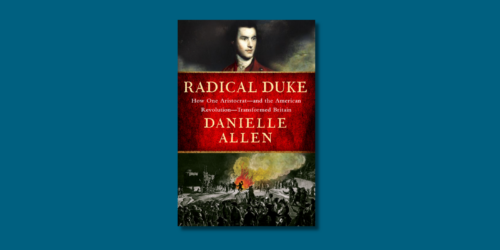
A photo of the cover of

CAMBRIDGE, MA — The Ash Center for Democratic Governance and Innovation at Harvard Kennedy School announces the publication of Radical Duke: How One Aristocrat—and the American Revolution—Transformed Britain, a major new work released by political theorist and historian Danielle Allen, James Bryant Conant University Professor at Harvard University and Director of the Allen Lab for Democracy Renovation at the Ash Center.

In Radical Duke, Allen offers a bold reinterpretation of the origins of modern democracy, arguing that the Age of Revolution began not in colonial America or revolutionary France, but in Britain itself. The book grew out of Allen’s discovery of a rare parchment copy of the Declaration of Independence long-overlooked in Sussex, England—a finding that opened the door to a deeper transatlantic story about political reform, popular sovereignty, and the emergence of democratic thought in the eighteenth century.

At the center of the book is Charles Lennox, the Third Duke of Richmond, an unconventional aristocrat who emerged as one of Britain’s leading advocates for civil liberties and political reform in the years before the American Revolution. Though born into aristocratic privilege, the duke championed freedom of the press, religious toleration, and broader political participation, becoming one of the Crown’s most outspoken critics.

Allen also uncovers the duke’s little-known collaboration with Thomas Paine before the publication of Common Sense. Drawing on archival discoveries and computational analysis, Radical Duke revisits the authorship of the influential Letters of Junius and identifies an early, previously unknown work by Paine, The Juryman’s Touchstone. Together, these findings reveal a transatlantic network of reformers whose ideas helped shape modern democratic thought.

Radical Duke reveals how deeply interconnected British and American political developments have been, restores an extraordinary but overlooked figure to his rightful place in that story, and shows how much we can still learn from 18th-century radicals,” says Allen.

Rather than embracing outright revolution, Lennox ultimately pursued reform within Britain’s constitutional framework, seeking to balance loyalty to the Crown with accountability to the people. Allen presents this tension as central to understanding the development of modern democratic governance and Britain’s distinctive path toward political reform.

Radical Duke will be released on June 16, 2026.


About Danielle Allen

Danielle Allen is the James Bryant Conant University Professor at Harvard University and author of Justice by Means of Democracy, Cuz, and Our Declaration, winner of the Parkman Prize. A member of the American Academy of Arts and Sciences, the American Philosophical Society, the Council on Foreign Relations, and the American Academy of Sciences and Letters, she lives in Cambridge, Massachusetts. At HKS, her Democracy Renovation lab focuses on renovating democracy for human flourishing.


 

Related Resources

AI models appear to recognize moral complexity — then ignore it, new study by researchers affiliated with Harvard Kennedy School’s Allen Lab finds
Outstretched hands holding a graphic of a scale and the outlines of two heads.

Media Release

AI models appear to recognize moral complexity — then ignore it, new study by researchers affiliated with Harvard Kennedy School’s Allen Lab finds

New study published in AI and Ethics introduces a new ethical-moral intelligence framework for AI and finds that leading AI models mimic human moral concern while making decisions that reveal a hidden value hierarchy. 

Q & A: Crocodile tears, Can the ethical-moral intelligence of AI models be trusted?
A hand pressing a tablet using AI.

Q+A

Q & A: Crocodile tears, Can the ethical-moral intelligence of AI models be trusted?

As artificial intelligence becomes more embedded in everyday decision-making, its role in shaping how people think about ethics and morality is drawing increasing scrutiny. In this conversation with researcher Sarah Hubbard, we discuss insights from her co-authored paper, “Crocodile Tears: Can the Ethical-Moral Intelligence of AI Models Be Trusted?—examining how AI systems respond to moral dilemmas, and what this reveals about the risks, limitations, and need for greater transparency and human oversight in AI-driven ethical guidance.

Bootstrap Blackness: Black Men, Conservatism, and Party Politics
A man voting.

Article

Bootstrap Blackness: Black Men, Conservatism, and Party Politics

A new research article by Dr. Christine Slaughter, Research Fellow at the Allen Lab for Democracy Renovation and co-authors examines the narrative of black men’s political “shift right”. The study finds Black men remain overwhelmingly Democratic, despite growing public attention to ideological divides.


More on this Issue

What Democracy Means to Us: Reflections on America 250
Images of Ash Center staff, faculty, and fellows on a grid layout.

Video

What Democracy Means to Us: Reflections on America 250

Exploring Ash Center perspectives on the meaning of democracy, democratic participation and citizenship, and how democratic life might evolve over the next 250 years.

The Declaration of Independence at 250: Five Questions About America’s Founding Document
A painting of the Declaration of Independence signing.

Q+A

The Declaration of Independence at 250: Five Questions About America’s Founding Document

As the United States approaches the 250th anniversary of the Declaration of Independence, its founding principles—and its enduring contradictions—continue to provoke reflection and debate. In this conversation, Alex Keyssar, historian and Matthew W. Stirling Jr. Professor of History and Social Policy at Harvard Kennedy School, discusses the historical circumstances in which the Declaration was written, the ideals it sought to articulate, how its meaning has evolved over time, and the tensions between its soaring language and the realities of slavery, inequality, and political compromise.

Terms of Engagement – America at 250: Rethinking U.S. Democracy at a Historic Inflection Point

Terms of Engagement – America at 250: Rethinking U.S. Democracy at a Historic Inflection Point

Democracy historian and theorist Danielle Allen joins Archon Fung and Stephen Richer for a special America 250 episode of Terms of Engagement to discuss what the Declaration of Independence says about freedom and equality and her recent scholarship on the surprising origins of the American Revolution.