

Q+A
Danielle Allen’s “Radical Duke” reveals an unsung catalyst of history
Allen uncovers the deep—then volatile—friendship between a British duke and Thomas Paine.
Commentary
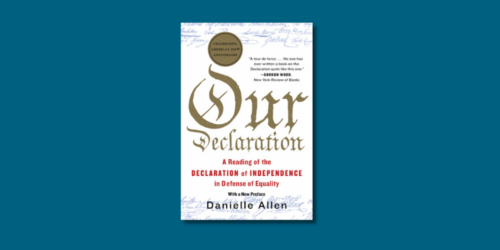
First published in 2014, Professor Danielle Allen’s Our Declaration has been reissued with a new foreword this year to mark the 250th anniversary of the Declaration of Independence.
This commentary was originally published on the Harvard Kennedy School website.
First published in 2014, James Bryant Conant University Professor and Director of the Allen Lab for Democracy Renovation at the Ash Center Danielle Allen’s Our Declaration has been reissued with a new foreword this year to mark the 250th anniversary of the Declaration of Independence. Our Declaration shares Allen’s personal story about teaching this foundational American document along with an account of the colonial world in which it was written and the philosophy that it expresses. “The purpose of this account will not be to retell a well-known tale but rather to discover, through that tale, the birth of the Declaration, the art of democratic writing,” Allen explains. “Democracies are built out of language. To succeed as citizens, we need to understand this fundamental political fact.”
Allen’s primary argument is that the Declaration of Independence is not simply about the concept of individual liberty but also about political equality, and that these two notions are interrelated. “Ideally, if political equality exists, citizens become co-creators of their shared world,” Allen writes. “Freedom from domination and the opportunity for co-creation maximize the space available for individual and collective flourishing.”
Q+A
Allen uncovers the deep—then volatile—friendship between a British duke and Thomas Paine.
Video
Exploring Ash Center perspectives on the meaning of democracy, democratic participation and citizenship, and how democratic life might evolve over the next 250 years.
Q+A
As the United States approaches the 250th anniversary of the Declaration of Independence, its founding principles—and its enduring contradictions—continue to provoke reflection and debate. In this conversation, Alex Keyssar, historian and Matthew W. Stirling Jr. Professor of History and Social Policy at Harvard Kennedy School, discusses the historical circumstances in which the Declaration was written, the ideals it sought to articulate, how its meaning has evolved over time, and the tensions between its soaring language and the realities of slavery, inequality, and political compromise.