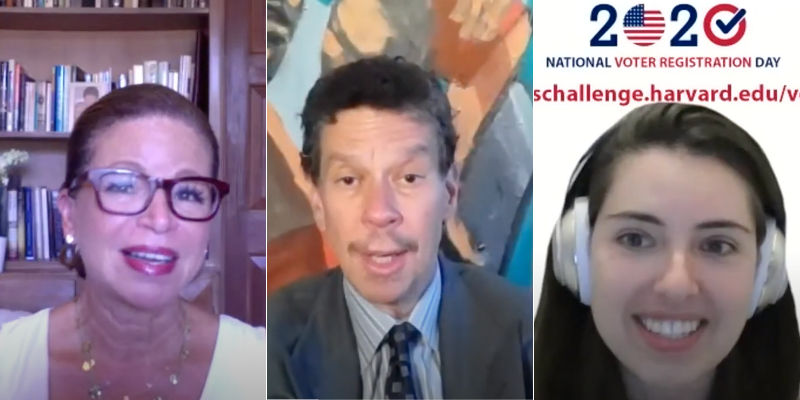
Following the 2016 presidential election, senior advisor to then President Barack Obama Valerie Jarret and First Lady Michelle Obama poured over election return data. “Michelle Obama and I did a lot of soul searching trying to figure out what happened,” said Jarrett during a virtual discussion moderated by Harvard Law School Lester Kissel Professor of Law David Wilkins, hosted by Harvard Votes Challenge, the Ash Center for Democratic Governance and Innovation, and Institute of Politics, this Tuesday to mark National Voter Registration Day. “I think the number that really jumped out at us was that nearly 100 million eligible Americans did not vote. That’s a big number in a country that depends on democracy, which requires civic engagement and participation at the most fundamental level.”
Driven in part by those anemic voter turnout figures, in 2018 Jarrett and Obama helped launch When We All Vote, a non-partisan organization with a mission to change the culture around voting and help increase voter participation among young people and people of color, two groups that traditionally vote in disproportionately low numbers. Now board chair of When We All Vote, Jarrett shared her insights into how to engage voters leading up to the 2020 election and the role that young people can play in this election.
The first action that everyone should take, said Jarret is to “make sure that you are registered to vote and once you’re registered, make a plan for how you’re going to vote.” Especially in the midst of a pandemic, she stressed the importance of knowing your options and preparing well in advance to cast your ballot, whether by mail or in person. Young people can also play an important role on Election Day as poll workers, or for law students, as voter protection volunteers.
Asked what she thought about how to engage with young voters specifically, Jarrett laid out a strategy of meeting voters where they are. Acknowledging that a traditional media strategy won’t reach Gen-Z voters, typically those born in the late 1990s and early 2000s, she described how important using social media and influencers, like athletes and musicians, has been for When We All Vote. In addition, “I think we are leaning on local leaders to tell us who are the organizations in their community who are most impactful and to help connect us with the leaders on the ground, so that we can make sure again, that we’re meeting people where they are,” she said.
Business and organizations like universities play an important institutional role in getting out the vote as well. “What we’re asking colleges and universities around the country to do is to help their students and their community develop that plan and heighten their awareness through conversations, such as this, about why voting is so important,” said Jarrett.
There’s value in every one vote, reminded Jarrett, encouraging the audience to not just think about the presidential election, but local elections as well. “I would ask yourself who are the people that share your values, who share your priorities, who you think are going to look out for you and those you love and then get out there, up and down the ballot at every single possible place and vote.”
And despite the many challenges that lay ahead, Jarrett remains hopeful about the fast-approaching election. “In what has been a horrendously painful year for so many of us between COVID-19 and the racial unrest that we’ve seen across our country, I am optimistic,” she concluded. “The fact that we’ve had mostly peaceful demonstrations in all 50 states. People of all ages, races, and backgrounds who’ve come forward and said black lives matter and they want to make our system and our policies and our practices fairer, that’s terrific and it gives me hope.”