Commentary
California Writes Public Deliberation Into Law
Engaged California is the nation’s first state-run deliberation program, and a new law aims to make it last.

Read the latest news, commentary, and analysis from the Ash Center.
Commentary
Engaged California is the nation’s first state-run deliberation program, and a new law aims to make it last.
Newest
Commentary
This is a guest post by Mason Holland, an undergraduate student at the University of Connecticut majoring in Political Science. He also serves as President of the Student Body.

Feature
Speaking at Harvard Kennedy School, landback movement leader Alvin Warren MC/MPA 2013 argues for the return of land to Indigenous communities
Feature
As the IARA Truth and Transformation Conference keynote speaker, Lee asks if the U.S. is ready for a national racial reckoning?

Video
At the 2022 Truth and Transformation conference, during the welcome, we heard from Professor Khalil Gibran Muhammad, head of the Institutional Antiracism and Accountability Project at Harvard Kennedy School, as well as Talia Landry, Mashpee Wampanoag Tribe.
Video
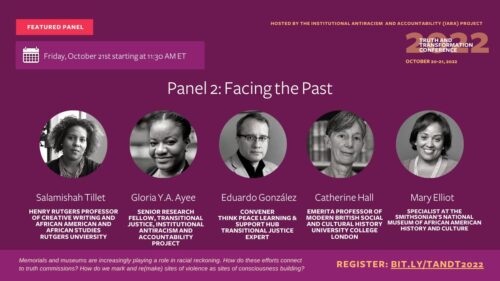
Memorialization efforts and museums are increasingly playing a role in racial reckoning. How are state officials, activists, and organizers using memorials to face the past? How do these efforts connect to the work of truth commissions? How do we mark sites of violence and re(make) them as sites of consciousness-building, truth-telling, and historical documentation?
Video
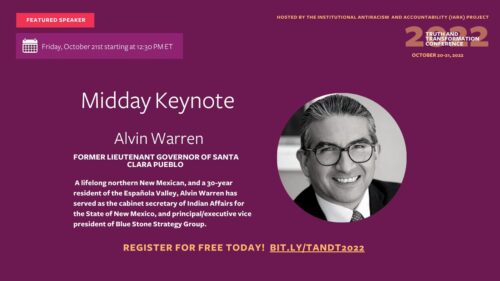
Tune into a musical performance by Raye Zaragoza followed by a keynote by Alvin Warren (Santa Clara Pueblo), former Santa Clara Pueblo lieutenant governor, about the deeper implications of the Land Back movement and how allies can take meaningful action to support Tribal Nations and Indigenous Peoples in these efforts.
Video
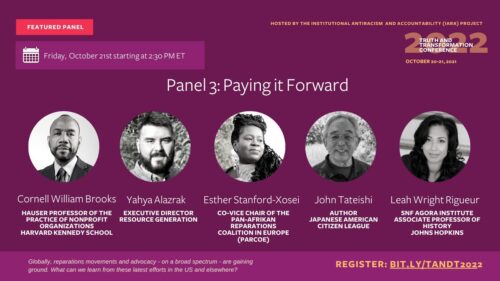
Globally, reparations movements are gaining ground. These movements focus on a broad spectrum of ways to return resources, achieve economic security and close the racial wealth gap, including cash payments, repatriating cultural artifacts, land givebacks, health access, and philanthropic investments. What can we learn from these latest efforts in the US and elsewhere? Looking into the future how can we make reparations work?

Media Release
Researchers from the Harvard Project on American Indian Economic Development (Harvard Project) released a policy brief outlining how to identify lands historically belonging to Indian nations that could be returned by the U.S. federal and state government—a process commonly referred to as landback.
Q+A
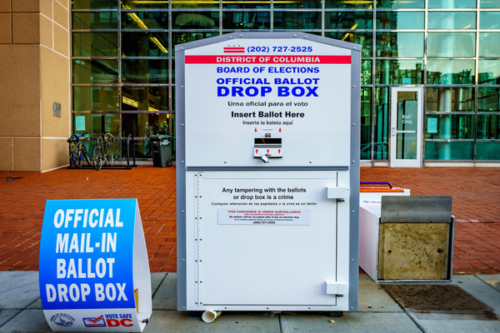
With the 2022 midterm vote approaching, the issue of ballot “curing” or correcting clerical errors on ballots has garnered increased attention as some jurisdictions work to expand vote by mail, while others have sought to curb the practice.