


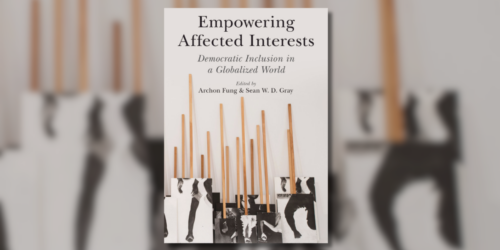

Empowering Affected Interests — Democratic Inclusion in a Globalized World
In this book, Empowering Affected Interests, Archon Fung and Sean W. D. Gray explore the radical implications of the All-Affected Principle in a globalized world, bringing together leading theorists to examine how democracy might be reimagined to address cross-border interdependence on issues like immigration, climate change, and labor markets.
Many demands for democratic inclusion rest on a simple yet powerful idea. It’s a principle of affected interests. The principle states that all those affected by a collective decision should have a say in making that decision. Yet, in today’s highly globalized world, the implications of this ‘All-Affected Principle’ are potentially radical and far-reaching. Empowering Affected Interests brings together a distinguished group of leading democratic theorists and philosophers to debate whether and how to rewrite the rules of democracy to account for the increasing interdependence of states, markets, and peoples. It examines the grounds that justify democratic inclusion across borders of states, localities, and the private sector, on topics ranging from immigration and climate change to labor markets and philanthropy. The result is an original and important reassessment of the All-Affected Principle and its alternatives that advances our understanding of the theory and practice of democracy. This title is also available as Open Access on Cambridge Core.
Cambridge University Press
November 2024
Archon Fung is the Winthrop Laflin McCormack Professor of Citizenship and Self-Government and the Director of the Ash Center for Democratic Governance and Innovation.
Sean Gray is an Assistant Professor of Political Science at Memorial University of Newfoundland, Canada.
The views expressed in this article are those of the author(s) alone and do not necessarily represent the positions of the Ash Center or its affiliates.
The Ash Center's Open Access Initiative
In celebration of over 20 years as Harvard’s hub for democracy research, the Ash Center launched its Open Access Scholarship Initiative to enhance the accessibility and the democratization of key works by making them downloadable for free.
Terms of Engagement—What If Millennials and Gen Z Leaders Replaced the Gerontocracy?
Amanda Litman, the president and founder of Run for Something, joins co-hosts Archon Fung and Stephen Richer to talk about why she believes democracy needs a generational makeover.
Terms of Engagement—How Does Our Civil Rights History Shape the Future of American Democracy?
Archon Fung and Stephen Richer invite Harvard Kennedy School Professor and civil rights advocate Cornell William Brooks to assess the evolution of America’s historical narrative and what implications history has on our contemporary political context.
Terms of Engagement—How Does Our Civil Rights History Shape the Future of American Democracy?
Archon Fung and Stephen Richer invite Harvard Kennedy School Professor and civil rights advocate Cornell William Brooks to assess the evolution of America’s historical narrative and what implications history has on our contemporary political context.
Allen Lab Fellow Spotlight: Why a People-Centered Approach to American Democracy Matters Now
Allen Lab Policy Fellow Christine Slaughter makes the case that democracy must be understood through people’s lived experiences and agency, not just institutions.
Supply Skeptics or Abundance Acolytes? Mayoral Views on the Housing Crisis
Economists and policy analysts broadly agree that more housing needs to be built in order to reduce costs in America’s most expensive cities. Using a novel survey of mayors of mid-sized and large cities to explore mayors’ views on the roots of America’s housing crisis and what solutions they believe will most effectively address their constituents’ housing challenges, the authors summarize mayors’ attitudes and perceptions on key issues related to expanding the housing supply, reporting how well these views correlate with mayors’ assessments of their own cities’ supply needs.