Commentary
California Writes Public Deliberation Into Law
Engaged California is the nation’s first state-run deliberation program, and a new law aims to make it last.
Additional Resource
After Neoliberalism: From Left to Right brought together hundreds of leading economists, political scientists, journalists, writers and thinkers from across the political spectrum to explore and debate emerging visions for the future of the political economy.
Panel videos below.
By:
 Charlie Covit
Across the United States, there is a growing consensus that the neoliberal economic order has failed to address many of the systemic challenges facing our society. Even as the economy has boomed in recent decades, too many Americans have been left behind, contributing to political polarization, distrust, and profound discontent.
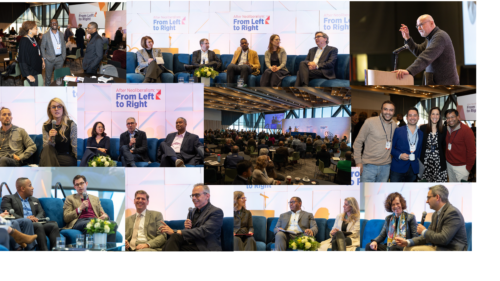
Against this backdrop, on December 11, 2025, scholars, policymakers, journalists, and civic leaders convened for After Neoliberalism: From Left to Right, a two-day conference presented by the Allen Lab for Democracy Renovation. In this moment of profound transformation, the conference brought together the thinkers behind ideas for a new economic future from left, right, and center. Together, participants presented and debated emerging frameworks for a new political economy.
Building on the first day’s examination of the failure of neoliberalism, the second day of After Neoliberalism: From Left to Right, continued the conversation around the paradigms emerging in its wake. Throughout the morning, scholars, policymakers, and civic innovators discussed what is broken, what is possible, and how new and concrete ideas might be put into practice.
Videos and descriptions of all panels below.
Danielle Allen, James Bryant Conant University Professor at Harvard, opened the conference with a deeply moving reflection, sharing how a personal tragedy inspired her commitment to building an economy that uplifts society’s most vulnerable. Allen grounded the conference in a simple yet powerful reminder: “the economy is always for something…and at the end of the day, it should matter for the project of human flourishing.”
Jennifer Harris, director of the Economy and Society Initiative at the William and Flora Hewlett Foundation, which sponsored the event, described the United States as standing at a pivotal historical crossroads and warned of the danger of sticking with the status quo. “As the kids might say: the vibes are bad, even if the pie keeps growing,” Harris said.
The conference’s first panel explored the need for new frameworks to succeed neoliberalism. Drawing panelists from across the political spectrum—including members of the Council of Economic Advisers from the Obama, Biden and Trump administrations—the discussion revealed unexpected areas of consensus amidst sharply differing worldviews. Though the panelists have held positions at the apex of government and academia, they spoke candidly about how failures of academic and policy elites have contributed to a steep decline in public trust in government. The panelists agreed on the need for a new paradigm going forward, and as moderator Anne-Marie Slaughter noted, “We opened more questions than we answered—but that’s exactly what we should do.”
Larry Kramer, president and vice chancellor of the London School of Economics and Political Science, spoke of the need to communicate a vision of the economy that can rebuild a divided society’s faith in democracy. Emerging ideas must be synthesized into a story that ordinary citizens can understand and connect with — one that “can become intuitive to them,” Kramer said.
The conference’s second panel, “Telling the Stories of Contemporary Crisis,” emphasized listening and storytelling as essential to imagining a new political economy. Rob Watson highlighted the role of grassroots change and his work empowering communities to confront systemic and intergenerational obstacles. Kate Woodsome drew connections between democratic erosion and declining mental health, underscoring the urgency of addressing challenges such as post-traumatic stress disorder, while D. Graham Burnett discussed his research on the commodification of human attention by technology companies in our “attention economy.” Bri Stensrud, of Women of Welcome, discussed her organization’s unique work harnessing the compassion of conservative women to support immigrants and refugees.
Oren Cass and Rebecca Henderson sat down for an intimate fireside chat to discuss Cass’ book, The Once and Future Worker. Cass and Henderson, despite entering the conversation with their own unique worldviews and visions of a new American economy, discovered numerous areas of alignment over the course of an incredibly frank conversation. Cass outlined a series of concrete policy overhaul proposals, including subsidizing low-wage work and reimagining the role of welfare. When Cass implored attendees to focus not only on the size of the metaphorical pie, but also on how it is distributed, Henderson expressed her “violent agreement.”
Kicking off the afternoon, Dean Weinstein urged participants to confront the transformative impact of AI and automation on work, opportunity, and democratic life. “I’ve been called a luddite for drawing attention to the social impacts of technological change,” he said. “I’m not against technology, but I do believe that solving for the public good means taking seriously the role of government in shaping the path of technological change. This is a posture that’s pro-democracy, not anti-tech.”
Margaret Levi, moderating “Where Do We Go from Here: From Left to Right,” focused the conversation on the principles and priorities guiding a new political economy. The diverse group of panelists converged on the urgency of fostering inclusive growth in the context of a dynamic and rapidly changing economy. Multiple panelists emphasized the need for high quality jobs and services in an era of deep social disconnection and highly unequal returns to capital. Allison Schrager reminded participants that any effort to chart a new course must begin by recognizing those who have been failed by the current economic reality: “We all agree that this economy is not giving everyone the opportunity and security they need, and a lot of people are left out,” she said.
In “Applications of a New Paradigm: Technology Development,” panelists discussed how today’s rapidly emerging technological advances can be harnessed for the good of society. E. Glen Weyl, moderating the conversation, implored participants to imagine a world in which innovation is not motivated solely by the incentives of, for example, a venture capital firm. The panel addressed the changes workers are already watching play out in real-time, ranging from the promise and peril of automation to the dangers of information centralization and the concentration of power.
In “Applications of a New Paradigm: Family, Migration, and Demographic Transformation,” panelists explored how family and migration policy shape the social fabric of American society. Danielle Allen, moderating the conversation, focused on the interconnected roles of markets, civil society, and public institutions in supporting flourishing communities. Panelists emphasized the critical role families play in everything from serving as “gatekeepers of information” in an era of omnipresent technology to shaping the fast-expanding care economy, focusing on the need for economic policies that allow for family members to care for one another. Panelists also offered new frameworks for immigration policy, sharing visions for short-term and community-driven migration to address worker shortages in the care economy. Over the course of a deeply personal discussion, panelists shared how their own families’ experiences have shaped their views on cultural cohesion, assimilation, and American identity.
Yochai Benkler closed Day One by reflecting on the need for a “new theory of capitalism” attentive to work, power, and dignity. Benkler stressed that rethinking the political economy requires not displacing markets, but reshaping them. Benkler challenged participants to challenge exploitation while still promoting innovation.
Rebecca Henderson opened the day by declaring, “I have 10 minutes, and I’m going to talk about love.” Drawing on Dr. Martin Luther King Jr.’s warning that “power without love is reckless and abusive,” she argued for a reimagining of the economy and American society beginning at the community level. The best-designed policies, she cautioned, will fail if they cannot be translated into values and stories that people can relate to. We need “the union of power and love” to strengthen social bonds and institutions, she argued, in order for democracy to survive and thrive.
Moderated by Brandon Terry, “Applications of a New Paradigm: Housing, Health, Education, and Jobs,” examined the core crises facing all too many working class Americans. Terry framed housing, health, education, and jobs as areas of “experimentation and contestation,” each conducive to new economic models capable of reshaping the American economy. Felicia Wong warned that too many progressives still lack a coherent “vision of the good life … and, even harder, the good society.” On a similar note, Gordon Hanson argued that recent administrations, both Democrat and Republican, have failed to tackle the structural barriers standing between many Americans and high quality jobs. Yet panelists also looked at areas for opportunity, with education and organized labor emerging as two frontline sites of democratic struggle.
The conference’s final panel, “Applications of a New Paradigm: Democracy, Effective Governance, and State Capacity,” explored how institutions can successfully govern a new political economy that supports collective prosperity and well-being. “At the end of the day, questions of governance are fundamental to what kind of economy we have, how it operates, how we steer it,” she explained. Jack Goldsmith called for renewed focus on the separation of powers, warning of the danger in concentrating power in the executive branch, rather than the halls of Congress. The erosion of political trust and belief in the role of government as a force for good emerged as a persistent area of concern, together with what Jennifer Pahlka called “a crisis of state capacity.” Panelists emphasized that in order to both rebuild that trust and stimulate the economy, governments must begin delivering tangible policy outcomes within politically relevant timeframes.
Danielle Allen closed the conference by returning to Abraham Lincoln’s definition of democracy as “of the people, by the people, for the people.” State capacity, democratic participation, and substantive outcomes, she argued, each demand unique attention and action. In inviting participants to reflect on the past two days, Allen urged participants to think of “a burning question you’ll be leaving with,” be it skepticism of artificial intelligence, the new tools shaping today’s political economy, or any other topic of their choosing. Allen finished by expressing hope that attendees had found “points of connection and … rich nourishment” that would carry their work forward. With table-topic breakouts extending the conversation over lunch, the conference came to a conclusion.
Commentary
Engaged California is the nation’s first state-run deliberation program, and a new law aims to make it last.

Additional Resource
In a recent guest essay for The New York Times, Allen Lab Democracy Stack Fellow Beth Noveck argues for putting A.I. behind every public servant.

Media Release
Commentary
Engaged California is the nation’s first state-run deliberation program, and a new law aims to make it last.
Additional Resource
In a recent guest essay for The New York Times, Allen Lab Democracy Stack Fellow Beth Noveck argues for putting A.I. behind every public servant.
Policy Brief
A new policy brief explores how unions help members become more engaged in civic and political life.