
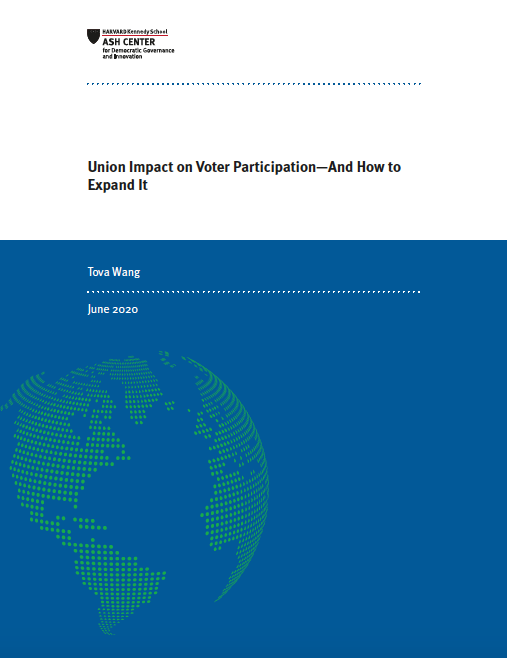
Some politicians have enacted measures in recent years to make voting harder and to reduce participation among certain groups. Others have sought to counteract that voter suppression by implementing laws to make voting easier, such as same-day or automatic registration. There is another antidote to the effort to reduce participation: lifting up worker organizations. This is especially important to understand given the ways in which powerful individuals and groups have sought to weaken unions because of their political strength representing American workers.
In this report, the author first explains efforts to weaken unions and the voice of working people; then what the decline of unions and union membership has meant for participation; next, Wang looks at the data showing the positive effects unions have on voter participation; and finally, she suggests how going forward we can reform the laws and how labor is structured such that it not only continues to facilitate voter participation, but even enhances it.
Terms of Engagement—How Does Our Civil Rights History Shape the Future of American Democracy?
Archon Fung and Stephen Richer invite democracy and civil rights advocate Cornell William Brooks to assess the evolution of America’s historical narrative and what implications history has on our contemporary political context.
White House reporter Annie Linskey offers a closer look at how the Trump White House makes decisions and what recent actions reveal about its strategy.
Terms of Engagement—How Does Our Civil Rights History Shape the Future of American Democracy?
Archon Fung and Stephen Richer invite democracy and civil rights advocate Cornell William Brooks to assess the evolution of America’s historical narrative and what implications history has on our contemporary political context.
Allen Lab Fellow Spotlight: Why a People-Centered Approach to American Democracy Matters Now
Allen Lab Policy Fellow Christine Slaughter makes the case that democracy must be understood through people’s lived experiences and agency, not just institutions.
Supply Skeptics or Abundance Acolytes? Mayoral Views on the Housing Crisis
Economists and policy analysts broadly agree that more housing needs to be built in order to reduce costs in America’s most expensive cities. Using a novel survey of mayors of mid-sized and large cities to explore mayors’ views on the roots of America’s housing crisis and what solutions they believe will most effectively address their constituents’ housing challenges, the authors summarize mayors’ attitudes and perceptions on key issues related to expanding the housing supply, reporting how well these views correlate with mayors’ assessments of their own cities’ supply needs.