This article was originally written by Kate Selker for Harvard Kennedy School.
In her new book, “Radical Duke: How One Aristocrat―and the American Revolution―Transformed Britain,” Professor Danielle Allen makes the case that the “Age of Revolution” did not begin with the American Revolution, or even the French.
Instead, she argues, the seeds of that turbulent era were sown in Britain — led, in part, by a reform-minded aristocrat. Allen uncovers the story of Charles Lennox, the third Duke of Richmond, and details his path from friendship to bitter rivalry with English-born American revolutionary thinker Thomas Paine. We spoke to Allen about her book, the duke, and what his story can teach modern-day readers.
What got you interested in the “radical duke”?
I started this project more than a decade ago, mainly because of a connection to the Declaration of Independence.
The main character of the book, Charles Lennox, the third Duke of Richmond, was an ardent supporter of the Americans. And it turns out that he was given this incredibly beautiful ceremonial parchment of the Declaration of Independence.
The world thought there was just one ceremonial parchment — it’s in the National Archives. But my research team found the second one in Southern England, and then we had this mystery to solve of how on earth did it possibly get there.
You determined that the second Declaration was likely a gift to the duke from Thomas Paine. How did that happen?
Thomas Paine had worked as an excise collector in Lewes, which is also in Sussex in southern England, from 1768 to 1774. Those were the six years before he went to America and wrote “Common Sense” [a pamphlet advocating American independence].
He always told people after he got to America that he had never written anything before “Common Sense.” This was always implausible because it is such a beautiful and powerful piece of writing, but people have bought that hook, line, and sinker for more than 200 years. At any rate, it’s not true. He had been a radical writer for twenty years before he left Britain.
When he was an excise officer in Lewis, he was working under the third duke’s jurisdiction, and he was actually there as a cover. He was doing political writing for the duke during that time.
The duke was supporting and coordinating a network of radical political writers who operated secretly and produced what are called the Junius letters. They were published in British papers from 1768 to 1772, and they were inflammatory. They were extraordinarily critical of the king, breaking all kinds of boundaries in terms of what you could say. They threatened revolution as directly as you can imagine in that period. So there’s a reason Paine later said he’d never written anything before America. What he had written in those earlier years would have put him on trial for sedition.
Can you describe the duke? How did he become “radical”?
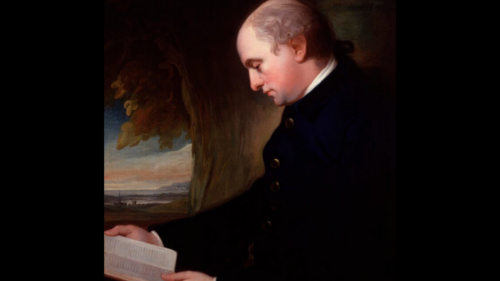
He was from one of the most aristocratic families in Britain and he was a direct descendant of Charles II. His family was fabulously wealthy. They were incredibly good-looking and cultured. He was known as the most beautiful man in England. He had all of the privilege that you would expect would lead to somebody to be a real backer of the establishment.
Instead, his dad died when he was 15, he became a duke at that early age, he went on a grand tour in Europe for five years — and while he was there, two things happened to him that put him on a different pathway.
For starters, he stopped to visit his dad’s good friend, Montesquieu, the famous philosopher who’s the author of the “Spirit of the Laws” and had such an influence on the American founders.
Also, he found himself really interested in the military and made friends with somebody named Major-General James Wolfe, who became a leading figure in the British military, but who also had an enlightenment-informed philosophy about trying to fight corruption in what he saw as a broken monarchic system.
Between Montesquieu and General Wolfe, Richmond got an education and, as one of his peers wrote, “all of the liberal ideas of the day.” He really came to see the British government as growing very weak because of problems of corruption, because of an inability to see talent wherever it might be and pull talent forward in society.
That really put him on the path of radical reform. It was an astonishing personal transformation.
How did the duke’s “path of radical reform” differ from that of American revolutionaries like Paine?
In the 1760s and 1770s, the [American] colonies and people in Britain had the same set of problems. They both had problems of an overreaching executive, of problematic foreign entanglements, of corruption, and so on — and there was the question of what to do about it.
In England, they started from an early point working on pretty radical reforms — for example, universal manhood suffrage — that would have been instantly transformative of politics. They sought to reduce the king’s access to discretionary funds, for instance.
And at the same time, the Americans were deciding what to do. They, of course, chose the even more radical path of full revolution. Once the Americans made that choice, the question came back to England. Should England also choose revolution?
At that point, the duke had a choice. Would he go the more radical direction and join with the people calling for revolution? Or would he try to keep things on this path of reform? Ultimately, in a period of intense politics between 1780 and1783, as the American Revolution was coming to a close, he chose reform—and ended up working hard to weld the project of reform to the institutions of the monarchy.
How are the duke’s beliefs relevant in modern-day America?
You look at the 18th century, and they had all kinds of problems that rhyme with problems that we have today. They had the challenge of executive overreach — the king with his ministers was doing things like arresting publishers when they considered their writings to be seditious. They were blocking people from taking seats in parliament when they’d been duly elected. They were entangling Britain in foreign wars that the people in Britain couldn’t really see the purpose of.
And then there was the problem of corruption. The king had access to funds that he could use to give bonuses to members of parliament, and he had control of about 200 out of the 558 seats in parliament. That control meant that parliament essentially stopped acting independently from the king.
Also, over the course of the 18th century, the percentage of people in England who had access to the vote shrank. We always think of the electorate as only ever getting bigger and wider, but in the 18th century, it shrank.
We have all of those problems today: an unbounded executive, a legislature that is supposed to be independent of the executive but has become dependent instead, corruption, abusive use of funds to control politics.
We’re watching many of the kind of pathologies that were degrading the caliber of governance in Britain apply to us today.
What do you want people to understand after reading the book?
England came much closer to a revolution in the years between 1765 and 1790 than most people realize. It was a period of incredible political turbulence, of radical innovation, and of real efforts to transform how the monarchy operated.
The duke helped drive this period of radical change. He introduced a bill for universal manhood suffrage. And it was once I came to understand that the 18th century had a lot of the kind of political pathologies of our contemporary times, and that this figure, the third Duke of Richmond, had some solutions to them, I got doubly interested in the power of his story.
I hope the book will give people a sense of just how turbulent British politics was, how intertwined the American cause and the British cause were in the 18th century, and how much we can learn from their efforts to drive quite serious transformation in their politics.
What was it like to work on this book?
It was so much fun. It was really one of the most fun things I’ve ever had the chance to work on. It was an accidental project. I never expected to be writing a biography of an 18th-century British politician, let alone a duke, but the story fell into my lap.
I did have to do serious archival work. The duke destroyed a lot of his papers, particularly from this critical period. Also, several of his family members had destroyed their papers. But I learned that the duke had had a magnificent library. Think of it as equivalent to Thomas Jefferson’s library, full of philosophy and history and studies of governmental systems all over the earth. I was able to reach out to the current duke’s family and their staff, and they shared the catalog of the library with me. I realized that if there were any annotations or marginalia in the books, that would be where the story was. The family graciously gave me permission to do research in their beautiful library, with gilt mirrors and velvet drapes, and beautiful paintings across bookcases that are many feet high, with rows and rows of books.
To be able to go sit in a British summer in a beautiful, gorgeous library, looking out at the designed gardens of a British landscape, a butler kindly bringing me tea and water and cookies while I was researching? It’s definitely a researcher’s dream come true.
And sure enough, there were a lot of annotations in those books. The duke’s intellectual life is written out there in the pages.
You write about the duke’s radical imagination for the future. As we approach America’s 250th, what’s your dream for the nation’s next 250 years?
I wish I could claim to dream for 250 years. I’m not sure I do. I do dream for 50 years, and in my 50-year imagination, we would increase the size of the House of Representatives and transition to having multi-member districts with ranked choice voting, which would give us a form of proportional representation.
These words are easy to say. They’re technical. We could spend a lot of time walking through how you would deliver this kind of technology of representation. The truth is a transition of that kind is monumental, and it will probably take us 50 years to achieve it. But if we could, it would mean the full enfranchisement of the American people.
How did the duke explore that “technology of representation”?
When the duke proposed universal manhood suffrage, he also proposed equal electoral districts—the idea that you would take the land of Britain and divide it up into units with equally sized populations. Later in his career, he proposed what is now called Britain’s mapping service. So he got the ordnance survey going. To invent equally sized districts was a big deal. They had existed in antiquity…but he and some of his allies were reinventing them in the modern world.
Right now, we take electoral districts for granted: How could we function if we didn’t have the country divided into these congressional districts? But his invention was a technology. It was a way of organizing institutions so that the people’s voice could be connected to the government.
It’s important for us to remember that representation is a technology and we can upgrade it. We can make new inventions. We can draw on technology to improve how we connect the people’s voice to government.