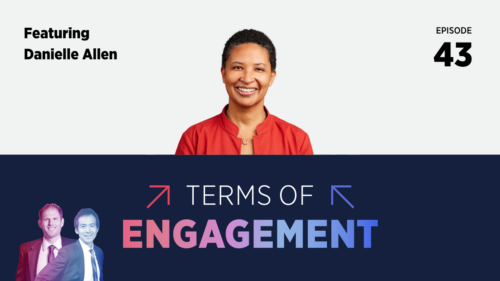
Intro: You’re listening to Terms of Engagement, a weekly show from the Ash Center for Democratic Governance and Innovation at Harvard Kennedy School, featuring Ash Center Director Archon Fung and Senior Practice Fellow in American Democracy, Steven Richer. Now let’s get to the show.
Archon Fung: Hey, welcome to season three of Terms of Engagement. My name’s Archon Fung. I’m a professor at the Harvard Kennedy School and Director of the Ash Center for Democratic Governance and Innovation.
Stephen Richer: And I’m Steven Richer. I’m a former elected official from Arizona, and now I’m a fellow at the Ash Center.
Archon Fung: And as always, Steven and I are speaking as individuals, not on behalf of Harvard University or the Kennedy School or the Ash Center.
Stephen Richer: Yes. So Archon, welcome back. Good to see you.
Archon Fung: Welcome back. Good to see you. It’s been a few weeks.
Stephen Richer: Good to see all of our guests. Thank you for rejoining us for season three. We’ve been enjoying doing these. Hopefully you’ve been enjoying watching them. I know Archon and I have appreciated the opportunity to learn from a lot of different experts on a wide range of political topics pertaining to American democracy, but today really gets to the crux of American democracy because we’re going to be talking about the Declaration of Independence. And as I saw those words come up on the screen, I actually wanted to start singing from the Schuyler Sisters component of Hamilton. We hold these truths to be self-evident that all men are created equal, but I won’t pain you with the rest of my rendition from Hamilton, but we are going to be talking about the declaration. It’s important 250 years later. I think it was yesterday, this day in 1776 when Thomas Jefferson completed the draft, I want to say, of the Declaration.
But fortunately, we’re going to have a real expert to answer these questions and to discuss two of her books and what the Declaration means today. And so, I’m going to turn it over to Archon to introduce our guests.
Archon Fung: Great. And so, this show is celebrating this weekend, as Steven said, the 250th anniversary of the Declaration. And the one word for that, which everybody should learn for the show is semi-quincentennial, which literally means half of 500 years. So, we have a great, great guest, a friend of the stream to talk about the declaration along with her new book, which we’ll get into in a moment. And of course, our guest today is Danielle Allen, who’s a political theorist at Harvard, a colleague here at the Kennedy School. She is the James Brian Conant University professor and directs the Allen Lab for Democracy Renovation. She’s a past winner of the MacArthur Genius Grant, former chair of the Mellon Foundation Board and author of books ranging from “Talking to Strangers,” to “Cuz,” to “Justice by Means of Democracy.” And in 2014, she published our “Declaration, A Reading of the Declaration of Independence in Defense of Equality,” which is almost a page by page, line by line reading of the Declaration.
And we’ll talk about that in just a moment. And we’ll also talk a little bit about her new book, which is just hot off the presses called “Radical Duke,” which is about the third Duke of Richmond. And in many ways it is a sequel, although Danielle doesn’t, I don’t think, frame it this way, a sequel to the 2014 “Our Declaration,” both dealing with the revolutionary period on either side of the Atlantic Ocean. So everyone, welcome Danielle Allen.
Danielle Allen: Thank you, Archon. Thank you, Steven. Good to see you both again. I’m glad to be here for this fun conversation.
Stephen Richer: Great. Thank you. And I’ll see you on campus soon. I’m in Phoenix now, but I’ll be back in Boston area in August. So the best part about doing this for our economy is we get to ask the first questions of our celebrated guests, but we do want to hear from you as well. So if you do have questions, please feel free to put them in the comment box. I’ll be keeping an eye on those and working them into the conversation. So Archon, where do you want to start?
Archon Fung: So let’s just get right into it on the two big ideas that people thinking about democracy have been talking about for a long, long time are freedom and equality. And on this show, I’m a little bit of the freedom guy and Steven’s a litle bit of
Stephen Richer: The freedom guy. No, no, no, no, no. Other way, you’re the equality guy. I’m the freedom. Oh
Archon Fung: Yeah, I’m the equality guy. Oh, I misspoke. I’m the equality guy
Stephen Richer: And
Archon Fung: Steven is the freedom guy.
Stephen Richer: Don’t you dare try and tag me with an equality line.
Archon Fung: We’ll talk about how they relate, but you open your book about the declaration by talking a lot about freedom and equality. And you say that the freedom part of the declaration has received a lot of attention and the equality part somewhat less attention, but you think the equality part is actually the larger half in the declaration if I have it right. So why don’t we just dive into it? What kind of equality is expressed in the declaration and how do you think those two big ideas relate for Thomas Jefferson and Adams and others?
Danielle Allen: Sure. No, I appreciate that. Thank you. And well, basically the way the two of you fit together, that’s the way freedom and equality fit together, like hand and glove essentially. It’s important for people to understand that the definition of freedom that the 18th century used drew deeply from ancient traditions, especially Roman traditions. The definition was really one of freedom from domination. That meant you didn’t want to be subject to anybody’s arbitrary control and that freedom from domination requires you both to have access to being able to steer your own life in your private life, but also to be able to steer the public. And the only way you can do that is actually without dominating somebody else in turn, is to do that by sharing power with everybody, by being political equals with your fellow citizens. So freedom from domination requires political equality. You cannot achieve it for everybody universally without political equality.
Now that’s only one of the ways equality comes into the declaration, that idea of political equality. There’s a second way that’s also really important. The fact that we humans sort of deserve to have freedom from domination also reflects something about what we are as creatures on this planet. We are creatures with purposes, striving to make tomorrow better than yesterday. That’s really what the kind of idea of pursuit of happiness means. And we are all equal in being those kinds of striving creatures. So that striving is our innate desire for freedom and we seek it, we pursue it precisely because it actually empowers us to achieve our full flourishing and we have that drive equally. We’re all different, lots of differences among us, but in terms of what kinds of creatures we are, that is something that we all share. So there’s that kind of fundamental human moral equality.
That human moral equality is partly reflected in our shared love of freedom, our striving to pursue our happiness. And then to achieve that, we all need freedom from domination, which means we need political equality to realize that.
Stephen Richer: So how is this beyond the normal throwaway line that maybe freedom zealous people say about equality, which is not equality of outcome but equality under the law. And then that’s what we mean by equality and that’s sort of the extent of it.
Danielle Allen: Yeah. No. So if you think to answer that question, people actually have to understand that what happened in the 19th century to the concepts of freedom and equality. All right. The 18th century gifted us a political universe where freedom and equality were totally linked to each other. And then in the 19th century, we had industrialization. We had the rise of these sort of industrial cities with working class immiseration. We had the rise of communism as a response to that. And Karl Marx, for example, argued that the path to emancipation required infringement of the rights of the bourgeoisie. So that’s his literal language, right? Infringement of the rights of the bourgeoisie.
And at that point in time, we start getting this kind of conflict between those kind of basic rights of property that had been protected under earlier conceptions of freedom and an equality that became focused on economic equality, sort of Christian material outputs and so forth. And so at that point in time, the concept of freedom, the kind of common understanding of it starts to shift instead of understanding it as freedom from domination, people begin to think of it as freedom from interference, from that kind of infringement that Marx was talking about. And so then you get this view that freedom is about freedom from governmental interference and government has the job of delivering egalitarian economic outputs. And so then that kind of frames a lot of the conflict of the 20th century. So in that regard, that sort of definition of freedom, Steven, that you were asking about is a kind of… I almost think it was a bit of blinders that sort of comes from the late 19th to 20th century. It prevents people from seeing the full rich content of the 18th century arguments about how freedom and equality are linked to each other.
Archon Fung: We have a great question in the chat already, which is, did the signers of the declaration agree with the principles? And we’re beginning to talk about some of those principles of freedom and equality, and I’ll talk about more as we go on. Or as Jeff says, were they more concerned with the document to convince other people to support and join the revolution? So is it more of a statement of principles or more of a, come join us because we’ve got to fight King George?
Danielle Allen: Yeah, that’s a great question. It’s definitely not either or. It’s both and. It was absolutely a statement of principles that they did actually subscribe to. And I can say more about that in a second. And of course, yes, it also had a really important political purpose. Interestingly, those two things come together. They recognize that doing something like starting a whole revolution, building a new society, you were actually only going to achieve the kind of political coalescence of a coalition if you actually could ground that in values that people could sign onto and share. So the values matter substantively and they actually matter politically. You’re not going to get where you’re going without having clarity about the kind of anchoring values. Let me just say two words about how we know that they did care about these values substantively. For starters, that all important second sentence that starts with, “We hold these truths to be self-evident, all men, all people are created equal” and so forth.
That language flowed immediately into drafts of state constitutions. For example, in Massachusetts, also in Vermont, Vermont was its own country at the time, not a state. It still sometimes feels like its own country and then Pennsylvania as well. And based on that legal structure, the sort of preamble language about natural rights, slavery was actually abolished in Massachusetts, Vermont and Pennsylvania before the end of the Revolutionary War. So that is how seriously they took those principles. It caused immediate and radical change. But as I said, at the same time, yes, they absolutely were trying to rally folks. If you don’t mind, maybe I’ll just say one more word about that.
Archon Fung: Please.
Danielle Allen: That long second sentence, the self-evident truth sentence, it’s a set of clauses for that clauses in a row. Okay. They all belong together. A whole package is what philosophers call a syllagism, but the last clause lays out the job of citizens in a self-governing constitutional democracy or Democratic Republic. And that job is to consider whenever government is not securing rights and when it’s failing to do that, then it’s the route of the people as they wrote to alter or to abolish it and to institute new government laying its foundation on such principles and organizing its powers in such form is to them shall see most likely to affect their safety and happiness. So they were actually explicit that the job of governing and the job of being a citizen is to lay the foundation on principle and then figure out how to organize the powers of government.
And they did that consistently. The Declaration was a statement of principle. Articles of Confederation was the governing instrument. They came to the Constitutional Convention, they asked the same question, “Do we need a new statement of principle or just a new governing instrument?” They decided they didn’t need a new statement of principle, so they just rewrote the governing instrument and we got the Constitution instead of the Articles of Confederation. I’m going on at length because they took principles so seriously that you cannot understand the politics of the period if you don’t recognize that first fact.
Archon Fung: Oh, that’s great. And this follows up a little bit on Jeff’s question. So Steven and I, we have our differences about freedom and equality, but I think at root, both of us accept that both have some important role to play and what the balance is and what the relationship is all three of us can talk about and disagree about, but they’re there. And so my question here is who is the declaration who’s Thomas Jefferson, the other signers, who are they arguing against and what do they think? Are the people that they’re arguing against doubting freedom and equality or is it more the implementation that they’re doubting that, “Oh no, King George is protecting our freedom and equality.” No, he’s not. So where’s the disagreement and who’s it with?
Danielle Allen: Yeah, no, that’s a great question. And the politics of the period are actually exceptionally complicated. So they’re sort of layered audiences here. At one level, it’s true that the statement about natural rights and freedom and equality in the declaration is really continuous with what is at that point a century and a half long wig political tradition as it’s called a tradition in England of advocating for the kind of basic rights of English subjects. So even though they were subjects under a monarchy, they considered themselves to have rights to trial by jury, rights to parliament, rights of contract, property, et cetera, a whole lot of stuff that we now also think of as our basic rights. So many people saw the declaration that way. It was just a kind of yet another statement of British subjects, but there are a couple of critical differences here. So on was their diagnosis as was also the case for people in Britain was that the king was no longer respecting basic rights so that there were people who had actually moved away from the idea that rights should be protected.
The king was throwing people in prison for sedition. So free press was kind of disintegrating, ditto juries were being interfered with. So rights trialed by juries were disintegrating, et cetera. So there’s kind of like an argument against a cluster of people around the king who were genuinely eroding that sort of bucket of basic rights and liberties, that sort of argument one. But then there’s argument two, to your point, there were people in England who said, “Well, yes, this king is doing that, but it’s an implementation failure, but there’s nothing fundamentally wrong with monarchy. We just need a different king.” And the Americans are saying like, “No, it’s not enough just to have a different king unless it is government by the people, consent of the governed, you will never actually have a government for the people. ” Lincoln gives us actually the pithiest summary of that argument in the Declaration of Independence.
Archon Fung: Wow, that’s terrific.
Stephen Richer: So elevating equality to the level of liberty and freedom in the declaration. I know that you’re very concerned about the state of civic education. So if you ask most people, most Americans about the Declaration of Independence, they might invoke National Treasure and Nicholas Cage, but if you scratch a level deeper and some people who have at least some familiarity with the declaration will usually talk about in the Lockean tradition of establishment of natural rights. So when did the equality component take a backseat? Was it really that time period that you were talking about in the 19th century or was that gradual or is that a more recent manifestation?
Danielle Allen: That’s a great question. It’s an especially important question because there’s a sort of paradox in it because the very concept of natural rights is a concept of equality. So although people think that the natural rights concept is a liberty concept, I mean, the whole point is like everybody has them and that’s equality. So then how did people stop seeing the equality part of it? I mean, I think is a great way of thinking about the question. And I think it was one of those things, it was like slow and then fast essentially. So there was this sort of buildup in the 19th century that I described and that sort of new conflict between capitalism and communism, which was cast in this language of communism interferes with liberty for the sake of equality and capitalism defends liberty, doesn’t care about equality. That became a kind of frame in economic policy, but it got reinforced by things that were happening in other parts of the philosophical tradition.
So when I was giving that first account of freedom from domination, I said that that freedom has two parts. It’s like, you got to be free in your private sphere to do your own thing, but you also need the freedom of participating in the public sphere to help steer the collective ship. And over the course of the 19th century, there are a lot of liberals, Benjamin Constant first, and John Stewart Mill goes up to Isaiah Berlin who start to argue that that sort of participatory steering part, it doesn’t really matter that much. As long as your private rights are protected, that’s okay. So people lose sight of that kind of really core element of our equality, which is we are supposed to all have access to governance. And so that weakens the case for equality and it allows the kind of material economic questions to really just stand in for the equality conversation.
So then you get to the Cold War, like the hard conflict between the US and the Soviet Union and that’s the fast moment. That’s what crystallizes those frames and suddenly it really just is about a capitalism and communism or like the stand-ins for this conversation about liberty and equality and political equality sort of disappears.
Stephen Richer: Let me see if I can get this right. So perhaps a John Stewart Mill acolyte would say political liberties are merely to secure economic and civil liberties and you can envision a world in which natural rights are respected as reflected in the declaration, even if you don’t have a democratic form of government in which you have equal political opportunity. And you’re saying that no, that political equality is a necessary ingredient for the freedom components of natural rights.
Danielle Allen: Yes, yes, more or less with little kind of caveats around the Mill interpretation, but yes.
Stephen Richer: Okay. Well, you’re the political theorist experts, not me. No,
Danielle Allen: It’s okay.
Archon Fung: Yeah. And so in this kind of philosophical literature that Danielle was just talking about, people make a distinction between the liberty of the moderns and the liberty of the ancients, where the liberty of the moderns is more Lockean, is more, “It’s my toothbrush, my house,” not to trivialize it.
Danielle Allen: Commercial interests.
Archon Fung: Exactly. Yeah. Liberty of the ancients is the participatory is Aristotle; somebody going to the forum and having his or her say, right and you’re trying to bring them both together and rescue the political freedom part of it.
Danielle Allen: Exactly.
Archon Fung: Yeah. I want to continue on. There’s lots of discussion in the chat, very important and relevant. And I wanted to pick up on something that is in different ways, probably on a lot of people’s minds, which is the issue of all men are created equal. And at that time, the political equality wasn’t even all men. It was all propertied men. It was quite narrow, not enslaved people, not women, not –
Danielle Allen: It was actually women at that time. It narrowed later, actually. People don’t know that, but yeah.
Archon Fung: Interesting. And probably some people in the chat and watching don’t know also that, you devote many pages to this, is some of the drafts in particular Jefferson’s original draft had a passage condemning slavery and you have this great word I wish I’d written down the quote about it wasn’t tortured and not complicated, but something like that about Jefferson’s relationship with slavery, which is a fantastic line. And I’m sorry, I can’t reconcile. No,
Danielle Allen: Don’t worry. Don’t worry.
Archon Fung: And so, I’ll just read a couple sentences from the draft that didn’t make it into the National Archives Virgin that Jefferson evidently wrote. And Jefferson said he, that is King George, has waged cruel war against human nature itself, violating its most sacred rights of life and liberty in the persons of a distant people who never offended him, captivating and carrying them into slavery in another hemisphere or to incur miserable death in their transportation thither. This is piratical warfare, the opprobrium of infidel powers is the warfare of the Christian king of Great Britain, determined to keep an open market where men should be bought and sold on and on and on.
So it’s quite a eloquent condemnation of slavery that didn’t make it in. So how do you read the contemporary debate about slavery and why the all men are created equal didn’t take a more inclusive cast in the declaration, ended up not in the one that everybody signed.
It narrowed.
Danielle Allen: Yeah. No, I mean, so I guess I’ll push back on that interpretation in a couple of ways. So for starters, it’s always just important to remember that the declaration was drafted by a committee and Jefferson was one of five members of that committee. The others were John Adams from Massachusetts and he never held people in bondage and always thought enslavement was wrong. Benjamin Franklin from Pennsylvania who had held people in bondage earlier in his life, but had repudiated the practice by 1776 and was now an abolitionist, Roger Sherman from Connecticut and Robert Livingston from New York. So that matters because they were obviously having a kind of big conversation here. Yes, Jefferson wrote the first draft. It’s his eloquence that defines the rhetoric of the document for sure, but it’s very much a collective statement.
And yes, so for your point, first of all, that draft passage, it uses the same language of sacred rights for the people, distant people in Africa as the colonists were using for themselves. So that’s a very powerful statement of human equality. And although that passage gets cut out, that meaning doesn’t disappear because it’s what then supports the abolishment of enslavement in Massachusetts, Pennsylvania and Vermont before the end of the Revolutionary War. So it does its job even without that paragraph in the draft form. Also the phrase life, liberty of the pursuit of happiness, happiness is replacing property. Property would have been the standard Lockean phrase that the natural rights are life, liberty and property. But it’s Adams who puts happiness in there. He’s been writing about happiness all year, not Jefferson Adams. And he’s doing this precisely in order to stave off a right to slavery claim because the right to property by the spring of 1776 is already being connected to a defense of the right to enslave people.
This comes up in debates about the articles of Confederation as well. So at any rate, the sort of life literally, the pursuit of happiness phrase also anchors that abolitionist orientation. So the passage is a loss for sure that they didn’t get that full condemnation of the slave trade, but they didn’t lose the operable parts of it that were actually in fact already crystallizing the beginnings of abolitionism. And the last thing I’ll just say here with regard to women, the fact that in that paragraph where they criticize the slave trade, they also criticize the auctions where men, and it’s written in all caps, are bought and sold, is a real tell that they were genuinely using the word men in a universal sense, that sort of 18th century universalizing, because it wasn’t just males who were sold, right? It was also females who were sold. It was children as well as adults.
So they did use men in a universal sense and they began to operationalize it with the end of enslavement in Massachusetts and Pennsylvania before the end of the Revolutionary War. And women could vote in some states at that time. It wasn’t until 1807 that women lost the right to vote everywhere.
Stephen Richer: That’s great. Good. How do you think we would… Talk to me about the assessment of where we’re at today vis-a-vis the declaration because part of that is assessing the declaration through a contemporary lens of our understanding of equality, but then flipping that, assessing modern society, I think a lot of people like to play this as a parlor game, what would the founders think of society today? Because going through all of these sins committed by King George, some of them seems like peccadillos in light of today’s society seem pretty minor. So do you think we’re holding up?
Danielle Allen: Well, I think for starters, every generation does need to have this reconsideration. I think we’re quite fortunate that it is that semi-quincentennial so that we can do this. Jefferson said this chilling thing that the tree of liberty needs to be watered with the blood of tyrants once a generation or something like that. I just think that’s a horrible, horrible idea and it’s sort of so much better that we should water the tree of liberty by reconsidering some of these basic concepts and basic kind of framing documents. So from my point of view, the easiest crib for knowing how to use the declaration to think about contemporary questions actually comes from Lincoln and it comes from the Gettysburg Address. He does two things in that address. He’s standing there at a battlefield where thousands of men have just died, like the worst casualties of the Civil War and it’s just been a horrific human tragedy.
And he takes those destiny, describes them as rededicating the nation to this founding proposition that all people are created equal. And so he’s right and he consistently in his work pulls out that proposition as he calls it the golden apple and the constitution is just a silver frame whose job is to hold that golden apple about the dedication to human equality in place. And so then you have the question of, well, how do you evaluate how well you’re doing with that? And that’s where the end of the Gettysburg Address gives a great answer to that when Lincoln says he hopes that never will perish from this earth a government of the people that is also for the people because it’s by the people or in his phrase government of the people by the people for the people. And it’s that last pairing government by the people for the people that is so important.
The argument is really that government can only ever be for the people if it is fully by the people. And so then that’s the check. Right now, a lot of people would say, “No, this government is not for us. It’s not solving rising prices. It’s not solving climate change. It’s not solving housing. It’s not solving mobility.” We see all kinds of ways in which our government is not for the people. And so then we have to ask, “Well, can we trace that back to it’s not being by the people? ” And indeed we can. We are watching a government that’s been captured because of the way money plays in politics. We are watching concentrations of power between in the technology industry, concentrations of power and capital. We’re watching an executive branch that has also consolidated power and taken away the steering wheel from the first branch, Congress, which is supposed to be the voice of the people.
So then the real question is like, what can we fix so that we actually have government by the people again? And so that’s why I’m committed to democracy renovation because I think there’s a list of things that we could do to make sure that government is once again by the people and not captured by particular interests and therefore steering it off the rails away from the direction that is for the people.
I hope that made sense.
Stephen Richer: Yes, it does. I do think that there’s pretty broad consensus that American government right now is not necessarily responsive and reflective of the American populace. I think actually that explains a decent amount of the Trump movement was a certain class of Americans feeling like Washington DC had become wholly disconnected from their concerns of everyday life. Where I think people would be differ is sort of the causal link in your analysis there and then of course how to solve it, I’m sure there would be lots of differences on. Although some of the things that you have made a critical part of your professional work and talk about a lot are broadly accepted but not always as effectively implemented or funded. When I think of the commitment to civics learning and the funding of civics learning, I feel like only over the past 10 or 15 years has there been a renewed Figure for that.
Danielle Allen: Yeah. Yeah. No, you’re right about that. I mean, civic learning, but you’re right. But we hit bottom basically is my view about a decade ago and we’re inching our way back up, not sprinting our way back up, but inching our way back up, but we’re directionally headed in the right direction. There is widespread agreement across ideological lines in the country about the problem of money and politics and widespread interest in addressing that. I think my own, if I had to bet, I think after this long drought for constitutional amendments, I think the first one that’s going to get through is the For the People Amendment, which undoes the effects of Citizens United and puts it back in a place where we can actually control money and politics. There’s an organization, American Promise, working on that and I think they’ve got 25 states at this point that have signed, passed resolutions to call on Congress to start an amendment process.
They have to get up to two thirds of the states, but the last two states that signed on were Oklahoma and I think Idaho. And I think Oklahoma, it was unanimous in the state legislature signing on for this. So that’s a case where there is actually, I think, pretty widespread agreement. It’s not implemented yet, so we can’t know the effect. And then I think there’s lots of hard work going on around our electoral systems. How can we get out of the two-party doom loop as Lee Dropman has described it, the sort of duopolistic control, which is squeezing power out and taking it away from ordinary people and really captured by the small establishment interests in both parties that control those structures.
Stephen Richer: Yeah, definitely. What was I going to say? I do want to point to one of the questions, which is what is the role of K-12 and higher education in this renovation that comes in from Julian through LinkedIn?
Danielle Allen: Yeah, no, it’s a great, great question. So for me, I suppose when I think about that government that is for the people because it is by the people, the by the people part has two halves. It has an institutional half and that’s kind of what I’ve just been naming with reference to all those reforms, but then there’s also sort of civic culture half. So the people needs to have combination knowledge and skills and dispositions that really empower them to be effective in exercising their steering capacity. So we have this structure of rights that should give us steering capacity. Right now, the institutions have been distorted in ways that actually block us from our steering capacity, but if they were undistorted, it would still be the case that people also need those kind of cultural supports to be ready to lean in and sort of take advantage of that opportunity to steer.
Stephen Richer: And incidentally, on the American Promise front and on the campaign finance reform and on Citizens United, we should say that we’re speaking on a day in which though the blockbuster decision was perhaps the birthright citizenship case, one of the three opinions released from the Supreme Court today was on campaign finance and it was a more permissive structure for spending by political parties and the limits or now lack of limits on coordinated spending between the political parties and the candidates. So certainly, a very live issue
Archon Fung: For sure. Danielle, one of the great features of your book is you argue that the structure of the declaration has these three different parts and I wanted to articulate the parts and then think about how we’re doing in now in 2026 on those three parts. And so one, the very first part, the first paragraph is a statement of principles and who we are. We are people created equal endowed with certain inalienable rights. And so that’s like laying out a subject, an American subject. So that’s the first part. The second, which is most of the declaration is how are we doing on those statement of principles? And those are all of the complaints about King George and the many, many violations. And so we most just now, it’s kicked off by Steven’s question, mostly been talking about that second part, the how are we doing? And then there’s a third part is if we’re not doing well, then what kind of commitment do we have to make it better? And that the declaration ends with the commitment of our lives, our fortunes, and our sacred honor.
So maybe let’s talk, if you would, a little bit about the first and the third is how are we doing on that first? There’s a lot of discussion now that a big part of movements in political America want to reject the credal nature of who an American is and are positing some other idea, Heritage American, right? That’s like different and somewhat novel, at least in my lifetime.
And then the third part, what kind of commitment do we have? Who’s down for committing our lives, our fortune, and our sacred honor to this project of renovation and improvement?
Danielle Allen: Well, I’m asking people that question every single day. That second question, I’m like, “Yeah, I need you. I need you. Are you with us on this? ” So that is the question. I mean, it’s a growing community of people, I will say. I think every month there are more people who I think get connected to the idea that addressing some of these core features of our institutions is what we need to unlock our system so it performs better for all of us. But yes, you’re right, that question of is there commitment is a key one because we can’t get there unless we can really build a national community of people ready to embrace that commitment with that degree of seriousness. Maybe one more thing there before coming back to the first half of your question, this really is a second gilded age. Sam Wong at Princeton is really good at articulating that.
And so in that regard, the first gilded age did then lead to a whole slew of reforms as people try to get the Constitution rebalanced, essentially. And I do believe that that’s where we’re headed too in this country, that over the course of the next 10 years, we will see meaningful reform. So in terms of the kind of nation question, yeah, I disagree with the vice president is how I would put it most bluntly. And again, I would call on Lincoln again. I mean, sort of Lincoln called the Declaration of Independence and electric cord that connects not just all Americans actually, but all of humanity. I mean, it was a really strong statement. He made this statement in a context of reflecting on the impacts of German and Irish immigration to America. And he’s like, “It doesn’t matter how long these people have been here. As long as they’re connected to the electric cord of the declaration and these sort of propositions, they are American.
And the beautiful thing about these propositions is that anybody anywhere on the globe can actually connect to them. That is their power. So I would affirm that again. I think that does matter. I will say, and I’ve heard people say, well, yes, and even if you’re a Creole nation, you need a set of cultural practices to go with that. Sure. Yeah. No, I would agree with that and accept that. But what makes us the Americans is the acceptance of the creed and then the acceptance of the practices that go with that. And it doesn’t take inheritance through your DNA to accept those practices. You can choose to accept them.
Stephen Richer: Yeah. I like that. The Declaration is an electric cord that runs through the American people. All right. I’ll try and use that this weekend at least once. I know that you have a hard stop in not too, too long, but if we have a few minutes, tell us about your new book, which came out very recently, why you wrote it and how it fits into your understanding of the Declaration.
Danielle Allen: Oh, thanks, Steven. I appreciate your asking. So yes, my new book is called “Radical Duke: How One Aristocrats and the American Revolution Transformed Britain.” And Archon’s right. It is basically a sequel to the Declaration of Independence book. It started from it and from some continuing research that came out of that book. That continuing research led me to this crazy discovery of this beautiful ceremonial parchment of the Declaration of Independence in Southern England. People had thought that there was one. It’s in the National Archives in DC. Turns out there’s a second one. And so then there was a mystery to solve about how it got there. And the answer turns out to be this character, Charles Lennox, the third Duke of Richmond, who was a total hoity-toity aristocrat and yet sort of pushed that aristocratic background aside. It became one of the most important radicals in 18th century Britain. He was Thomas Payne’s first political patron and he also introduced a bill for universal manhood suffrage in parliament in 1780. So the book is the sort of story of the Duke, how he got involved with the Americans, how he got this Parchment Declaration of Independence and the kind of radical movement that he helped spawn in Britain in the late 18th century.
Archon Fung: It’s terrific. I confess I’m only about halfway through it and I learned yesterday…
Danielle Allen: Oh my gosh. Well, thank you, Archon for jumping in. I so appreciate that.
Archon Fung: I learned from you yesterday that he was probably one of the best-looking people in England at the time.
Danielle Allen: Yes. He was called the most beautiful man in England and he and his wife, the prettiest couple in England and so forth. They were very glamorous, very glamorous.
Stephen Richer: It’s nice to know that some things don’t change, that that was an asset then. It’s probably an asset for your public persona now, which is why I’ve always said Archon does so well in academia.
Danielle Allen: Right, exactly.
Archon Fung: All right. So going out, we only have a few minutes left. What are you guys doing to mark the fourth and what would you like people in the audience to do to mark the fourth?
Danielle Allen: I appreciate that. Well, I always say the same thing. I hope you will read the Declaration of Independence out loud.
Archon Fung: Oh, out loud.
Danielle Allen: Out loud. Out loud. And when you do, I hope you will also make sure to read the full second sentence as one sentence. It starts with, “We hold these truths to be self-evident. It does not end at pursuit of happiness.” So if there’s a period there, ignore that. That’s a typo that cracked into the text at a certain point. Go all the way to the phrase safety and happiness. It’s a collective safety and happiness. The sentence moves from I to we. So here the whole sentence about self-evident truths, that would be my request.
Archon Fung: That’s terrific. And for those of you who haven’t, you should read Danielle’s book, Our Declaration. It is full of insights into a close, close reading of the Declaration, which is after all only about 1300 words.
Stephen Richer: Yeah. And I skimmed through that one. That’s the one I had time to skim through and enjoyed it. And now I have the declaration, or excuse me, the Duke coming to me through Amazon. So excited about that. If I may ask one final serious thing I’d like you to reflect on. My short answer is I will be watching the World Cup. I will be watching visitors from around the world celebrate the glory that is free refills and American size portions and American beer.
I think the United States will get to the round of eight and that will be a beautiful thing. A lot of people glamorize the founding fathers and they think that it was this weird confluence of circumstances that brought together some of the most exceptional people to have ever lived over 300 years, not just even at that time. Do you think that’s true or do you think that just the circumstances sort of facilitated that and that if we were in similar circumstances today, the Thomas Jeffersons, John Adams’ and James Madisons are present here in our society today, although maybe they would look a little bit different.
Danielle Allen: It’s a great question. I mean, I think it’s a mixture of things. I mean, clearly there were some exceptional talents. Clearly there were other people who simply benefited from being around exceptional talents and there was kind of broader elevation. The colonists benefited from their physical distance from Britain. It took six weeks for a letter to get back and forth and so they genuinely had to invent forms of governing themselves. And so in that regard, I think they’d been thrown into a state of affairs that’s kind of highly unusual over the course of human history. And I think that state of human affairs for them accelerated their learning. Luckily, they then had an appetite for philosophical learning and they didn’t just learn from experience. They combined experiential learning and theoretical learning. And I think it’s like that fusion that made them a really exceptional generation.
Archon Fung: Yeah. And then as now, I think you do a great job of bringing this out, how wide the debates are. People really disagreed with one another on very, very fundamental issues and had it out for this incredibly creative process that was the declaration.
Danielle Allen: Exactly. Yeah. I mean, it was a team sport always all the way through. I mean, that’s why I always sort of insist on talking about the declaration is drafted by a committee. Nothing in a democracy ever happens because one person does something. And so it’s just really, really important to bring out that kind of team sport aspect and that team wrestling, that team fighting and debating. That’s always a part of the story.
Stephen Richer: I’ll take some measure of optimism in that, that it wasn’t merely that the planets were aligned for the only time in a thousand years because sometimes I do feel that way and that we could never achieve sort of governing greatness to that extent. All right Archon, what are you doing for the fourth?
Archon Fung: I’m going to read the declaration out loud and a couple other kind of classic documents to read. It’ll take you less long a third of the time. Read the Gettysburg Address out loud a little bit later. And then right in between in December of 1776, read a few paragraphs of Thomas Payne’s American Crisis. These are the times that try men’s souls, the summer soldier and the Sunshine Patriot will shrink in this crisis. Also, great. I probably won’t go out to Boston Common to watch the Pops because there’s going to be about a billion people there, but every 4th of July, I do like to watch Independence Day, the
Stephen Richer: 1990s movie
Archon Fung: With Will Smith.
Stephen Richer: Absolutely. And actually, Sarah in the office is also somebody who commits to watching Independence Day and the speech by Bill Pullman is like, “Oh, that gets me every single time. That’s one of the things that I’ll try to do. Okay. Well, I think that’s sufficiently patriotic for the director of a center on democratic governance and innovation. So I will officially allow you to stay director of the Ash Center. You’re welcome. That is definitely within my power. It is also within my power to say thank you very much to Danielle for making time for us today. We really appreciate her kicking off season three and thanks to all of you who are watching live and thanks to those of you who watched the recording. Happy 4th of July to everyone. We’re excited to be exploring again another season of current events and how they are connected to broader Democratic ideals and what a way to kick it off, but a discussion of the declaration and the 250th anniversary. And I don’t have the word yet to the point where it just rolls off my tongue.
So I’ll let Archon say it and say final goodbye.
Archon Fung: Semi quincentennial. Yeah. Half of five hundred. All right. Thank you very much.
Danielle Allen: Thank you. Good to see you. Take good care.
Outro: Thank you for listening to Terms of Engagement. Email us your questions, suggestions or thoughts for future episodes. You can find an email address in the show notes below. See you next time.