Racist appeals in American politics used to require deniability. Increasingly, they don’t. Critics on both the left and the right are writing articles with titles like “The G.O.P. Has Gone Off the Deep End” (Jamelle Bouie, New York Times, September 16, 2026) and “The Republican Party Has a Nazi Problem” (Tom Nichols, The Atlantic, February 23, 2026).
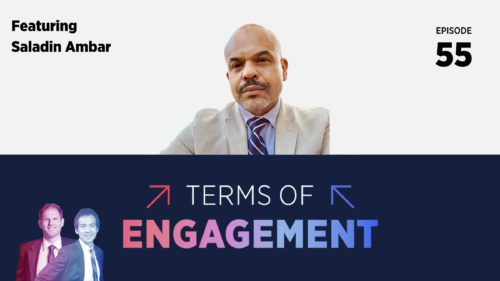
In this episode of Terms of Engagement, Archon Fung and Stephen Richer talk with Saladin Ambar, a political scientist at Rutgers University, about how political discourse has moved from dog whistles to racial invective, what this shift tells us about the fracturing of America and the basis of our democracy, and whether trying to rein such speech in would help or backfire.
Listen to the Audio Podcast
Coming soon!
About our Guest
Saladin Ambar is a Professor of Political Science and Senior Scholar at the Center on the American Governor at Rutgers University’s Eagleton Institute of Politics. He is the winner of the Association of American Publishers’ PROSE Best Book Award in Government and Politics for “Stars and Shadows: The Politics of Interracial Friendship from Jefferson to Obama,” and his “Malcolm X at Oxford Union: Racial Politics in a Global Era” is in development as a feature film. Ambar has served as the Co-Director of the Democracy Committee for New Jersey’s Reparations Council and was a contributor for the Lincoln Presidential Foundation’s docuseries on the Lyceum Address. He has been a fact-checker and contributor for the Smithsonian Channel, CNN’s Race for the White House, and PBS’s MetroFocus. His latest book, “Murder on the Mississippi: The Shocking Crimes That Shaped Abraham Lincoln,” was published in October of 2025 by Diversion Books. His seventh book, “America’s Lost Peace Dividend: Reclaiming the Promise of Demilitarization and Social Uplift,” with Dr. Benjamin Peters, is expected to be published by Oxford University Press in 2027.
About the Hosts
Archon Fung is the Winthrop Laflin McCormack Professor of Citizenship and Self-Government at the Harvard Kennedy School and the Director of the Ash Center for Democratic Governance and Innovation. His research explores policies, practices, and institutional designs that deepen the quality of democratic governance with a focus on public participation, deliberation, and transparency. He has authored five books, four edited collections, and over fifty articles appearing in professional journals. He received two S.B.s — in philosophy and physics — and his Ph.D. in political science from MIT.
Stephen Richer is the former elected Maricopa County Recorder, responsible for voter registration, early voting administration, and public recordings in Maricopa County, Arizona, the fourth largest county in the United States. Prior to being an elected official, Stephen worked at several public policy think tanks and as a business transactions attorney. Stephen received his J.D. and M.A. from The University of Chicago and his B.A. from Tulane University. Stephen has been broadly recognized for his work in elections and American Democracy. In 2021, the Arizona Republic named Stephen “Arizonan of the Year.” In 2022, the Maricopa Bar Association awarded Stephen “Public Law Attorney of the Year.” In 2023, Stephen won “Leader of the Year” from the Arizona Capitol Times. And in 2024, Time Magazine named Stephen a “Defender of Democracy.”
The views expressed on this show are those of the hosts alone and do not necessarily represent the positions of the Ash Center or its affiliates.