
Video  

Do Social Media Platforms Make People Happier?

Social media has become one of the primary ways that families, communities and societies stay connected. As its use becomes increasingly embedded in everyday life, opting out can feel difficult for those who want to remain connected to others. At the same time, critics argue that people may be better off using social media less, or perhaps not at all. Why, then, do people continue to use products they may believe are ultimately harmful to their well-being?

The Program on Democracy and the Informed Public hosted a seminar with Cass Sunstein, Robert Walmsley University Professor at Harvard University and founder and director of the Program on Behavioral Economics and Public Policy at Harvard Law School.

Related Resources

How Americans Navigate Voting Information Ahead of the 2026 Midterm Elections
Captiol building with trend graphic

Additional Resource

How Americans Navigate Voting Information Ahead of the 2026 Midterm Elections

The Shorenstein Center’s 2026 Voting Information Trends project—developed in collaboration with the National Internet Observatory at Northeastern University, the Ash Center for Democratic Governance and Innovation’s Program on Democracy and the Informed Public, and The Civic Health and Institutions Project—provides new insights into the voter information landscape in the United States ahead of the 2026 midterm elections.

Among the resources, an interactive dashboard maps where Americans are finding voting information and learning about key aspects of the voting process—from sourcing polling locations to voter registration. Also included are a series of trends reports gauging perceptions of voting in the lead up to the 2026 midterm elections.

Content Creators, Election Administration, and Voting: Can Social Media Be Used to Improve the Voter Information Environment?
Woman holding phone with a cup of coffee

Video

Content Creators, Election Administration, and Voting: Can Social Media Be Used to Improve the Voter Information Environment?

In this webinar moderated by Tova Wang, director of democratic research projects at the Ash Center, panelists Julia Angwin, Amanda Yarnell, Tommy Gong, and Brianna Wiggity Weck explore how election officials can leverage social media’s reach to improve public awareness around voter registration, voting, and election integrity. The discussion builds on the Ash Center paper, “Building Capacity to Use Social Media: How Election Officials Can Leverage Content Creation to Provide Accurate Voter Information,” which outlines frameworks for collaboration between election officials and digital content creators.

Raising Wages by Changing Norms: Work Policy for the Long Game
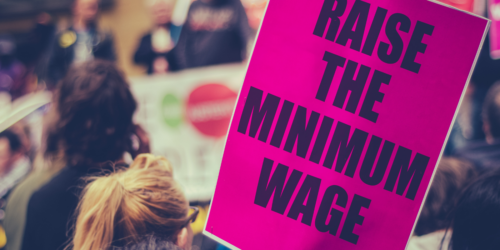
Protest for raising the minimum wage

Policy Brief

Raising Wages by Changing Norms: Work Policy for the Long Game

When Amazon announced a company-wide $15 minimum wage in 2018, the obvious assumption was that every competitor fighting for the same workers would have to match it or lose their workforce. They didn’t. Despite dramatic wage jumps at the companies that voluntarily raised their floors — and real cuts to turnover and hiring costs that made the move pay for itself — researchers find zero evidence of wage spillovers to the “poacher” and “feeder” companies competing in the very same local labor markets. The explanation turns out to say less about generosity than about just how much leverage employers hold over workers who have nowhere else to go.

More on this Issue

How Americans Navigate Voting Information Ahead of the 2026 Midterm Elections
Captiol building with trend graphic

Additional Resource

How Americans Navigate Voting Information Ahead of the 2026 Midterm Elections

The Shorenstein Center’s 2026 Voting Information Trends project—developed in collaboration with the National Internet Observatory at Northeastern University, the Ash Center for Democratic Governance and Innovation’s Program on Democracy and the Informed Public, and The Civic Health and Institutions Project—provides new insights into the voter information landscape in the United States ahead of the 2026 midterm elections.

Among the resources, an interactive dashboard maps where Americans are finding voting information and learning about key aspects of the voting process—from sourcing polling locations to voter registration. Also included are a series of trends reports gauging perceptions of voting in the lead up to the 2026 midterm elections.

Raising Wages by Changing Norms: Work Policy for the Long Game
Protest for raising the minimum wage

Policy Brief

Raising Wages by Changing Norms: Work Policy for the Long Game

When Amazon announced a company-wide $15 minimum wage in 2018, the obvious assumption was that every competitor fighting for the same workers would have to match it or lose their workforce. They didn’t. Despite dramatic wage jumps at the companies that voluntarily raised their floors — and real cuts to turnover and hiring costs that made the move pay for itself — researchers find zero evidence of wage spillovers to the “poacher” and “feeder” companies competing in the very same local labor markets. The explanation turns out to say less about generosity than about just how much leverage employers hold over workers who have nowhere else to go.