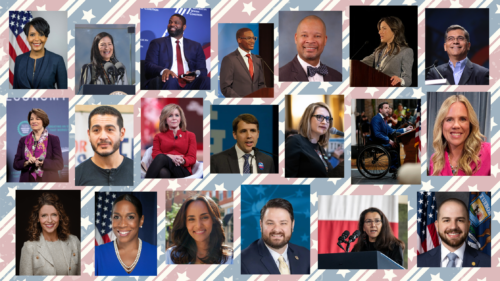
The 2026 midterms changed the balance of power in Washington. They also brought leaders from historically underrepresented backgrounds into governors’ mansions and Congress, giving more Americans the chance to see important aspects of themselves represented in government.
Voters elected the nation’s first Black woman governor, first Native American woman governor, first Muslim senator and first openly gay male senator. Other winners broke barriers within their states, across both major parties.
In Georgia, former Atlanta Mayor Keisha Lance Bottoms, a Democrat, became the first Black woman elected governor of any U.S. state. She will also be Georgia’s first Black governor and first woman governor. In New Mexico, former Interior Secretary Deb Haaland, a member of Laguna Pueblo and a Democrat, became the first Native American woman elected governor. Haaland had already made history as the first Native American to lead a federal Cabinet department.
Three more states elected their first Black governors: Byron Donalds, a Republican, in Florida; David Crowley, a Democrat, in Wisconsin; and Aaron Ford, a Democrat, in Nevada. Alongside Bottoms and reelected Maryland Gov. Wes Moore, they will make up a group of five Black governors serving at the same time. The United States now has the most Black governors ever elected in U.S. history.
Latino candidates made history in two of the country’s largest states. Democrat Gina Hinojosa became Texas’ first Latina governor after defeating incumbent Greg Abbott. In California, Democrat Xavier Becerra became the state’s first elected Latino governor, after Romualdo Pacheco held the office briefly in the 19th century after succeeding another governor.
Women reached several other state milestones. Democrat Amy Klobuchar is Minnesota’s first woman governor-elect, and Republican Marsha Blackburn is Tennessee’s first. Democrat Amy Acton is the first woman elected governor of Ohio; Nancy Hollister served briefly as governor through succession in 1998 and 1999. Counting Georgia, four states elected a woman governor for the first time this year. When the newly elected governors take office in January 2027, there will be at least 15 (and potentially up to 17 with Alaska and Kansas) female governors serving simultaneously in the United States. With these races fully called, women will hold about 34% of all U.S. governorships across the country.
The midterm elections also bring several historic firsts to the Senate. Michigan Democrat Abdul El-Sayed became the first Muslim elected to the chamber. New Hampshire Democrat Chris Pappas will be its first openly gay male member and Minnesota Democrat Peggy Flanagan, a citizen of the White Earth Band of Ojibwe, became the first Native American woman elected to the Senate.
Iowa also elected Democrat Josh Turek, a former Paralympic wheelchair basketball player who was born with spina bifida. Turek had already broken barriers when he became the first disabled member of Iowa’s legislature in 2022. He now becomes the first U.S. Senator with spina bifida.
Two other Senate wins broke state barriers. Democrat Annie Andrews became the first woman elected to the Senate from South Carolina. Republican Julia Letlow became the first Republican woman elected to the Senate from Louisiana. Illinois Democrat Juliana Stratton will join Sen. Tammy Duckworth, making Illinois the first state represented by two women of color in the Senate at the same time. Stratton will also join Angela Alsobrooks and Lisa Blunt Rochester as the first three Black women to serve in the Senate concurrently.
In the House, Colorado Democrat Melat Kiros, 29, became the first woman from Generation Z elected to Congress and the first Black woman elected to Congress from her state. Denise Powell will be Nebraska’s first Latina member of Congress, while Claire Valdez will be New York’s first Native American woman in Congress. Michigan’s Jeremy Moss and Indiana’s JD Ford will become their states’ first openly LGBTQ members of Congress.
Mississippi has added another historic first: Democrat Scott Colom defeated incumbent Cindy Hyde-Smith, becoming the state’s first Black U.S. senator-elect since Reconstruction. The Associated Press called the race on November 11. Two other milestones remain possible. Hakeem Jeffries could become the first Black speaker of the House when the new Congress votes, while Mary Peltola could become the first Alaska Native senator if she wins Alaska’s still-undecided race.
Together, these victories reflect just how many doors opened in a single election. The winners span different regions, generations and political parties, but all their elections are historic. In this moment, progress toward an inclusive multiracial American democracy is worth marking. What they do with their offices will be the next chapter. We look forward to working with these and other elected leaders in the coming years on advancing democracy and self-government, starting with newly elected congressmen and congresswomen at the Institute of Politics’ New Members Orientation next month.