“Elections are one of the greatest investments societies make in democracy. But winning an election and strengthening democracy are not automatically the same goal.”
– Professor Danielle Allen
“How Do Voters Experience Elections?”
After 15 years working in political technology as a campaign practitioner, startup founder, tech builder, and investor, I have watched our sector scale voter contact efforts to an extraordinary degree. We have more tools, more data, more channels, and more reach than at any point in history. And yet voter contact effectiveness has been declining since 2008. Trust in democratic institutions is declining too. Something is being missed.
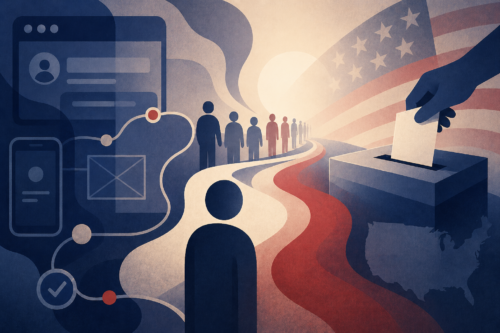
Last May, Professor Bruce Schneier and I introduced the concept of Voter Experience (VX) in a piece published here on the Ash Center site. We asked a simple question: what would happen if we applied user experience (UX) design methodology to elections?
UX is a proven framework for understanding how people interact with products and systems from their own vantage point. Tools like user journey mapping help designers uncover what end users are actually thinking, feeling, and doing at each stage of an experience, and use those insights to design more effectively around their real needs. Bruce’s recent work in “Rewiring Democracy” explores how modern democracies have not kept pace with the technological advances that now shape daily life. How fitting, then, that user experience research, a methodology born in the technology sector, could be applied to help modernize how we understand and serve the people at the center of democracy.
The Voter Experience Convening
In late March, I led an all-day Voter Experience Summit at the Harvard Ash Center as part of my fellowship with the Allen Lab for Democracy Renovation. The event brought together 25 cross-partisan experts who do not typically sit at the same table: UX designers, election administrators, political scientists, behavioral scientists, campaign practitioners, and academic researchers. The goal was not consensus or a finished product. Rather, it was to begin to map the voter experience together, with enough rigor and diversity of perspective that any gaps would become visible. If the exercises proved helpful, we would templatize the framework.
The day opened with an energizing set of short, back-to-back lightning talks to begin our exploration of the voter experience concept from multiple expert perspectives. Next, Anyi Sun and Emily Fishbaine of Koi Studios designed and facilitated a Voter Journey Mapping exercise.
The Voter Journey maps divided the voter experience into seven sections:
- Ambient Civic Awareness
- Candidate and Issue Discovery
- Sense-Making & Decisioning Processes
- Registration
- Vote Casting
- Results & Reactions
- Governance Experience
Participants were divided into small groups tasked with mapping the priorities of three key actors at each stage: voters, campaigns, and election administrators. For each stage, small groups documented voter actions, thoughts, feelings, pain points, opportunities, and an evaluation of stakeholder alignment across all three actors. Persona guides covered six large blocks of voting and non-voting citizen demographics, helping groups incorporate multiple experience sets.
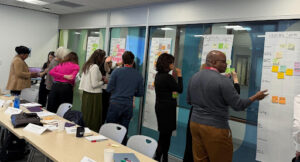
Over the course of two hours, a fascinating and colorful journey map took shape. As the group digested the map, a highly insightful and honest conversation about voter experience emerged.
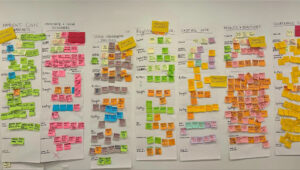
What the Voter Journey Map Showed Us
The exercise surfaced a set of persistent questions and tensions that are difficult to see from inside any single stakeholder’s vantage point. These are not conclusions. They are the observations this exercise made precise enough to act on.
- The voter is the only actor who experiences the whole arc. Campaigns see their slice. Election administrators see their slice. But the voter walks through all seven stages, accumulating every friction, every silence, every moment of confusion or overload or inspiration, into one continuous experience happening on top of daily life. No other entity is watching that whole arc. No stakeholder is accountable for cumulative effects. If that is true, a user-focused VX framework can directly help surface new insights and opportunities.
- The most persistent through-line was this: voters (and nonvoters) are constantly evaluating whether their participation is worth it. At nearly every stage of the journey, from discovering candidates to casting a ballot to watching election results come in, the underlying question identified by the group was that beneath the surface there is a version of “does my participation actually matter?” If that question will not get answered by more voter contact, can it be answered with better design?
- Misaligned incentives drive the gap between winning elections and strengthening democracy: So where does the misalignment actually live? Campaigns, election administrators, and voters each prioritize different things at different moments for fundamentally different reasons. Of the seven stages we mapped, nearly all showed partial or full misalignment. Only at the phase of Vote Casting did groups agree there was near-alignment, and even that was debated. Making those gaps visible and specific, stage by stage, is what opens the door to potential interventions.
- If voting is a leap of faith, do specific emotional moments matter more? Voters may not experience elections linearly. They loop, double back, opt out and re-enter, carrying residue from past cycles into new ones. The exercise surfaced moments of particular emotional and ethical intensity, such as registering to vote and filling in a ballot, during which the connection between an individual’s action and a much larger societal outcome has to be believed, not just understood. Voter sentiment is typically only defined by time-bound issue polling, but mapping the emotional texture of key milestones is where human-centered design adds something genuinely new. The “I Voted” sticker is a great start. How else could these moments be strengthened?
- In civic participation: non-voting is an outcome, not a character flaw. When looking at a nonvoter’s path through the journey map, the drop-off points are not mysterious. They are often rational responses within lived experiences. Re-situating some of the responsibility for not voting within a collection of actions from multiple stakeholders rather than placing it entirely on nonvoters themselves opens up enormous opportunities for intervention and improvement. What else might we learn by listening to non-voters in their own words?
- Finally, the post-election period is the single greatest missed opportunity in the entire journey. The Results and Reactions stage generated more emotional content than any other stage we mapped. Voters are maximally activated in the days and weeks immediately up to and after an election and the system goes almost completely silent. There is often no follow-up, no acknowledgment, no relationship maintenance, even when that is not the intent. Closing the loop, even partially, could have an outsized effect on long-term civic engagement and institutional trust.
The summit also surfaced questions we are still sitting with. Can voter experience be optimized within systems where incentives are structurally misaligned? Is voter satisfaction always the same as democratic health? And if a significant portion of the population is materially worse off than they were a decade ago, will better designed touchpoints matter? When looking toward evaluation of VX interventions: How would we measure improvements in voter experience when poor practices still dominate the cycle? We do not have clean answers to those questions. But naming them is our first step.
Where We Go From Here:
If elections are the greatest investment societies make in democracy, as Professor Allen opened the day by reminding us, then the incentive gap between winning an election and strengthening democracy is not inevitable.
Empowering the stakeholders who are part of elections to examine and improve voter experience, using the kind of human-centered design thinking this exercise demonstrated, could improve civic trust, increase campaign efficiency and efficacy, and reinforce democracy itself. Rather than a top-down approach, the most promising path forward lies in equipping local groups to apply this framework to identify their own unique impact points. If our conference room full of stakeholders can generate new insights and open up so many new perspectives in a matter of hours, imagine what’s possible when groups around the country engage in this exercise and make it their own.
Next, we are building a replicable template: a version of this voter journey mapping exercise that any organization can run with their own team. Whether you are a county clerk, a campaign manager, a candidate, a civic organization, or a nonprofit that reaches voters in any way, this template will help you identify where you are specifically situated to move the needle on voter experience, and what that could mean for your mission and your results.
We are looking to connect with early partners willing to go through the exercise and implement one or more voter experience interventions in the 2026 cycle. The midterms are an opportunity to learn in real time. Interested in getting involved?
We would love to hear from you.
Special Gratitude:
VX Lightning Talk Speakers
Amelia Powers Gardner, Senior Fellow at the Joseph Rainey Center and former Utah County Clerk, on election administration as trust infrastructure.
Professor Samuel Wang of Princeton’s Gerrymandering Project, on the mathematics of political polarization and the instability of single-axis politics.
Professor Christine Slaughter of Boston University, on how different demographic groups perceive the costs and barriers of voting.
Professor Anthony Foxx, former U.S. Secretary of Transportation and former Mayor of Charlotte, on the gap between what voters expect from elected officials and what governance actually allows.
Professor Danielle Allen, Director of the Allen Lab for Democracy Renovation, on the relationship between winning elections and strengthening democracy, and why those are not always the same goal.
Professor Bruce Schneier of Harvard Kennedy School, on the Voter Experience concept and why applying UX methodology to elections is a valuable approach.
VX Journey Mapping Facilitation
Anyi Sun, Co-founder of Koi Studios
Emily Fishbaine, Adjunct Professor of Service Design at NYU Tandon School of Engineering
Hillary Lehr is a Policy Fellow at the Allen Lab for Democracy Renovation at the Harvard Ash Center and the CEO and co-founder of Quiller. This piece builds on “The Voter Experience,” co-authored with Bruce Schneier and published by the Ash Center in May 2025.
The views expressed in this article are those of the author(s) alone and do not necessarily represent the positions of the Ash Center or its affiliates.
A note on process: AI tools were used in the production of this piece, including voice dictation and transcript processing, draft editing and refinement, and the transcription of handwritten notes and post-it materials photographed during the summit. All analysis, insights, and editorial judgments reflect the author’s own synthesis of the day’s work.