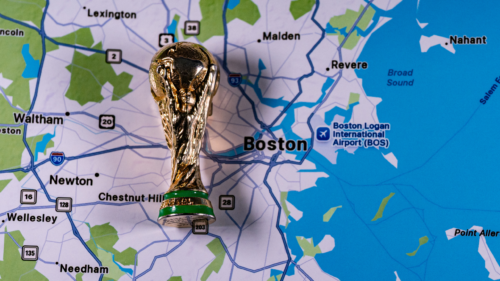
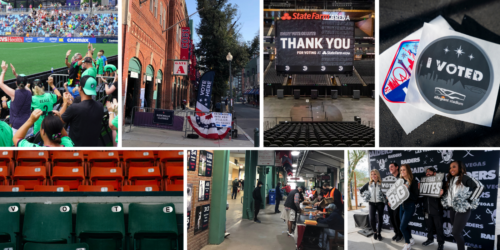
Even though the Tartan Army and Les Bleus have left Boston, residents here and in other host cities know we experienced something very special during the 2026 World Cup, beyond the pitch. It might seem like a one-off, something only the World Cup could create, but that doesn’t need to be the case.
In Boston and across the country, the World Cup illustrated something much more universal, profound, and enduring than just some temporary fun or a short-term economic boost: Sports have the power to build community, strengthen social ties, create cross-cultural engagement, and improve civic life and values year-round. Given Boston’s extraordinary relationship with its teams and sports in general, we — city government, professional teams, and residents alike — should take some lessons from this summer and use sports as this kind of civic scaffolding going forward. Boston has the potential to lead the way, serving as a model for parlaying a deep devotion to sports and community pride into a better city for everyone.
More than most, Bostonians have seen and felt this before; think about the championship parades for the Patriots, Red Sox, and Celtics. As a Patriots executive, Scott Pioli experienced that energy firsthand, riding a duck boat during a championship parade and unexpectedly finding himself in tears as he took in the palpable civic pride of the crowd.
We all know that Americans are increasingly politically polarized and socially isolated. One of the main contributing factors has been the steady erosion of shared spaces where people gather across differences and divides. Almost three decades ago, Harvard professor Robert Putnam identified this issue in his famous publication, “Bowling Alone.” He used data to show that a key factor in the erosion of democratic practice in the United States was the decline of civic institutions — such as unions, community-based churches, rotary clubs, and, indeed, bowling clubs — where people once came together around common goals and interests.
Since this transformative concept of “social capital” was introduced, these spaces have continued to rapidly decline, and in the face of new technology, some have even disappeared altogether.
Except for one: sports.
Without even trying, sports bring people together across differences in ways few aspects of American life do today. People of different races, socioeconomic backgrounds, religions, sexual orientations, nationalities, and political beliefs find a common bond, joy, and sense of purpose in supporting a team or loving a sport.
For sports fans, team loyalty is a strong part of their identity — at times on par with religious affiliation — and, uniquely, it cuts across political beliefs, even in times of division. When the home team wins, fans say, “We won last night,” with the “we” meaning the team itself and anyone who supports them. Fans display their solidarity in countless ways: T-shirts, hats, mugs, and flags on houses and cars. Some even get tattoos.
Whether in stadiums, living rooms, bars, or public watch parties, sports events are one of the few places left where people gather in person to root for the same outcome — no matter their other identities or backgrounds. (Or, as is often the case for those of us who are New Yorkers living in Massachusetts, to engage in healthy, benign trash talk.) This is how community and belonging are built — the prerequisites of a healthy civic culture.
That is not to deny all the negative aspects of how sports operate in our country, to say nothing of how sports have been misused on the international stage. But we ought to also recognize that our shared love of sports has the capacity to do great social good when done right, and we should lean into that aspect of it.
So how do we make the most of this summer’s great vibes?
While this is something we collectively need to strategize around, here are a few thoughts:
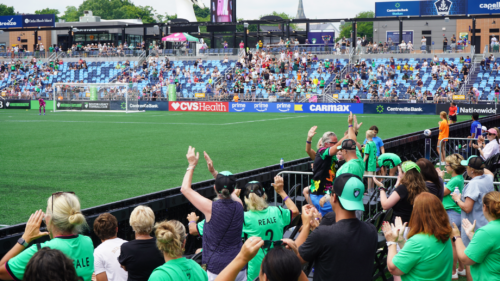
Let’s keep using public spaces to bring people together in ways that brings out our desire for the greater good. Most of us could not afford tickets to the World Cup, and many families are priced out of other sporting events, too. However, during the World Cup, people from all backgrounds could collectively celebrate our sports fandom without paying for a ticket or buying anything. We could sit, watch, listen, scream, cheer and — most importantly — engage with people we wouldn’t otherwise meet.
This didn’t just happen at the level of City Hall, and given the scale and cost, that isn’t even necessarily the ideal. The state offered millions of dollars in mini-grants for neighborhood block parties and watch events, and these types of resources could be deployed more often, including by the teams themselves. Providing these additional spaces for fans to gather and watch sports would expand fan bases (adding to the bottom line), build goodwill, boost merchandise sales, and give us a rare chance to get to know our neighbors.
Our research has repeatedly demonstrated the tangible benefits of using sports stadiums and arenas as voting sites, poll worker training facilities, as well as locations for voter registration drives and poll worker recruitment. In 2020 and 2022, many teams did this — for example, the Red Sox delighted Boston fans with the opportunity to be greeted by Wally and Tessie, pose with World Series trophies, and take selfies with the Green Monster background when they went to vote. More spectacularly, the Las Vegas Raiders opened Allegiant Stadium on Election Day in 2024, turning voting into a full family experience, complete with team-branded “I voted” stickers. After extensive outreach, 4,200 citizens voted at the stadium seamlessly. Allegiant was by far the area’s most popular and enjoyable site. Our research indicates that voting at the stadium drew the attention of people who are traditionally less likely to vote: The electorate at Allegiant, while having no partisan skew, was much younger and included a much higher share of first-time voters compared to other voting locations
Going forward, cities and states should facilitate this practice. Any team contract involving stadium construction, renovations, or public taxpayer dollars should require teams to open their facilities for voting and other civic activities.
Teams could be doing much more in this regard and in ways that would be to their own benefit. Fans, given their strong sense of identity, respond to their teams and players in unique and powerful ways. While every team has a philanthropic arm, teams could be leaning into that more, not just by doing PSAs at election time but by consistently deploying the complete suite of their marketing talents to go into neighborhoods, schools, and communities. They can actively model and facilitate community engagement, compassion, and good citizenship. Have you ever seen the faces of school kids when a professional athlete comes to visit? Check it out.
The point is that civic life is not just town hall meetings and elections; it is creating and strengthening the web of places where people feel they belong. Our sports teams and games inherently have the ability to be these spaces.
Through good times and bad for our teams, and through our own moves, breakups, losses, victories, and whatever life throws at us, our loyalties as sports fans endure. Cities, teams, and fans everywhere should embrace and celebrate this unique common bond as much as possible in a time when there is otherwise so much dividing us.