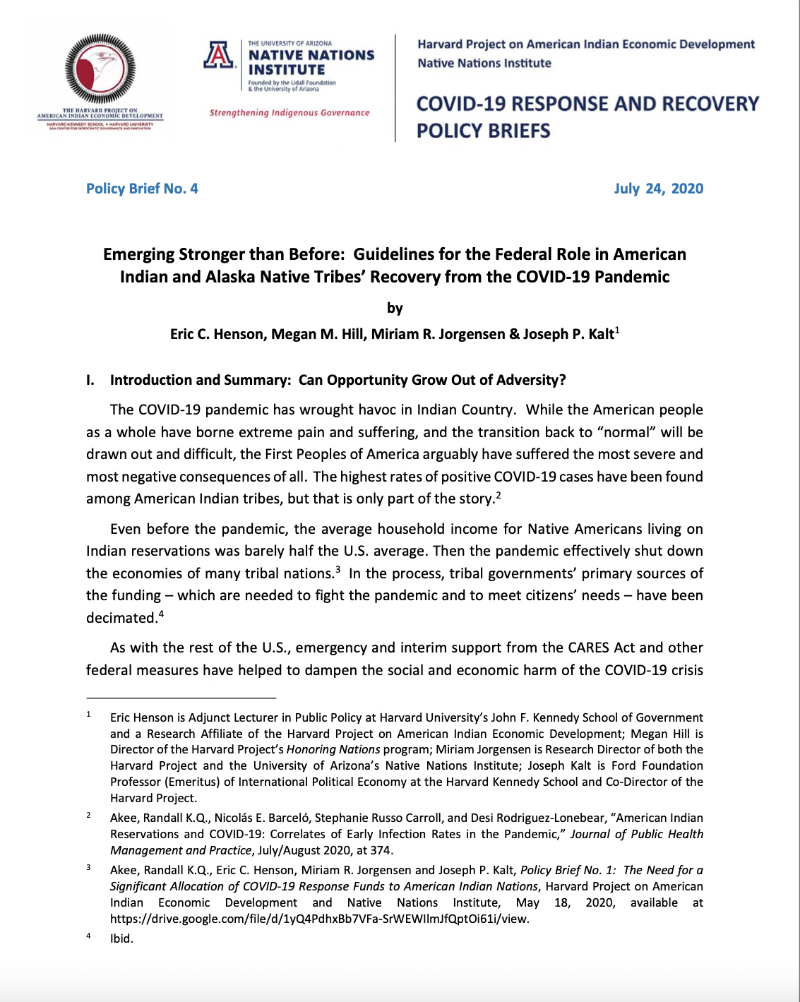
The federal response to the COVID‐19 pandemic has played out in varied ways over the past several months. For Native nations, the CARES Act (i.e., the Coronavirus Aid, Relief, and Economic Security Act) has been the most prominent component of this response to date. Title V of the Act earmarked $8 billion for tribes and was allocated in two rounds, with many disbursements taking place in May and June of this year.
This federal response has been critical for many tribes because of the lower socio‐economic starting points for their community members as compared to non‐Indians. Even before the pandemic, the average income of a reservation‐resident Native American household was barely half that of the average U.S. household. Low average incomes, chronically high unemployment rates, and dilapidated or non‐existent infrastructure are persistent challenges for tribal communities and tribal leaders. Layering extremely high coronavirus incidence rates (and the effective closure of many tribal nations’ entire economies2) on top of these already challenging circumstances presented tribal governments with a host of new concerns. In other words, at the same time tribal governments’ primary resources were decimated (i.e., the earnings of tribal governmental gaming and non‐gaming enterprises dried up), the demands on tribes increased. They needed these resources to fight the pandemic and to continue to meet the needs of tribal citizens.
American Indian Casino Operations and Firm Long-Run Employment and Sales
A new working paper by Randy Akee, Julie Johnson Kidd Professor of Indigenous Governance and Development, and co-authors examines the role of The Indian Gaming Regulatory Act of 1988 in facilitating sustained private-sector growth for American Indian reservations through tribal casino development.
The Disproportionate Burden: Health and Economic Outcomes of COVID-19 for Native American Communities
A new research article by Randy Akee, Julie Johnson Kidd Professor of Indigenous Governance and Development and Director of the Project on Indigenous Governance and Development, and co-authors examines enduring consequences of the COVID-19 pandemic among American Indian and Alaska Native (AIAN) populations.
American Indian Casino Operations and Firm Long-Run Employment and Sales
A new working paper by Randy Akee, Julie Johnson Kidd Professor of Indigenous Governance and Development, and co-authors examines the role of The Indian Gaming Regulatory Act of 1988 in facilitating sustained private-sector growth for American Indian reservations through tribal casino development.
The Disproportionate Burden: Health and Economic Outcomes of COVID-19 for Native American Communities
A new research article by Randy Akee, Julie Johnson Kidd Professor of Indigenous Governance and Development and Director of the Project on Indigenous Governance and Development, and co-authors examines enduring consequences of the COVID-19 pandemic among American Indian and Alaska Native (AIAN) populations.