Stephen Richer (00:00):
… solution then.
Archon Fung (00:33):
Hey, welcome everyone to Terms of Engagement. My name is Archon Fung, and I’m a faculty member at the Harvard Kennedy School and Director of the Ash Center for Democratic Governance and Innovation.
Stephen Richer (00:43):
And I’m Stephen Richer. I’m the former elected Maricopa County Recorder. I’m now a lecturer at the Harvard Kennedy School and a fellow at the Ash Center.
Archon Fung (00:51):
Great. And if you’re joining us live this lovely Tuesday afternoon, please enter your comments, questions, feedback, reactions right into the chat. And Stephen is better at keeping an eye on it, but we’ll both try to keep our eye on the chat and bring folks into the conversation.
Stephen Richer (01:09):
Please do because we do enjoy that. But as always, Archon and I are speaking on behalf of ourselves, not on behalf of Harvard University or any affiliated entities. We are doing a little more intro to this topic to clue you in as to why Archon and I are thinking about it. A little more intro than we normally do. So to set the stage before we introduce our guest, the question we’re asking is, does American politics have a Nazi problem? And so we’re going to talk about Nazis, but we’re also going to use Nazis as a stand-in for a presumed broad set of contemptible opinions, whether Nazism, or racial supremacy, or antisemitism, or otherwise.
(01:49):
And so I want to start by taking you back to 2019. And in 2019, it seemed like every politician in Virginia had worn blackface. Ralph Northam, a Democrat, then governor of Virginia was credibly accused of wearing blackface in a 1984 medical school yearbook. There was widespread outrage and condemnation, but he did not resign. And then less than a month later, Mark Herring, also a Democrat and then Attorney General of Virginia, admitted he had worn blackface in 1980 while a student at University of Virginia. He resigned as co-chair of the Democratic Attorney’s General Association, but he did not resign from office.
(02:32):
So fast-forward to today’s world. In February 2026, President Trump’s true social account released a video depicting various politicians disliked by the president in an unflattering but absurd animal rendition. But the video ends with portrayals of Barack and Michelle Obama as apes, something that, of course, has a rich history in racism. There were broad condemnations, and the president took the video down, but there was never any suggestion that the president should resign and discussion of the video lasted less than a week.
(03:05):
And then there’s Nazism and antisemitism. In the last week alone, at least two prominent articles have published claiming that the GOP has a Nazi problem. Jamelle Bouie of The New York Times published, “The GOP has gone off the deep end,” on September 16th, and on the same day, conservative commentator Erick Erickson wrote a lengthy and, I must say, excellent post titled “The Midwestern Führerbunker Driving the Right Off the Cliff.”
Archon Fung (03:34):
Oh my gosh.
Stephen Richer (03:34):
And on the left, many see an increasing prevalence of racism and especially pronounced antisemitism. Sef Casim, a democratic nominee in Prince William County, had a rich history of social media posts using the N-word. Chris Rabb, a democratic state representative in Pennsylvania, expressed sympathy for the murdering of Jews on Bondi Beach, Australia. And of course, most prominently, democratic nominee for US Senate in Michigan, Abdul El-Sayed, excused a March 2026 attack on a Jewish temple in Detroit, and he has kept quarter with virulent Jewish antisemites like Hasan Piker. And lastly, of course, “From the river to the sea,” a chant that contemplates the destruction of Israel and the erasure of the Jewish people from the area has become a popular refrain from some left-wing activists.
(04:25):
So what’s going on? Are we witnessing a spate of racism and Jew hate, or do we have more tolerance for it now, or are we simply more aware of its existence? And so to do that, we have a great guest, and Archon is going to introduce him.
Archon Fung (04:40):
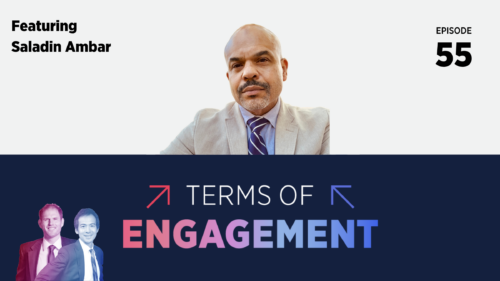
Yeah. So we do have a great guest, Saladin Ambar, who is a professor of political science and a senior scholar at the Center on American Government at the Eagleton Institute of Politics, which is based at Rutgers University in New Brunswick. His work is wide-ranging. He’s written about the American presidency governing and especially race and ethnic politics. I had the pleasure of reading this weekend his most recent book. He’s written many books, extremely prolific, but his most recent book, which is super relevant to today’s topic, is called Murders on the Mississippi, which is about vigilante murders and lynchings that shaped Abraham Lincoln’s view about race and American democracy.
(05:28):
He’s also written another really relevant book, Malcolm X at Oxford Union, which is about a famous speech that Malcolm X gave in the later part of his political thinking in Oxford. And he’s written another book called Stars and Shadows: The Politics of Interracial Friendship that looks at many interracial friends from the revolutionary period in Jefferson up through Obama. Before he was a professor, you guys should know, he taught for 18 years in New York and New Jersey in the public schools, and so he’s had a broad-ranging career in education in both K through 12 and higher ed. Okay. So, come on in, Saladin. Oh, wait. We can’t hear you.
Stephen Richer (06:22):
Nope, there he is.
Archon Fung (06:23):
Yeah.
Stephen Richer (06:24):
Let’s-
Archon Fung (06:25):
Oh, I think you’re muted.
Stephen Richer (06:30):
No.
Archon Fung (06:30):
Oh, that’s weird.
Stephen Richer (06:31):
Okay. Well, we might ask for you to exit out, and then come back in. And in the meantime, we will be showing an intro video.
Archon Fung (06:38):
Right. Great.
Stephen Richer (06:39):
Perfect.
Archon Fung (06:40):
Yep. And so we thought we’d spend a little more time than usual introducing the topic, and here’s a way of what the reality and the phenomenon is. Can you put my screen share on? Great. Okay. So what you’re looking at here is a video game that you can find in whitehouse.gov/arcade. And so they’ve put up some video games for the entertainment of the American people in Twitch style, Hasan Piker style.
(07:13):
I’m going to play this game for a couple of minutes here. And so this is the classic snake game. Only, this one, you have a white guy in a suit, and he’s chasing around largely brown people, some of them white it looks like. And then once he gets them, they don orange jumpsuits and become part of the snake. And so I’m not sure what the White House Communications Office was thinking in developing this game, but I guess I regard it as a fairly explicit expression of racism and xenophobia. And we can talk about whether other people regard it that way.
(08:01):
Okay. And then so now, just a few of the current developments here. Oh, sorry. Okay. So a little bit of the history of… slideshow that Stephen started to talk about. Here’s a little bit of an earlier interview with Republican strategist Lee Atwater who worked in the Reagan and Bush campaigns. And this is an interview about his thinking about how political discourse has evolved, especially on the right with the so-called Southern Strategy of the Republican Party, and here’s Atwater.
Lee Atwater (08:50):
You start out in 1954 by saying, “(beep), (beep), (beep).” By 1968, you can’t say (beep). That hurts you. Backfires. So you say stuff like forced busing, states’ rights, and all that stuff, and you’re getting so abstract. Now, you’re talking about cutting taxes, and all these things you’re talking about are totally economic things, and a byproduct of them is Blacks get hurt worse than whites and-
Archon Fung (09:15):
So remember that, that little quote. He’s talking about what the American people will accept and what appeals in politics, and he says, “Well, in 1954, you can make explicitly racial appeals. By 1968, that’s not okay anymore, so you have to use different kinds of language even if you’re pursuing the so-called Southern Strategy.” And then a big part of the question of our discussion is whether that dynamic has changed again, and now, racial appeals seem to be more effective in politics.
(09:50):
This was widely reported. A young Republican chat group had lots and lots of messages that had a racist and antisemitic character and/or antisemitic. And here are a few of the quotes, “I love Hitler,” “Can we fix the showers?” Et cetera. And then JD Vance, Vice President Vance was asked to respond, and this was his response, was not a condemnation, but something of an apology.
(10:18):
More recently, this is Bo French, who is Tarrant County Republican Chair in Texas. He’s also running for office as railroad commissioner. So he puts out on his X account, “I heard UT graduation this year looked like this. I can’t believe it. The problem is obviously far worse than anyone imagined.” And I fuzzed out some of the faces, but they’re South Asian faces in the foreground there.
Stephen Richer (10:48):
I think those kids have been seen enough.
Archon Fung (10:52):
Yeah. Right, right, right. Yeah, maybe I didn’t need to. And then there is a lot of pushback from the Republican Party. Jeff Leach in the Texas House says, “I think that’s racist, and it makes me sick.” Here’s another in the political discourse, “Zohran Mamdani, a mayor of New York City, must be deported immediately. The only thing I want to see him running for is his gate at JFK for his deportation flight back to Uganda.” That’s Representative Randy Fine about an elected representative. Certainly, one of the most important political offices in the United States.
(11:28):
And then Abdul El-Sayed is running against Mike Rogers in the GOP for the Senate seat in Michigan, and Mike Rogers says, “Never in a million years did I think that I would be running against someone who believes that America deserved 9/11.” PolitiFact rated that a pants on fire. Abdul Sayed definitely did not say that. What he did say in… What he, Abdul El-Sayed, said in his 2020 book was, “I watched terrorists with names like mine attack the country in the name of my faith. 3,000 of my fellow Americans were killed in the craven attacks in New York, Washington DC, and Pennsylvania. The attack devastated me.” That’s why presumably that was a pants on fire rating from PolitiFact.
(12:15):
And then this is Paul Ingrassia who said, “I do have a Nazi streak in me from time to time.” And then the president himself, “I don’t want them to run our country. I’ll be honest with you, their country stinks, and we don’t want them in our country talking about Somali immigrants.” And then pushback from the right, the far-right, Laura Loomer says, “I’m going to say it. The GOP has a Nazi problem. The more we pretend we don’t like, the worse it’s going to get.”
(12:47):
And then Karl Rove, very prominent commentator and political advisor from the right, says, “The GOP has a growing number of Bo Frenches, and not only in Texas, conservatism and the party it dominates have an increasing number of bigoted advocates of heritage America.” He’s writing this in The Wall Street Journal in an article titled Why I’m Voting for a Texas Democrat. So that’s Karl Rove.
(13:14):
All right. So those are some of the exhibits. We can take the show down now. Saladin, what do you think? Is the problem worse? How do we reckon the current state of political discourse? I think from an historic’s perspective, there’s always been a lot of racism in American politics. What about this moment?
Saladin Ambar (13:38):
That’s a great question. I hope you can hear me, by the way.
Archon Fung (13:40):
Yeah, yeah. We can.
Saladin Ambar (13:41):
Yeah. Terrific. I don’t know if the problem is worse. The volume is up. Let’s put it that way.
Archon Fung (13:46):
Okay.
Saladin Ambar (13:46):
The volume is up. I think part of the challenges… Maybe the challenge underlying all of this is the rate of demographic change in this country and how Americans, particularly white Americans, are and have been responding to it. If I could take your viewers and listeners back to the Great Gatsby, they may recall Tom Buchanan engaging in a racist rant about immigrants and the loss of whiteness. And there’s a moment when… I think it’s Jordan Baker responds, looking around the room, and says, “But we’re all white here.”
(14:26):
It’s an outdated image because that’s no longer the case. We’re not all white here. This was Fitzgerald’s writing in the ’20s, and Buchanan is fearmongering. But what do you do in a society when the former racial majority that had essentially a governing lock on politics has to share power? And I think this reaction is quite predictable, frankly. It doesn’t make it any more palatable or desirable, but I think you could see this happening, that America was going to have to face a choice whether or not it could truly be a multiracial democracy or jettison democracy in the name of preserving the mythic whiteness. I think that’s what we’re engaged in, to be frank.
Stephen Richer (15:19):
So that explains the evolution from 1920 to maybe 2015, but how do we account for the fact that I think even as a short of time ago as 2019, as I tried to illustrate in those Virginia examples, that it felt like it was more broadly condemned? It felt like if you had done blackface or if you said something that was openly antisemitic, then Republican or Democrat, you might not have resigned, but you would’ve caught broad condemnation, and it would’ve really hobbled your future political career. And now, it feels like Tuesday.
Archon Fung (15:58):
Right.
Saladin Ambar (15:58):
Yeah.
Archon Fung (15:59):
Do you think that’s true that… I guess if you had to put dates on it, take Lee Atwater’s date, 1968 to 2019, you couldn’t, really, in big politics, be as explicitly racist. There were lots of dog whistles, lots of code, but it felt different. At least to me, it felt a lot different.
Saladin Ambar (16:20):
Well, I would say 2015 to be frank.
Archon Fung (16:23):
Okay, okay.
Saladin Ambar (16:23):
And I am referring to the imminent political rise of Donald Trump and the hall pass he gave Americans to speak “freely” about their racist fears, desires, interests, and so on. So I think much of it does begin with Trump in terms of this latest incarnation of racial hatred and its acceptance.
(16:48):
The other thing is around that time, certainly, and maybe a few years before, we have a social media world, a cosmos, if you will, where so many voices are accepted, have the ability to be heard in ways unlike years past. And so it’s been mainstreamed in part because there are just so many avenues and outlets available to people.
(17:16):
And then I guess finally, the thing to suggest or to say is that we are now in a culture that’s been degraded in large part because there’s no political trust in our institutions, whatsoever. And certainly, there’s little to no trust in our mainstream media sources and outlets, which means that everyone has the truth in quotes. Everyone is a commentator. Everyone has the ability to stand on their own wisdom, if you will, and that creates a culture where my word is just as good as yours. And so that’s the vicious cocktail we’re in, I think, those elements altogether.
Stephen Richer (18:01):
Let me push the 2015 hypothesis, because, again, I felt like there was something even in 2019 that made this different. And I would say that this has given more of a permission card. Something’s given more of a permission card to Democrats. Certainly, they don’t hold up Trump as their prototypical ideal model. And then it’s also… Yes, we talked about race at the onset. We’re going to talk about Nazism, we’re going to talk about antisemitism, but it just seems like… Even the Me Too Movement now seems almost quaint a little bit, the things that were being rebuked during the Me Too Movement. Was there a sense that as a society, we’ve gotten too caught up with condemnation broadly and we should just be more accepting of the id of society, the Freudian id of society?
Saladin Ambar (18:59):
I don’t know. You tell me. We’re in an OnlyFans culture where individual prominence, preeminence, voice trumps everything. Pardon the pun. I hate to do it, but there it is. We’re in a world that has become reduced to me, you know?
Archon Fung (19:17):
Yeah.
Saladin Ambar (19:18):
And I’m hardly a William F. Buckley conservative in that way and here to denounce individualism and the me generation, if you will. But I do think that that has become an accelerant to some of this, and so maybe 2015 is not as good as 2019, but I think what we’re seeing is an accelerating process by which my personal views and my personal anxieties.
(19:51):
There’s a journalist a few years back, Haynes Johnson, wrote a wonderful book called The Age of Anxiety, and he talked about the shift from the Cold War to the war on terror. And I dare say we’re looking at a new kind of information era war where people feel compelled to express their deepest, innermost thoughts, whatever their origins and however despicable they may be. So I think there’s a lot going on. I don’t think it’s the one thing, if I can… You know?
Archon Fung (20:20):
Yeah. Sure, sure. But part of it that’s really interesting is the idea that norms against racist expression or antisemitic expression are at maybe more of an elite and institutional kind of construct or source. And once the distrust and institution goes away, then the floodgates are open on that sort. I hadn’t really thought about it that way, but-
Stephen Richer (20:47):
So if it was-
Archon Fung (20:47):
Yeah.
Stephen Richer (20:48):
If it was elites who were doing the policing, it was big media that was doing the, “Hey, you can’t come down to our show and say that,” or it’s universities setting some sort of moral code about how we treat people under equal employment opportunities or something like that.
Archon Fung (21:07):
Right, right, or DEI, Whatever.
Stephen Richer (21:08):
And we think that all those places stink now. Then, maybe we’re throwing some of the baby out with the bathwater is the thesis?
Saladin Ambar (21:20):
Yeah, 100%.
Archon Fung (21:22):
Right.
Saladin Ambar (21:24):
I just moved from Philadelphia. When I was in Philadelphia, my mailman had as much influence maybe as I did, arguably, in terms of his social media, and it certainly felt that way. And I think lots of people feel empowered, all due respect to the postal service and my brothers and sisters doing that work. Everybody feels equally empowered to share, and some of that is good. I’m not here to knock the diversity of viewpoints. I think it’s incredibly important. Having said that though, this is not the world where if you’re Buckley, you could kick the John Birch Society out.
Archon Fung (22:05):
Were just talking about that.
Stephen Richer (22:06):
Can we pause on that?
Saladin Ambar (22:08):
Yeah. Sure.
Stephen Richer (22:09):
Do you accept that narrative? Okay. So within the Republican world, within the conservative world to which at least I still belong, the Republican world’s changed a bit, but the narrative we would tell is that there was always a faction within the conservative movement that was not necessarily fit for polite society. But the thing was is that William Buckley, who was the gatekeeper of the great ideas of the conservative movement, said the John Birchers aren’t allowed to publish in National Review, and therefore, their ideas aren’t worth considering. And so yes, while they might be part of the conservative coalition, we keep them at bay, and the only thing that’s changed is we’ve lost William Buckley. Do you accept that, or do you think that that was a glossed-over portrayal of the 1970s and ’80s, and now we’re just facing reality?
Saladin Ambar (23:06):
I don’t know if it was glossed over. I think it was an important stand, frankly, that Buckley took. Having said that, those voices, just because you don’t let them into your… It’s like in the movie Sinners. When you don’t let the vampire in, they don’t go away. They’re still there. Archon, I appreciate that. I wish my students responded with that kind of love, but yeah.
Archon Fung (23:30):
Great movie. Yeah.
Saladin Ambar (23:32):
Yeah. Well, yeah, those views don’t go away, and that’s the challenge. So you’re better off, on some level, not embracing them, but allowing them to have some voice so that you can contest them and perhaps embarrass them, perhaps ridicule them even through counter arguments. Those voices-
Archon Fung (23:55):
And not be misled that they don’t exist because they’re there.
Saladin Ambar (23:55):
Right. 100%. Those voices have not gone away. They’ve metastasized, pardon me for all the medical professionals out there. They’ve changed. They’ve morphed into something else. How about that?
Archon Fung (24:07):
Yeah. So let’s talk about that pretty provocative thesis that maybe there’s something positive. I mean, how do you even formulate that? Maybe there’s something positive to the explicit expression of these racist and antisemitic views, the video game, the slideshow, whatever, because at least it’s more honest and it gives all of us a more realistic picture of the range of political views out there in America that our democracy has to grapple with. Does it have a positive? Is there a silver lining?
Saladin Ambar (24:46):
Well, yeah. I’ll say two things. First of all, I’m someone who did write a book on Malcolm X and his Oxford speech. Malcolm X was invited to Harvard. I think John F. Kerry invited Malcolm X to Harvard. I think there might even be a Kissinger invitation somewhere. This is a guy who-
Archon Fung (25:00):
I did not [inaudible 00:25:03].
Saladin Ambar (25:04):
Yeah. This was a man whose views were reprehensible in the eyes of nearly everyone in the mainstream politics, and a good deal of Black folk were terrified of what Malcolm X was saying. But yet, Ivy League institutions, all kinds of colleges and universities invited him. Oxford, obviously, famously invited him. And I, for one, think that I want people, without their views, radical views, unconventional views, to be heard and to be confronted and challenged if need be. And certainly, that’s part of the story, I think, we’re getting at here.
(25:41):
The other side of this is that a few years ago, I signed that Harper’s letter. I don’t know if you remember Harper’s letter on open debate that lots of people said, “I think it’s the only time my name has ever appeared with J.K. Rowling,” but there were a lot of signatories from across diverse fields who signed onto it. I signed onto it because I do believe in the idea of parrhesia, of frank debate, open debate, speech that confronts and challenges. And you can’t really have that as Voltaire once said, dare I bring in Voltaire, unless you’re willing to defend the rights of those who immediately disagree with.
Archon Fung (26:21):
What do you think, Stephen? I mean-
Stephen Richer (26:23):
I don’t know. I mean, I guess I have-
Archon Fung (26:24):
It’s challenging.
Stephen Richer (26:24):
… a strong level of discomfort with not drawing any lines, and Archon and I have discussed this in the context of whom do we invite to the Harvard Kennedy School. So if that person puts up a swath sticker on the side of the building the day before, is that person still within this conversation? Does that mean a person still materially contribute? On the one hand, yeah, at least that person is then identified, and there’s no tiptoeing around it. That person is presumably pro-Nazi, anti-Jew. But I don’t know. I continue to struggle with that.
Saladin Ambar (27:02):
Well, Stephen-
Stephen Richer (27:03):
But I have a hard time saying like, “Oh, that’s salubrious for society that now it’s out and about.”
Archon Fung (27:10):
But what do you do about a Bo French? Say you’re in the Texas Republican Party. Silencing him would be, “Okay. We’re going to kick you off X because of that.” Right? And I’m opposed to that, but am I opposed to saying people articulate those views have no business running as Republican candidate?
Stephen Richer (27:33):
No, no, no. Certainly, not that.
Archon Fung (27:35):
Yeah.
Stephen Richer (27:35):
But would you invite Bo French to be a speaker? I think it’s a different conversation.
Archon Fung (27:38):
Yeah, yeah.
Stephen Richer (27:39):
I actually think the Bo French thing was actually wound up being a pretty positive saga, because yes, you saw that his post got lots of likes and it got lots of anonymous defenders, but you also saw everyone of consequence within the GOP in Texas saying that this is inappropriate. And so hopefully, that was an instructive moment for, I don’t know, younger Republicans who are on social media and being like, “Okay. There are limits. I just got to learn what one of the limits is.”
Archon Fung (28:10):
Yeah. Good. I don’t know. Do either of you… I don’t know how I feel. Does that count for you as cancellation? And if it is, is it a justified cancellation? It’s not suppression of speech exactly, but it is saying you’re not going to get to do this stuff because of your attitudes towards South Asians in Texas.
Saladin Ambar (28:33):
Well, I want to draw a distinction between an institutional invite, like maybe a commencement address. There are people who might think of institutions, whether it’s the Kennedy School or the Eagleton Institute of Politics where I work where I’d be really opposed to having certain speakers invited on the behalf of that kind of institution.
(28:50):
I think student groups, however, are a bit different and should be given, I think, some leeway to make errors, to make mistakes, if you will, that we would consider gross mistakes and inappropriate ones. But the institution may not support that gesture or that invitation, but I do think we should really… If we’re going to embrace the idea of free speech, short of violence, I think people who openly advocate violence or who lend themselves to rhetoric and/or actions, frankly, that are violent, I think that’s a more than fair and reasonable line to draw.
Archon Fung (29:29):
Yeah. Interesting.
Saladin Ambar (29:30):
Having said that, it’s hard to be a free speech First Amendment advocate until you get uncomfortable with those. I think at Rutgers, years ago, Condoleezza Rice was invited and then disinvited because students were upset. And I’m certainly not a huge fan of Condoleezza Rice or the Iraq War and number of policy initiatives that she was a part of, but I would’ve rather had her come and speak, and maybe face students’ questions and answers in that kind of forum afterwards than to have her disinvited, and I think that’s true for many speakers. But with respect to violent rhetoric and someone who brings to the program, if you will, a patina of violence, I think that’s a reasonable place to draw a line.
Archon Fung (30:24):
My floor is way below that, yeah?
Stephen Richer (30:26):
No, no, no, and mine is way below her.
Archon Fung (30:26):
Yeah.
Stephen Richer (30:28):
If you can’t invite Condi Rice, then I think that you’re missing a very large segment of the American population, but I guess I’m curious as to the underlying question. We’ve talked about what we would do. We’ve talked about who’s to blame in this situation, but all of this avoids the question of, has there been a degradation of the American character in recent years, whether that’s the last 20 years, whether that’s last 10 years-
Archon Fung (30:54):
Or 2015, whatever. Yeah.
Stephen Richer (30:54):
… or whether that’s the last five years?
Archon Fung (30:58):
Yeah.
Stephen Richer (30:59):
Is this a reflection of just Americans maybe don’t have the same noble spirit that we did whenever the pre-era was?
Saladin Ambar (31:14):
Unequivocally, yes. The answer is yes. Affirmatively, yes.
Stephen Richer (31:19):
Why?
Archon Fung (31:19):
A decline. You think a decline?
Saladin Ambar (31:21):
Without question. Look, every year, I’m teaching a presidency class. Later this year, a few weeks, I’ll have them watch Kennedy’s first inaugural address. I’ll have them watch Reagan’s first inaugural. You go back, and look at the crowds. Forget the speech. Listen and observe the crowds, the decorum, the fact that they didn’t need to jump out of their seat every two minutes to applaud or to be raucous. Their tentativeness during long and at times, dry portions of a speech. These were people who were steeped in a listening mode-
Archon Fung (31:58):
I see.
Saladin Ambar (31:59):
… and a kind of intellectual maturity that is completely absent today, almost completely. I won’t say completely, but… That’s too strong, but very, very degraded. Yeah, our characters have been degraded, and I think part of it is the fact that we are become, dare I say, an imperial nation where politics is a secondary obtrusive part of our lives where our private lives have taken on this outsized being that our public-centeredness has evaporated. And so we’ve become crass, self-centered, beyond description, and impatient in part owing to our technology, impatient with ourselves even.
(32:51):
And I don’t say this to preach to others as much as to preach to myself. I could barely watch a movie through anymore, and I realize the change in myself, and I’m someone who traffics in words and reading books. The attentiveness we have to things beyond ourselves has waned tremendously-
Archon Fung (33:13):
Oh, interesting.
Saladin Ambar (33:14):
… and it’s hard not to see that take shape in the forms of our character as you suggest. Yeah, it’s awful. It’s terrible.
Archon Fung (33:24):
So I want to bring in your Murder on the Mississippi book in the following way. So the speech, Lincoln’s speech there, a big part of it is about mob violence and these three episodes of basically vigilante violence that you cover, some against gamblers, some against Black people in an abolition way, and the last one against the publisher.
(33:58):
It’s analogous to what you just described in that people aren’t being good citizens at all by engaging in this vigilante violence. And then Lincoln is often read, as you say in the Lyceum speech, the solution… Two things. One is obey the law and don’t take the law into your own hands. Okay? But another is a kind of civil religion is what people are… So what would you want people’s civil religion to be in this moment where there’s antisemitic, racial invective, a lot of ugliness where people are expressing themselves and not listening to others? What is the set of, I don’t know, norms, dispositions, virtues that we all ought to have, whether it’s antisemitism on the left or the right that you’d recommend and that you’d urge?
Saladin Ambar (34:54):
Well, I would simply say that any time we witness the dehumanization, the devaluation of other human beings, irrespective of their faith, be they Jewish, Islamic, atheist, it really is irrelevant. Same goes for color. Any effort to dehumanize other human beings has to be called out and condemned. But in some ways, that’s the negative.
(35:21):
At the end of the second inaugural, Lincoln says, “With malice toward none.” And that’s a Lockean liberal toleration edict, “With malice toward none,” not to hate anybody. But then, the next words after a comma are “with charity for all,” and that’s out of… The etymological origin of charity is caritas, love, with love for all, and that’s a positive, willful effort to demonstrate love towards your fellow citizen, love towards your fellow brothers and sisters, whomever they may be.
(35:57):
Now, that’s Lincoln saying we’ve moved from one kind of possibility, “Malice toward none,” toleration. That’s good in a republic. You need that, but that’s not enough. It’s insufficient. We have to have something more than that. And I would dare say that part of our devaluation of others is a loss of that spirit. And it’s something that certainly needs to be reclaimed, and renewed, and reinvigorated, and in some ways, re-imagined altogether because it’s so easy for us to demonize and devalue others because of any number of differences.
(36:36):
So bottom line is Lincoln at the Lyceum is saying, “The institutions, who cares if they will hold?” I know there’ve been lots of people talking over the last 5, 10 years. Institutions will hold. The institutions are-
Archon Fung (36:49):
The two of us are worried about institutions.
Saladin Ambar (36:51):
Yeah. We got Robert Mueller. Don’t you dare worry about it. Mueller is coming or the courts will… You know what? That’s not Lincoln’s concern. That’s James Madison’s concern. We got structures, and checks and balances, separation of powers, a compound government, yada, yada, yada.
(37:08):
What Lincoln is saying is, “No, good for you on those institutions. This is about how we educate people. This is about the muscle memory of democracy and passing on the wisdom of the framers and the revolutionary generation about self-government, about the rule of law.” And you can’t have a democracy simply on the… Germany was a form of democracy, right?
Archon Fung (37:32):
Yep.
Saladin Ambar (37:33):
Institutions are not unimportant, but what’s most important is the spiritedness of the people and how they value one another.
Stephen Richer (37:43):
Okay. And also, following the questions, please pop your question in the chat if you have a question. Maybe that’s self-serving given that we’re all at universities and we’re here talking about the need for a civic renewal, a civic education. Is that what you had in mind, or what are we missing in terms of the education of the people or what has materially worsened over the last X number of years?
Archon Fung (38:11):
Yeah. What’s the vehicle for that malice toward none and charity for all?
Saladin Ambar (38:17):
Well, one simple thing is just to recall that power and victory, and being a part of an inquisitive society, getting more shit, if you will. That’s not enough. Okay. Great. You can do things, you can acquire things, but we need to re-envision what power looks like, what victory looks like in a society and culture that is continually gaining new things. I can’t tell you how many times I bought new iPhones, if you will, for my kids, but are they any happier? Are we any happier?
(38:54):
So I think part of it has to come with… Look, if I can invoke the anti-Federalists, maybe Stephen will be happy to hear my love for the anti-Federalists, but part of their… We can chat offline about that. But perhaps their opposition to the Constitution should be taken lightly. Yes, we have these limited qualifications. You only had to be 30 to run for Congress, 35 for the presidency. What are we talking about? Where is the sense of character? There’s no other… and so virtue. Can I use that old-fashioned word, virtue?
Stephen Richer (39:32):
Yeah. Yeah.
Saladin Ambar (39:33):
We have no sense of virtue any longer, and that’s what we all have to work on. And that comes not from politics, that comes from family life, that comes from community life, and-
Stephen Richer (39:43):
Yeah. But that-
Archon Fung (39:44):
I mean, that’s much more Stephen with conservative views and me, the secular liberal over here.
Saladin Ambar (39:45):
Well-
Stephen Richer (39:46):
Yeah, but you’re sounding like a Catholic Integralist.
Archon Fung (39:51):
Yeah.
Stephen Richer (39:52):
I think that that small L, liberalism, is the problem.
Saladin Ambar (39:56):
Well, I was trained by Jesuits, so I’m assuming, you know?
Archon Fung (39:57):
Yeah. Oh, right. Right.
Stephen Richer (39:57):
So your obsession with flat screen TVs and air conditioning, and reducing the price of those has come at the degradation of your character because you lost the pursuit of virtue. You stopped reading Aristotle’s ethics or Thomas Aquinas.
Archon Fung (40:15):
Yeah. Yeah. What seems luck.
Stephen Richer (40:17):
Yeah. I just don’t know that that’s really happened over recent years. I would just say there’s a lot of anger, I would say, in the post-2008 financial collapse in the Iraq War Exodus and maybe just-
Archon Fung (40:31):
And in immigration.
Stephen Richer (40:32):
… that anger is manifesting in ways that was… just water flows downhill and anger runs towards racism, anti-Jewish hate, or whatever it is because that’s just natural. And we’re just finding out that we lost sight of virtue because now we have it mixed with a lot of anger and hurt for a hypothesis.
Archon Fung (40:55):
Yeah. Hey, so we have a couple of very different questions in the chat. One backward-looking. Maybe we’ll do that one and then turn to the more forward-looking. The backward looking is Gus Murby. So his is a historian’s question. You’re in part a political historian. “Are you suggesting that today’s political behavior is more egregious than past practices, say, like, tarn feathering and direct physical confrontations, indeed, assaults between members of Congress?” So he’s looking for the longer historical view, I think, and asking in that long… I think the implication is you can’t think that the current moment is worse than the immediate antebellum period when people are beating each other up.
Stephen Richer (41:36):
Yeah. We have museums of lynching.
Archon Fung (41:37):
Yeah. Right.
Stephen Richer (41:38):
We have museums of lynching in the United States.
Archon Fung (41:39):
Yeah, yeah.
Saladin Ambar (41:40):
Sure. It’s interesting. So the short answer is no, it’s not worse to the degree that we certainly have had more divisive moments, but I want to think about or have the question to think about democracy. And even in the antebellum period and certainly, during the Civil War, Confederates and others who did egregious things certainly engaged in states’ rights advocacy that was autocratic, and violent, and vehemently racist. They still adhered to, at least verbally, in word, the idea of democratic forms and a democratic society.
(42:24):
What we’re seeing now is a kind of embrace of, back to the earlier premise, of if not a kind of Nazism, certainly, a form of authoritarianism that is highly desired. It’s very masculine, dare I say, and appealing aesthetically to lots of people, particularly young men.
(42:46):
We are in a society now where democratic forms in and of themselves are not nearly as interesting or lauded, and so I would say that that is a difference. Even those who engaged in these kinds of violent acts in the past would swear upon the Bible, if you will, that they were small D, Democrats, or are Republicans in the sense of believers in self-government. I don’t know if that’s so true anymore.
Archon Fung (43:16):
Oh, indeed.
Saladin Ambar (43:17):
In fact, I know it’s not. In fact, I know it’s not.
Archon Fung (43:18):
Yeah, yeah. So the consensus goal or a sort of consensus even during the Civil War period is not the consensus ideal, which is small D, democracy, as you say. Yeah.
Stephen Richer (43:32):
Good question because I want to turn a little bit to what to do in various positions, but it can be as broad as simply a member of society, and Arsh Pathan’s question of, “If you call it out or if we sit here and we have this program, are we just sanctimonious little snots who can condemn this type of behavior from our comfortable offices, but that doesn’t actually do anything, and it just signals where we’re at, and then it lets others read that signal and go in different places?”
Saladin Ambar (44:10):
Well, I would say no. Call it self-serving if you will, but I happen to think that ideas are things, that thoughts are things, that these things matter. There’s a reason why people go back and read the Federalist Papers to make justifications for how Americans should live.
(44:26):
I think conversation, certainly, a lost art, but I don’t think it’s an irrelevant art. I think it’s very much needed. Certainly, it should be done more in person than online. But if it can only be done or best done in a given setting online, then so be it.
(44:41):
I think these things matter. I think people internalize thoughts, they internalize language, and they value debate. I don’t think that the American people are beyond it. In fact, I think that’s why the Nazis censored so much of it, and it’s why we have censored so much in the way of images, right?
(45:03):
There’s a reason why Dick Cheney was upset seeing those coffins coming home to Dover Air Force Base. There’s a reason why people don’t want certain conversations to be had. And so no, these things matter very much more than we can probably imagine, frankly.
(45:21):
I think this is important, and it’s not just us. It’s not just people with PhDs or who are working in fancy places. It’s conversation among people like my mailman in Philly, shout out to Joel, or other people who have every right, an equal right as me who has earned a PhD to go out there and engage in democratic conversation. That’s what we need.
Archon Fung (45:46):
Yeah.
Saladin Ambar (45:46):
Yeah. I don’t want to belittle it.
Archon Fung (45:49):
Yeah. So, also on the moving-forward front, we’re talking about this a little bit before we went on air here about Malcolm X in the Oxford Union and his position before that maybe it might be preferable for America to have a Goldwater rather than a Kennedy or even later on a Nixon, because then, the racism would be upfront and visible, and we could talk about that and fight over that rather than paper it over. What do you think about that position? And right now, is it better to have the Bo Frenches running so we can talk about it, and argue about it, and see it, or is it better that they not be in any political primary or general election?
Saladin Ambar (46:38):
Well, I think Malcolm’s point was that you can’t confront something you can’t see or you’re told doesn’t exist, right, that it’s a figment of your imagination. So I think it is important to bring these darker forces out to the light. They wouldn’t be my preferred candidates, some of these folks, to put it mildly.
Archon Fung (47:01):
Oh, yeah. Right.
Saladin Ambar (47:02):
Having said that, there is something about our current political moment that I think is helpful and hopeful, and that is that we’re seeing a lot of the ugliness that’s always been there. And God knows the Black freedom struggle and folks who’ve been a part of it have confronted it, and are well aware of it, and don’t need this conversation to put a stamp on it. And the same for other oppressed groups, frankly.
(47:27):
So having said that though, there is something valuable about seeing it in the light of day so up open and in your face that you have almost no choice but to confront it, or if you agree with it, then be bold and say it with your chest as the kids say. But certainly, what we’re seeing now, whether it’s antisemitism, frankly, anti-Islamic hate, whether it’s racism, you name it, anti-Asian hate, across the board, we’re seeing people who are very proud to be all of those things today and to speak their mind. And that’s ugly and terrible, but in some ways, their freedom to say it has made it easier for us to confront it and certainly, morally incumbent upon us to confront it in ways where we could pretend, “Well, that’s just a handful of people.” No, it’s in your face now, and you’ve got to take a stand.
Archon Fung (48:19):
Yeah. So, I… Oh, go ahead, Stephen. Yeah.
Stephen Richer (48:21):
I have to flag that I dispute the characterization of my man, my Arizonan, Barry Goldwater, but I look forward to reading it. I look forward to reading-
Archon Fung (48:30):
For the sake of argument, playing this out.
Stephen Richer (48:32):
And I’ll read Professor Ambar’s book when it comes out, and I’ll engage in the intellectual exercise. But do you think that there will be people in the short-term future who will run openly as a explicit racist or a explicit Jew-hater and just like that’s-
Archon Fung (48:54):
Maybe.
Stephen Richer (48:56):
… that’s a thing you can do and say, or do you think it will just keep getting up close to the line, never explicitly say it, but try to send all the signals?
Saladin Ambar (49:07):
Brother, you sound like you didn’t know George Wallace ran for president.
Stephen Richer (49:12):
No. Of course. Yeah, yeah. No, that… I’m sorry. Yeah. Of course. I mean, I’d quote-
Saladin Ambar (49:15):
You sound like you don’t know that he ran.
Stephen Richer (49:16):
Yeah. No, no, no. That’s silly because David Duke, David Duke, of course, was a successful politician.
Saladin Ambar (49:24):
Oh, yeah.
Archon Fung (49:24):
Yeah, yeah, yeah.
Saladin Ambar (49:24):
Yeah. Well-
Stephen Richer (49:24):
I guess almost only-
Saladin Ambar (49:24):
I know what you’re saying.
Stephen Richer (49:24):
Yeah.
Saladin Ambar (49:25):
I’m teasing, but also, a little bit. I’m being a little serious, but also teasing. Yes, I think it’s coming. I think in a world where the value of white supremacy feels more threatened than ever in a world where the… I’m at Rutgers, the number one surname here has been Patel for a while.
Archon Fung (49:48):
Wow.
Saladin Ambar (49:49):
It’s a South Asian name, right?
Archon Fung (49:51):
Yeah. Mm-hmm.
Saladin Ambar (49:53):
The world is changing, and I suppose whiteness is, in that way, threatened. But I want to go back to my brother, Herman Melville, who said, “We have still not solved the incantation of this whiteness and learned why it appeals with so much vigor to the soul.” That’s Moby Dick. That’s in the chapter on The Whiteness of The Whale. What is the appeal of this thing?
(50:16):
Well, part of the appeal is a fear that if I don’t have this thing, I’ll lose all of my identity, because we’ve grown up in a world in which this aspect of personhood has been so revered, so reverenced, so elevated. And people are definitely afraid of losing, I don’t know, whatever whiteness means as a country and as a culture.
(50:43):
And that’s why I think, as Melville says and Moby Dick, this is a spiritual journey. If you read The Whiteness of The Whale carefully, this is a spiritual problem. I hate for a political scientist to go off the rails here and invoke the soul, but this is a problem of the soul of this country, and that’s what it’s going to take. It’s not going to just… We can put all of the fancy strictures like Madison did on governmental solutions, but I think we also have to go beyond purely legislative solutions to something a little deeper.
Archon Fung (51:17):
Wow.
Stephen Richer (51:18):
It’s not just better systems, it’s better people.
Archon Fung (51:20):
Yeah.
Saladin Ambar (51:20):
I think so. I think so. Yeah. How do you do that? Well, I think part of what we’re doing is we’re doing it. I think-
Archon Fung (51:27):
I mean, that’s the work, right?
Saladin Ambar (51:28):
Yeah.
Archon Fung (51:29):
Yeah.
Saladin Ambar (51:29):
Yeah. Sure.
Archon Fung (51:30):
So, Saladin, it’s interesting. I mean, I think I’m with you. It’s pretty deep disagreement that we’re exploring here. I’m with you in that I think all of these views ought to be out there, and we should argue with the antisemites, and we should argue with the racists, and that will get us to a better place. But that’s a Jon Stewart Mill faith in discourse. And I don’t know if you would accept that, but… I mean, I believe that, but I think that’s a roll of the dice, right?
Saladin Ambar (52:02):
Yeah.
Archon Fung (52:03):
In other places, like, in… Some people, some of my German colleagues advocate for what they call a militant democracy. And if there’s a little Nazi party there, you outlaw those candidates, and you outlaw that party because we see where that openness goes, and we can’t go there. So that’s a different calculus about how much open debate and political competition, whether that will bring us to a good place eventually or a terrible and tragic one. So what about that possibility that you let the… whatever, run and-
Saladin Ambar (52:38):
Yeah. I love-
Archon Fung (52:42):
… and you lose the argument, so to speak?
Saladin Ambar (52:43):
I love your term, “roll of the dice,” and it is, and I want to just say we may lose this. And there’s a good chance that this goes off the rails and we don’t recover any semblance of what was and could be a magnificent democratic republic, multiracial, and human-centered. I think Dr. King had his doubts. Others have had their doubts, and I have my doubts, but my… I have given up. I am a free person. I have given up the idea that victory in that sense is the victory. I believe the victory is the struggle.
(53:24):
I’ll tell you a very quick story if I can. I gave a talk, oh, about a year ago at Hunter College’s Roosevelt Public Policy Institute, and it was about my former book on interracial friendship. There was a wonderful Q&A afterwards. An older white woman in the front row afterwards said, “I love your talk. You’re really great. I appreciate it, but I happen to think racism is never going anywhere. There’s just too much hate. I don’t think it’s ever going to change.”
(53:51):
And I said to her, and what I’m saying to you in my response is, “I’m not saying you’re wrong. You may well be right, but that doesn’t mean that right here now, you and I couldn’t engage in a friendship and a relationship, and connect, and demonstrate love to one another, and perhaps build something, just you and I, in the face of all of that. And that in and of itself is victory.”
(54:14):
I can’t control… I’ve been joking lately, maybe because I’m middle-aged and I’m approaching the twilight years, the autumn of it all. I don’t worry about this magnificent transformation. I’m worried about my soul, the soul of my kids-
Archon Fung (54:30):
Wow.
Saladin Ambar (54:30):
… the soul of my neighbors, the soul of my community.
Archon Fung (54:33):
Okay.
Saladin Ambar (54:33):
I’m a believer in the local. That’s why I invoke the anti-Federalist. I believe let it all fall down, but we must do our parts. This idea that it’s only worth trying if it’s victorious fires in the face of, frankly, generations on my Black side who were enslaved for years and generations on my Sicilian side who were peasants in Southern Italy and in Sicily.
(54:58):
The idea of fighting only to win, well, how many of those people would’ve just given up and destroyed their lives and themselves if that were the case? No. The struggle to fight and the struggle for humanity is the victory. That is where it’s at, and that’s where we have to get people to be because most people aren’t going to pick up a butter knife, metaphorically speaking, to make change if they think that it’s going to actually transform the world they’re in. Fine, you don’t have to believe it. I’m not so sure I believe it. I think it is a roll of the dice, but I’m going to roll anyway. That’s my point. That’s where I am in the face of the darkness we face.
Archon Fung (55:38):
Wow, that’s incredibly humbling. Thank you for that.
Stephen Richer (55:40):
Yeah. So that’s a-
Archon Fung (55:42):
Wow.
Stephen Richer (55:43):
We’re going to wrap there, one, because it was very touching and powerful. Two, because it reminded me of Burke and Little Platoons, and so I appreciate that, and yeah, I think that’s a good place to be, but also because Professor Ambar has been very generous with his time and because it is now 1:10 on the East Coast, and that is later than we said we would let him get back with his day. So thank you to you all for joining us live. Thank you to those of you who are going to watch it later, and then thanks as always to our production team. We appreciate everything they do. And Archon, any final words of wisdom?
Archon Fung (56:20):
Just a huge thank you, Professor Ambar. I think it has been a super wide-ranging conversation. We touched on a lot of ideas that certainly I have not explored, and I’m very grateful for being able to have this conversation. And thanks everyone on the chat. It’s super lively, and I know we didn’t get to some folks, but hopefully, you got something out of this conversation. I know I did. It’s incredibly rich. I’ll be thinking about this for a while. Thank you.
Saladin Ambar (56:46):
Thank you.