Archon Fung (00:31):
Hey, everyone. Welcome. This is Terms of Engagement. I’m Archon Fung, a professor at the Harvard Kennedy School and director of the Ash Center for Democratic Governance and Innovation.
Stephen Richer (00:40):
And I’m Stephen Richer. I’m the former elected Maricopa County Recorder, and I’m now a lecturer at the Harvard Kennedy School and a fellow at the Ash Center. And I am coming to you today from the lovely Brown University, the Watson School of Public Policy, where I was giving a talk earlier today and I appreciate their hospitality, but about an hour north of Archon today. Or hour south, excuse me.
Archon Fung (01:04):
Hour south in Rhode Island.
Stephen Richer (01:05):
I’m a Westerner. All these little states, they confuse me.
Archon Fung (01:08):
They’re very close together. What were you talking about?
Stephen Richer (01:11):
The same stuff, 2026 midterm elections, concerns, things that are going on, what is the federal government’s role in election administration, et cetera, et cetera.
Archon Fung (01:20):
Ah.
Stephen Richer (01:20):
Which coincidentally was also the topic that I was talking about at Yale University yesterday, except for with more of a legal focus.
Archon Fung (01:28):
A lot of interest.
Stephen Richer (01:29):
Yes.
Archon Fung (01:30):
Good. So we are recording this show live, coming at you as we usually do on Tuesdays at 12:15. So if you’re tuning in live, put your thoughts, your questions, comments in the chat.
Stephen Richer (01:45):
And as always, Archon and I are speaking on behalf of ourselves, not on behalf of any Harvard University related entity.
Archon Fung (01:52):
Great. And so we’re about two weeks, exactly two weeks out from the midterm elections.
Stephen Richer (01:58):
Yeah.
Archon Fung (02:00):
A lot of people are thinking about the elections, who to vote for, but they’re also thinking about the integrity of the elections. Will people be able to vote? Will people who aren’t eligible to vote actually vote or will non-people vote? And will the elections be properly conducted and will the results be accepted and will the winners be seated? All of those are questions that people are thinking about. Today, we’re backing off of the immediate horse-race questions about the elections and we’re talking about our favorite profession on Terms of Engagement, which is the election administrator. And unlike most other countries, election administrators and most election administrators in the US are elected, not appointed, and most of the ones who are elected are elected on a partisan basis as Democrats or Republicans.
(03:00):
And I think it’s fair to say a long discussion in the political community and the election administration community has been, “Is that a good idea? Should we elect the umpires of our elections on a partisan basis?” And I think the intuition that a lot of people have is probably, “No,” but today we’re going to kick the tires on that intuition by bringing somebody who’s probably done more empirical research than just about anyone else on this question of election administration and especially does election or appointment really make a difference of any kind and what kind of difference?
Stephen Richer (03:40):
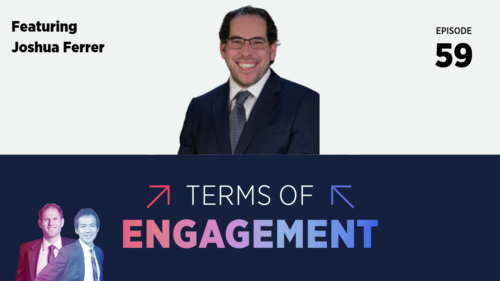
And does it make a difference on the confidence factor as well, as well as the administration factor? Because of course the confidence factor has been very much in the news over the past 10 years and going into this election, not all Americans are reporting a high level of confidence. So to discuss that, we have Professor Joshua Ferrer. Professor Ferrer is an assistant professor of government in the School of Public Affairs at American University where he studies challenges to democratic elections in the United States with an emphasis on state and local politics. He has appeared in many media outlets as well as academic outlets, but media outlets including The Economist, NPR, PBS, CNN, and The Guardian. He holds a PhD and master’s degree in political science from UCLA. He holds a master’s degree from the University of Otago and he holds a bachelor’s degree from Amherst College. So welcome Professor Ferrer and thanks for being with us.
Joshua Ferrer (04:44):
Thank you, Stephen, and thank you Archon for having me.
Archon Fung (04:47):
Yeah, great.
Stephen Richer (04:48):
So what’s the lay of the landscape? Archon said that we are distinct from many European countries in that we have a lot of elected election officials, but not everyone is elected, right?
Joshua Ferrer (05:02):
Right.
Stephen Richer (05:03):
And how many are which way and how many are the other way?
Joshua Ferrer (05:07):
Well, the US is distinct in a lot of ways when it comes to our democracy, even beyond election officials. In many European countries and even around the world, voters vote for one thing usually, it’s their national parliament. They might vote for some local office, but that’s really the extent of elections. Here we vote for a lot of different offices and that goes all the way down to election officials. And this is at a very local level. We have a little bit over 3,000 counties in the United States and counties are usually where elections are administered at, but there’s eight states, every New England state and then Michigan and Wisconsin where the municipal level is where elections are being administered. So we’re talking about town, village, clerks. Wisconsin alone has over 1,800 different election officials. So overall there’s around 6,000 different election officials who are working together to run elections and they’re in the run-up now just two weeks away to making sure that we have free and fair elections on Election Day.
(06:18):
In terms of elected versus appointed, a bit over 60% of jurisdictions, whether that be county or municipality, still elect their election official. So a minority of jurisdictions appoint, but a majority of the most populous jurisdictions appoint their election officials. So more than half of Americans are going to vote in a jurisdiction where their election official running the show is an appointed official.
Stephen Richer (06:49):
Okay. And so not only can it be elected or appointed, but also I ran as a Republican, I ran in the Republican primary first, and then I ran in the general election against the incumbent Democrat when I ran in 2020. So of the people who are running as a partisan chief-election-official, what percentage of those are partisan elections versus everyone just sort of runs and you’re on the ballot with no party moniker by you?
Joshua Ferrer (07:19):
The vast majority are partisan, something around the order of 65%. Now again, there is a divergence between the most populous and the least populous jurisdictions. The most populous jurisdictions are more likely to have nonpartisan races, but the truth is that the vast majority of election officials out there are partisan. And you might even consider a lot of the appointments are being made by people with a party affiliation, either they themselves ran with party affiliation or a majority party makes this determination.
Archon Fung (07:58):
Right. So I think you made a really important point is what an election official does varies hugely in the United States. In Michigan or Wisconsin, it could be a town clerk that is collecting bills or negotiating a refuse contract on one day and then running the elections on the other days. But for Stephen, running the elections is most of what you did in your job, is that right?
Stephen Richer (08:26):
We had other responsibilities, but given the prominence of election administration, it took up a large majority of my time.
Archon Fung (08:33):
Okay, gotcha.
Stephen Richer (08:35):
So we were also responsible, for instance, for all public recordings pertaining to real estate. So anytime a real estate transaction happened, which is where I got the name incidentally recorder, which used to be tied to the right to vote. So I guess it made more sense, maybe historically, property owners voting, but a lot of people were confused why somebody who would record the deed to your property or record a judgment against you would also be in charge of voter registration and election administration.
Archon Fung (09:03):
Right. I remember it was after 2020 and for various reasons during graduate school, I did some work in Madison, Wisconsin, and then I went back there to give a talk and somebody said, “Hey, do you want to talk to the election officials in Madison?” And so I said, “Yeah, absolutely.” And it definitely wasn’t the majority of what they did. It was something that they did when there was an election, but usually the day-to-day was other town business for sure. And so of course, after the 2020 election, elections get big in all public offices, and so it consumed an enormous amount of their psychological energy for sure because of all the attention that they were getting, but it wasn’t the majority of hours that they were spending in their public service.
Stephen Richer (09:52):
Yeah. I was hoping you could tell us a little bit about what these elections actually look like. So my 2024 election turned largely on commentary about previous elections and an absurd amount of money was spent on that race, but I know that a lot of my peers haven’t had a contested election in a long time. And actually a friend from Michigan just today sent me an article about, “Calling all willing participants to be county clerk,” because they have something like 400 open spots in the state of Michigan for elected officials across the board where nobody is running. So are these elections actually contested?
Archon Fung (10:34):
Wow.
Stephen Richer (10:35):
And if they’re contested, what are the types of things that people are campaigning?
Archon Fung (10:39):
Right. So it’s a notch below uncontested, nobody’s running.
Joshua Ferrer (10:42):
Right.
Archon Fung (10:42):
It’s not one candidate, it’s zero in a bunch of these. That’s sobering.
Joshua Ferrer (10:46):
So in the first part, there’s a great diversity. Most election officials are doing activities besides elections. So the most common title that does elections is a clerk. And as Stephen said, these folks are doing registrations. I’ll never forget, I’ve communicated with a lot of these election officials. I was trying to get election results from a jurisdiction and they sent me a cattle registration license, which is not quite the same ballpark, but that’s frequently those duties are put together. And this is another split between elected and appointed. A greater number of the appointed officials, the only thing they’re doing is election administration.
Archon Fung (11:27):
Oh.
Joshua Ferrer (11:27):
They’re called directors of elections, and that is what they do. Whereas virtually every single place where these folks are elected, they have a bundle of duties. Now in terms of races, Stephen, who served in Maricopa County, is not the modal case of elections, for sure. In fact, in my research, I found that it’s very rare that these elections are contested at all. I’m just looking at a list of 5,900 partisan elections over the past couple of decades. I found that fewer than one in four actually feature a contest between two candidates.
Archon Fung (12:12):
Wow.
Joshua Ferrer (12:13):
So 75% of the time, there’s one person on the ballot if that race even appears on the ballot. And then fewer than one in eight times, these are in these partisan races, was the margin of victory less than 20 percentage points. So when there was a contest between the two people, it was usually a blowout. Now, these findings are not unique to election administrators. Studies of local judges, local auditors, other offices find that local elections in general are rarely contested. Now that could mean one of two things. It could be people are really satisfied with the person who’s doing the election, and so no one comes up to bat because they know that they’re going to lose. Or the second option, which is a little less good for democracy, it’s that there’s not enough people willing to run to be election officials, so we’re not having the contestation we need in a democracy to ensure that the person doing the job is the right person and they’re doing a good job.
Stephen Richer (13:20):
So it seems like the dichotomy is less between a contested election and an appointed election director, and more the dichotomy is between an appointed election director and a system where it’s just waiting for somebody to raise their hand and say, “I’ll do it. I’ll run with my political party and I’ll get into this office and then maybe I’ll just keep doing it for a while and nobody will contest that election.”
Joshua Ferrer (13:49):
And this is one of the pressures we’re seeing from especially less populous jurisdictions and doing a lot of this work, I’ve found a lot of cases of jurisdictions that have switched between electing and appointing, and I know we’ll talk about this later on in this discussion, but one of the frequent reasons that’s brought up by these jurisdictions considering moving from elections to appointments is they’re having a lot of difficulty finding people willing to run. The person who’s good at running elections might not be someone who wants to go in front of the cameras and have a political debate. And there’s also usually jurisdictional requirements where if you want to run for an office, you usually have to live in that jurisdiction, whereas that’s not the case for appointments. You have a lot of jurisdictions that put out a call for an election director, and this is a call that goes out nationwide and they try to recruit whatever the best talent is around the country.
Archon Fung (14:47):
Yeah, good. So do you know whether the number of open spots has increased over the last decade or half decade? ‘Cause in these other surveys, like, Paul Gronke, I think the finding is that a lot of people who are working in elections, local election officials, are having a hard time and they’re thinking about leaving because of all the public attention and negativity. So has it always been difficult to recruit people or is it more difficult now than it used to be?
Joshua Ferrer (15:19):
It’s definitely become more difficult. I have some research, some of it joint with Dan Thompson at UCLA and some of it joint with the Bipartisan Policy Center where we’ve looked at the history of turnover of election officials over the past 20 years. And these are the people running the offices. There’s a lot of lower-level staff which are also having turnover pressures, but just the chief election official, like, Stephen was in Maricopa County, the turnover rate over a four-year period in 2000 was around 20%, 25%.
Archon Fung (15:53):
Okay. That’s not so … Yeah, that’s very sensible. Yeah.
Joshua Ferrer (15:56):
Today, it’s over 40%, just looking at the last election. So running up to this election, about 40% of the officials running this election are different from those who ran the election four years ago.
Archon Fung (16:07):
Wow.
Joshua Ferrer (16:08):
So there’s definitely a lot of churn. The reasons for this are complex and many. Some of it seem to be a recent political environment, which has been really difficult for election officials to run in, but part of it’s a longer-term as well. We’ve seen a year-to-year increase in turnover from the early 2000s. I think a lot of this speaks to the job has become more difficult as the law books get longer and the technology gets more complex in terms of running election, and we have more people than ever before.
Stephen Richer (16:41):
So a reminder that you can put your questions into the chat box and we’ll try to work them into the conversation. I’ll pick up Nancy’s because she asked the first question, which is, why did I choose to run as a Republican and did that change how I behaved in office? So I chose to run as a Republican because I’ve been a Republican my whole life. I’d been active in Republican Party politics. I had supported Republican candidates. I believed in the values of the Republican Party as I understood them for much of my life. How did that change my behavior in office? It probably made me more sympathetic to the questions that were being asked of me, especially after the 2020 election and made me more interested in really digging in and trying to get those answers. Now, I also hope that it would have afforded me more patience with an explanation of the process and not simply jumping to conclusions.
(17:40):
I was hoping that lots of people would say, “Oh, well, he’s one of us. He’s a Republican, so he’s going to get in there and he’s going to get some answers.” And I think some of that was true, but obviously not a sufficient amount of it was true because I wasn’t able to dispel every worry or concern about the 2020 election, and that obviously continues to this day. But that sort of turns us to the broader question that I wanted to pose to Professor Ferrer, which is is this insane? Because if you have people come in from outside the United States, or sometimes if you just walk down the street and you ask Americans who have this conception of election officials a little bit like Archon said as the umpire or as the referee, and you tell them that they’re elected and they’re in charge, then they just think that they’re dumbstruck, especially our European friends are dumbstruck by this. And so is this really stupid? Should we be doing it differently? What have you concluded in your research?
Joshua Ferrer (18:48):
So a lot of counties have switched almost uniformly from electing these election officials to appointing their election officials. The number is over 300 different jurisdictions at this point over the past half century, and there’s been an acceleration. Post-2000, a lot of attention was drawn towards election administration because the presidential election was decided by election administration for the first time in a long time. And that’s something that all election officials I think would agree, all Americans would agree we don’t want to happen. So there was a move towards switching from elections to appointments. A big reason for that move was the thought that appointed officials would be more professional in some way. So I’ve looked at the effects of this move, when jurisdictions switched to appointments, how did that change how their elections were administered? And the good news is that the differences were very small, overall.
(19:47):
Elections, whether the election officials elected or appointed were free and fair, the number of complaints were very small, the overall voter experience was very good. But in terms of voter turnout and registration rates, I do see a small bump when jurisdictions switch to appointing their officials. Voter wait times go down very slightly. Appointed officials are able to secure more resources to run their elections. They’re more likely to apply for grants to fund election administration, all else equal. And I do notice some other, the characteristics of these officials are a little different. Appointed officials are more likely to hold a college degree, all else equal. And this performance is especially large in small jurisdictions. And this goes back to our conversation about these elections where especially in smaller jurisdictions, on the one hand, it’s really hard to recruit people. On the other hand, the information that voters need to evaluate these officials is really scarce.
(20:54):
One really interesting part of this research that I found is that the jurisdictions that lack a newspaper is where the performance gap between the electeds and the appointeds are greatest, which again speaks to this idea that voters need information to evaluate their candidates and to evaluate people in office. Local newspapers provide that, and if that doesn’t exist, then they’re not able to adequately monitor, sanction, and evaluate different candidates. Now, this is a big problem across the nation. We’re having a lot of local news, newspapers, local television news gets subsumed into niche, national-owned entities and a lot of local newspapers are disappearing. But the big picture is both elected and appointed officials are able to deliver free and fair elections. The confidence question is another piece of this which is important. UC San Diego just had some good research that they produced. They ran polls finding that once again, I think majorities of both Democrats and Republicans have doubts that elections in the US can be administered in a free and fair manner, which is really concerning.
(22:07):
And Democrats and Republicans tend not to agree on much, especially local elites, but they do agree that nonpartisan appointed election administrators seem like a reasonable step to make. Majorities support the reform, but the reality is most folks don’t know much about how their elections are administered. I’ve run polls where I’ve asked voters questions, logical, factual questions about their election officials. I find that fewer than 17% can pick their election official, know the title of their election official. Only 8% can pick the name out of a list, and only about 5% know whether their local election official is elected or appointed.
Stephen Richer (22:58):
Okay. I didn’t know that that polling work was you, because we were talking about this the last two weeks when how well-informed or not are voters and do we have too much democracy and should we have fewer elected offices? We were talking about how few Americans can identify their elected officials or their elected election officials on a list of five names.
Archon Fung (23:21):
Yeah, absolutely. So I want to pick apart two different things that we’d like in election officials. One is the competence issue, the skillful issue. How good are they at running elections? How energetic, how creative and how competent in picking the machines and getting the word out and doing the registration, et cetera. So there’s a competence and capability dimension, and then there’s a, I don’t know, non-corruption or integrity dimension where they’re not simply a partisan hack trying to do whatever they can to help their party win. And so some of what you said … I think most of what you just said is about the first issue about competence, but then what about how much does it matter whether they’re wearing a red shirt or a blue shirt?
(24:13):
And I thought Stephen’s account was really interesting. It’s like, “Okay, I ran as a Republican because that’s my politics, but then in doing the job, I had a professional election administration piece of me that is running the elections and counting them well and properly, counting the votes well and properly. But then there’s also a political and communications dimension in which I’m in touch with that part of my community that in 2020 was quite election skeptical.” So you’ve got both things going on, but what’s not going on is the partisan hack part. So how worried should we be that electing election of administrators runs the danger of the political corruption and torquing out elections?
Joshua Ferrer (25:02):
Yeah, this is the biggest fear of voters, and I think why overwhelming majorities when asked, “Do you prefer partisan or nonpartisan administration of elections?” say they would prefer nonpartisan. It’s because of this fear that the election officials are going to, if they’re a Republican, they’re going to try to do things to boost their party. And if you’re Democrat, you’re going to try to do things to boost their party instead of running free and fair elections. I’ve done this research joint with Dan Thompson and Igor Geyn, where we looked at Democratic clerks and Republican clerks and looked at all of the administrative outcomes, looked at the overall vote totals and asked this question, “Do clerks who have a party affiliation benefit their party?” And in every single facet of election administration that we can quantify that we have data for, we found the answer is no.
(25:54):
Republican and Democratic clerks take similar actions in their office when they’re administering elections and they produce results that don’t in any way benefit their party. Now I know there are concerns. There’s a New York Times article a few weeks ago that there are election deniers in some of these offices, and I’ve started to look into this. The short answer there is that very few of these folks who have made statements saying the 2020 election was unfair are actually in the position of running elections in the election director position.
Archon Fung (26:34):
So-
Joshua Ferrer (26:34):
As far as we can tell, the answer is no, that these officials are not using their party affiliation in ways [inaudible 00:26:41]-
Archon Fung (26:41):
I think this is worth investigating. I mean, that’s a rare bit of good news and quite surprising, I think.
Stephen Richer (26:47):
Well, yeah, but we don’t know the causal factor, right. So that’s wonderful, and I’m glad that Professor Ferrer’s research shows that. Again, I want to reiterate that because it’s so important that having a Republican elected election official does not result in benefits to the Republican candidates on the ballot and likewise for a Democratic elected election official. That being said, what is the causal factor? Is the causal factor that once you get in there, you learn how the system works, you want to defend the system. Is it that people are more moral than perhaps we give them credit for? And when you’re on the campaign trail, everyone plays a little loosey-goosey, but then once you get into office, you abide by your code of ethics, or is it maybe social or professional pressure that when you’re around other election officials and you’re part of the community, you don’t want to be the one that sort of goes out on a limb. You don’t want to become the pariah within your industry.
(27:48):
Or as I consistently maintain, I think the level of discretion is vastly overestimated when it comes to election officials. People often liken this to, again, a referee in a football game who is making a determination on a past interference call and it’s questionable whether or not the defensive back had his arm around the wide receiver. And maybe if you’re unconsciously biased, you would call that in favor of Professor Ferrer’s UCLA Bruins, but maybe if you’re a Trojan fan, you could call it against UCLA. And I’m just saying, “Guys, we’re putting ballots into tabulators. There’s no discretion about that. Then the tabulators is just counting the ovals.” And so it could simply be that.
Archon Fung (28:38):
Yeah. What you’re saying is the discretion is narrow, and if you wanted to mess with the election in your jurisdiction, you’d have to color so far out of the lines that not so many people are willing to do that maybe, or even-
Stephen Richer (28:54):
I think that’s part of it. Again, I think that there’s very little discretion, but then the system is built such that it’s not just reliant on the morals of every single person working in this office. Now, again, I’m making this case. I firmly believe that these are all reasons. I don’t know where this puts me on should election officials be elected.
Archon Fung (29:18):
Right.
Stephen Richer (29:18):
I’m, generally speaking, think we should reduce the number of elected offices, so I probably would sign on to any policy that got rid of this. But also the bipartisan nature of all processes in the election, the fact that everything has to be checked and then rechecked by another person. So I think that you’d get exposed pretty quickly. And then again, also, someone like Tina Peters, the clerk from Mesa County, Colorado, she’s not welcome within the election community.
Archon Fung (29:51):
No.
Stephen Richer (29:52):
And just like lawyers or accountants or doctors who do something or say something very crazy, you become an outcast in those professional communities. And I do think that the election community is trying to develop more of a professional community and more of a professional ethos where maybe that is influential.
Archon Fung (30:14):
Yeah.
Joshua Ferrer (30:15):
Yeah, this is great.
Archon Fung (30:16):
Yeah. What do you think the counter question-
Joshua Ferrer (30:19):
Well, we try hard to disentangle, because this is the million-dollar question-
Archon Fung (30:22):
Pretty hard to disentangle-
Joshua Ferrer (30:23):
… or some might say the 150 million ballot question because it determines whether this finding is only for the last 20 years and could change. So on one hand, there’s this argument that election officials don’t have that much discretion, so even if they tried to gum up the system, benefit their party in some way, they wouldn’t be able to. And we found some evidence in this regard. When you scramble the election officials, you see no evidence of any different election official causing that much of a difference. Or even when in the places where election officials would have had the most ability and the most means, the most motive to try to benefit their party, again, we found no evidence that they were able to do so. The other argument is that this is the type of people who have gone into election administration really believe in free and fair elections, and so try to carry that out and not try to hold their Republican or Democratic candidates, do anything nefarious to try to benefit them.
(31:33):
We also see some evidence for that. Polling of election officials finds that they actually hold Democratic and Republican election officials hold more similar, less partisan views, divergent views on election administration than the average Democratic or Republican voter. Now, if that is the case, that does mean there is some fear that if a new crop of folks get into election administration who do really want to benefit their party, there could be some exposure there. I’m of the belief that I think it’s mostly the former and there’s maybe some potential for the latter. There are some areas of election administration where election officials do have some discretion. Where are they going to put polling places? How do they train election officials? But at the end of the day, most of this is state law.
Stephen Richer (32:26):
Can I pause you on that one?
Joshua Ferrer (32:27):
Yeah, absolutely.
Stephen Richer (32:28):
Where to put a voting location, ’cause we’ve got a question from Kevin Johnson who’s head of the Election Reformers Network, which is a group that pushes for appointed or at least nonpartisan elections of election-
Archon Fung (32:40):
Oh, gotcha.
Stephen Richer (32:41):
… officials. And so, “I’m the new Republican head of elections and I like the Republican Party, but I’ve got a good moral code too. And if somebody asks me to do something unlawful, I’m not going to do it. However, the Republican Party says, ‘Gosh, it would be great to have a few more voting locations in this area that happens to be an area of particular interest to the Republican Party.’ I’m in pretty constant communication with them, so I get that request and I think, ‘Well, there’s no harm in having a few more voting locations in this area.’ Does that type of thing happen more with elected officials than with appointed officials?”
Joshua Ferrer (33:26):
There is some evidence of, especially early voting decisions when you allow early voting to be a partisan split. The real question is how often does this happen and does it actually make a difference? A lot of the studies of the effects of these administrative voting decisions find fairly small effects, if at all, when they happen. So there is a potential for this. I think the big thing is the appearance rather than an actual effect.
Archon Fung (33:59):
Oh, interesting.
Joshua Ferrer (34:00):
And then the bottom line is we have very close elections. We have a fist-past-the-post system. So even though these really small, minor, where do you put a polling place, what exact hours of early voting do you have, likely make, if at all, a very small effect on the overall results that the best to our ability, we couldn’t identify any partisan effect. If the election result comes down to a hundred votes, I can’t guarantee that there’s not a hundred vote difference there. So this kind of comes to attention of these administrative decisions shouldn’t ever make a difference for an election, but if we have a really close election and we allocate all of the voice to a 50/50 coin flip, then you could point to any decision as being potentially determinative.
Archon Fung (34:53):
Right. So I want to offer a hypothesis, or not a hypothesis, just a position is that like Stephen and maybe you, Josh, I’m pretty open to shifting toward more appointed rather than elected, but I am concerned that shifting to more appointed is over promising. As people feel like, “Oh, if we shift to appointed, it’ll take the politics out of election administration. It might insulate people from pressure. Right now, maybe they’re behaving too much like partisan hacks and they wouldn’t if they were appointed.” And I read what you’re saying and a couple of your papers is saying, “Yeah, there are performance differences, but less the partisanship hack problems.” And then on the other side of it is something you don’t, this wasn’t your research question, but the last few years have made me think, “Well, yeah, appointed people are under plenty of political pressure also.” So it’s not a magic wand to all of a sudden insulate people who are doing public work from partisan pressure. Yeah. What do you think about the-
Joshua Ferrer (36:11):
Yeah, it’s not a magic wand. And I think there’s a democracy, democratic argument the other way, which is voters want to be able to hold the people running the government to account. So that’s why in some cases when this decision is being made, they put it up to a voter initiative or a referendum where we want to ask the voters before we take away something that they had a democratic voice to make. I totally agree that this is not a, if I waved the magic wand in every jurisdiction suddenly appointed their election officials, it would make a huge difference.
(36:58):
I do think the evidence shows that there are a lot of benefits to appointing officials and the fact that hundreds of jurisdictions across over a dozen states have made this decision in one direction shows there’s definitely a growing understanding that it makes sense to have our elections run by appointed officials. But it’s really important to emphasize that if you are going to vote and your election official is elected, they’re still delivering free and fair elections. The differences we identify are really on the margin, one or two different percentage points and turnout, no partisan effect at the end of the day.
Stephen Richer (37:37):
So is this just all appearance and perception like William Houser puts in the chat box, “Does an appearance and even small effects matter?” Is this just all about we want to feel warmer and fuzzier by having somebody who’s not running as a Republican or running as a Democrat or openly affiliated and out stumping with his or her party and that’s icky and we want to feel better. Is that what this is all about?
Joshua Ferrer (38:08):
Well, I would say yes and, because appearances are really important. Elections are these moments of political symbolism where who runs our country is decided. And a lot of this depends on transparency, a lot of it depends on trust, a lot of it depends on verification. As Stephen knows, Democrat and Republican are always in the room when they’re handling ballots, when they’re counting ballots, that’s all very important. But the appearance is really important. If you have someone with an R or D next to their name who are administering elections, to a certain degree, it doesn’t matter that they aren’t benefiting their party. The fact that they have that D or R next to their name has a legitimacy issue for how voters feel in their confidence. So even just the voter confidence, I think that’s a reasonable argument because appearances really do matter when it comes to elections.
Archon Fung (39:10):
So Josh, I mean, this is asking a lot of your research. I’m not sure there is a project that could do this, but say you went back to 2020 or another election that was quite close and a lot of people were disappointed at the outcome, are they less angry at an appointed official compared to an elected one or is it about the same? I want to push on the appearance point. How much does it matter when you’re really disappointed with the outcome?
Joshua Ferrer (39:40):
The bottom line is if you have a political elite who’s saying, “The election is rigged,” a lot of these things just don’t matter at the end of the day. The bottom line here is elected and appointed officials are delivering free and fair elections. Do appointed officials have some marginal benefits which are worth looking into? Absolutely. But after that free and fair election is delivered, if you have a political elite saying that it wasn’t free and fair, it doesn’t matter whether they were elected or appointed after the fact. Now, everything we can do to calm those tensions, to say, “This was a free and fair process,” that, “The election official is unimpeachable,” that, “They’re just trying to run elections,” I think it makes sense. And if this is an easy thing to do and a lot of jurisdictions have done it, then it’s something worth considering.
(40:37):
Though as with any … Once again, you’re taking some element of democracy away from the voters. So these conversations need to be had, they need to be open, and they need to make sure that the voters who have this decision now are on board taking away an office that they can vote for now for good reasons.
Archon Fung (40:55):
Yeah. Hey, I wanted to add, this is for Stephen, but also for Josh, William Houser’s earlier comment, Stephen, you’ve obviously faced very intense pressures as an election official. If you had been appointed instead, would that have moderated at all or you think it just would’ve been the same for some of the logic that Josh just laid out? Like, would appointment create some insulation, take some of the weight off?
Stephen Richer (41:22):
Yes, absolutely. It would’ve made my life a lot better.
Archon Fung (41:25):
Huh.
Stephen Richer (41:25):
I mean, was I consistently thinking about electoral impacts and for my own political future? Absolutely. Is that every elected election official? No, but I was a elected 35-year-old with a vision for myself and the future of the Republican Party in a hotly contested jurisdiction where I had to unseat an incumbent to get my office, and I was fully aware that I would be challenged within the Republican primary. And so that was certainly something that was on my mind.
Archon Fung (41:58):
Ah, interesting. Yeah.
Stephen Richer (41:59):
So whether that’s appropriate or not, I just think that’s the reality of people who are in elected politics.
Archon Fung (42:05):
Right. And this goes right to Kevin Johnson’s question, right. Elected clerks in Michigan are required to serve on the party’s executive committee, clerks in many other states have a future political career in mind. It goes right to that. So maybe with somebody with a little less integrity than you have would’ve zigged rather than zagged. It’s hard to say.
Stephen Richer (42:26):
There are some things that you do that are just because you’re in politics, you show up to the political convenings of your political party. You talk with the other politicians of your political party. And so you could make an argument that simply having more access to the elected election official is something that is suboptimal. But I do want to ask Josh about the flip side of the perception question where we said maybe there’s an ick factor with having an elected R or an elected D running the elections. But the flip side is what I suggested to Nancy at the outset, which was I hoped people would have more confidence from within my party given that I was identifying as a Republican and I was a partisan elected. Is there anything to that?
Archon Fung (43:23):
Good question.
Joshua Ferrer (43:25):
Yeah. The evidence isn’t great because they would need to know that you were running their elections. In a lot of cases they don’t.
Stephen Richer (43:33):
Yeah.
Joshua Ferrer (43:34):
So that is … And then there’s the question of, do we want a trade-off here? Right. The whole idea of elections, and there’s a lot of R versus D on this. The whole idea of elections is that, at the end of the day, no matter who wins, both sides need to agree that the results were valid. As much as I want the Bruins to win and they’re doing a good job of it now, I need to recognize that in a future football game, they could lose. It’s possible. Same thing for elections. And so I think probably the best way of that is you have someone without a D or without a R next to their name.
(44:10):
Now, are appointments perfect? No. A lot of times these people being appointed or being appointed by party officials, and I have research that shows that if Republicans control the appointment process, they’re much more likely to select someone who is a Republican, who’s a party affiliation and the same for Democrats. But without that D and R next to your name on the ballot, I think it does provide some insulation. The other part of this is what happens when you are running the election where you are on the ballot.
Stephen Richer (44:42):
Yeah.
Joshua Ferrer (44:43):
And in general, states don’t have great conflict of interest laws around this. Georgia actually is one of those cases where they had very strong conflict of interest laws where until recently, a couple dozen counties still had an elected chief election official, the probate judge who was elected with a party label. And they had a law that said, “If this person was on the ballot, they could not run that election,” which I think makes a lot of sense. Now Georgia is switched, everywhere’s appointed now, but those laws are not on the books in a lot of elections. And I think it’s a very obvious potential conflict of interest where if you are on the ballot, people can say, “Well, Stephen’s on the ballot. He’s going to do everything he can to benefit his party.” It’s not the best look.
Archon Fung (45:28):
Yeah. So I’m thinking about the appearance of a conflict, the appearance issues in restoring integrity. And maybe the way to think about it is shifting toward appointment would be a first step, but you need a lot of other things too, right. You’d want to create, whether at the state level or through some sort of federal guideline, an election apparatus, there was a little bit more like the Federal Reserve in that you had a lot of confidence that this thing was insulated from the political process, including how people are appointed to those election official positions. Just the fact of appointment, you can get all sorts of political appointments that are very subject to manipulation. So it’s just not the mere fact of election versus appointment, but what kind of appointment and what kind of wraparound can you create to say, “Yeah, this is really a body that’s insulated with a lot of integrity that we can believe in.”
Joshua Ferrer (46:27):
Absolutely.
Stephen Richer (46:28):
And I think we’ve seen some of that with the state judiciaries where some states have first a selection committee that is appointed by various political members, and then that selection committee screens all potential nominees for a certain level of competency. And then only then does it pass those names forward to the political bodies that then usually the governor who then appoints the judge so that it does hopefully insulate that process or put guardrails around that process.
Joshua Ferrer (47:01):
And some counties have extended that to appointed election officials. There’s almost as many different methods of how this official gets appointed as states and jurisdictions, but a handful of them have some Ds, some Rs at the table, but then the tiebreaker is a nonpartisan judge. And it would seem at least to me that those processes are the most secure against claims that there’s partisan shenanigans going on.
Stephen Richer (47:33):
Okay.
Archon Fung (47:33):
Yeah. Good. I just want to acknowledge Dominic’s comment at the end, which I think the research bears out. Dominic says, “Voters tend to trust their election officials. It’s other election officials that they don’t trust.” And I think we have some survey evidence to show that that’s the case. And Stephen’s much more in this community than I am, but I think there are efforts of election officials to vouch for at least the procedures that other election officials in other jurisdictions are following to try to increase trust of people who are in other places, which is an important kind of move, I think.
Stephen Richer (48:13):
Yes, absolutely. And then my last comment and followed by a last question. My last comment will be that I think the being on the ballot while being an election administrator is again more of a problem of perception than it is a problem of the actual mechanics. That being said, I believe so firmly in spreading confidence in election systems that I had the good grace to lose my reelection when I was the election administrator. I wanted people to have such confidence that I did that. And then my question is, Professor Ferrer, where should people go to see your future research on this topic? Because I know you have a few more papers that are coming out.
Joshua Ferrer (49:02):
Yes. My website, joshuaferrer.com is where I post all my working papers and I have several others on election administration. If you’re interested in learning more about this topic with real data, this is what I do.
Stephen Richer (49:16):
Okay. Did we lose Archon or is Archon still here? I think we might have lost Archon. Well, I’ll close this out then, and I will say thank you on behalf of Archon and myself for being here today. Oh, there he is. He’s back. Thank you for being here today. Thank you for watching live. Those of you who joined us live, we appreciate your questions. For those of you who are watching it recorded, thank you also. We will record again and we will be live at 12:15 Eastern Time next Tuesday. As mentioned, only two weeks away from Election Day. Very exciting. We’re probably going to stay in the election space for the next two weeks at least. And we appreciate our production team. And any final words, Archon?
Archon Fung (50:01):
Yeah, just a huge thanks to Josh for your research. I think it’s really just a model of how careful political science can inform election administration and ways that we run our institutions to make democracy work better. So thanks a lot for your work. Really appreciate your coming on.
Joshua Ferrer (50:18):
Thanks so much for having me.
Archon Fung (50:18):
Yeah. Good.
Stephen Richer (50:21):
Have a great week.
Archon Fung (50:22):
All right. Take care, everyone.