

Q+A
How Sports Fandom Strengthens Community Connection
New research from More in Common explores how sports connect Americans across differences and strengthen their community ties.

Podcast
Richard Hanania, a writer and former alt-right influencer who renounced MAGA and now favors political rule by elites, joins Terms of Engagement to discuss his book “Kakistocracy: Why Populism Ends in Disaster.” The book is named for the Greek word meaning “rule by the worst.”
Richard Hanania spent a decade as an influential voice on the online right — first pseudonymously in the alt-right, later as what New York magazine called “an intellectual muse of the Silicon Valley right.” Then he watched his own ideas take power and, in his words, “was horrified at what I had helped create.” His new book “Kakistocracy” is an argument that populism does not fail by accident but for structural reasons, that the cause is not elite failure but communications technology, and that the solution is not more democracy but better elites. He joins Terms of Engagement hosts Archon Fung and Stephen Richer to talk about populism, elites, and who should wield power in American politics.
Richard Hanania is a political scientist, writer, and president of the Center for the Study of Partisanship and Ideology, a think tank he founded to study how ideology shapes policy and institutions. He holds a PhD in political science from UCLA and a JD from the University of Chicago. He’s the author of the books “Kakistocracy” and “The Origins of Woke,” and his writing has appeared in outlets ranging from The New York Times to The Atlantic to The Washington Post. He is a prominent voice in online political commentary, publishing frequently on his Substack and known for provocative takes that draw both fans and detractors across the political spectrum.
Archon Fung is the Winthrop Laflin McCormack Professor of Citizenship and Self-Government at the Harvard Kennedy School and the Director of the Ash Center for Democratic Governance and Innovation. His research explores policies, practices, and institutional designs that deepen the quality of democratic governance with a focus on public participation, deliberation, and transparency. He has authored five books, four edited collections, and over fifty articles appearing in professional journals. He received two S.B.s — in philosophy and physics — and his Ph.D. in political science from MIT.
Stephen Richer is the former elected Maricopa County Recorder, responsible for voter registration, early voting administration, and public recordings in Maricopa County, Arizona, the fourth largest county in the United States. Prior to being an elected official, Stephen worked at several public policy think tanks and as a business transactions attorney. Stephen received his J.D. and M.A. from The University of Chicago and his B.A. from Tulane University. Stephen has been broadly recognized for his work in elections and American Democracy. In 2021, the Arizona Republic named Stephen “Arizonan of the Year.” In 2022, the Maricopa Bar Association awarded Stephen “Public Law Attorney of the Year.” In 2023, Stephen won “Leader of the Year” from the Arizona Capitol Times. And in 2024, Time Magazine named Stephen a “Defender of Democracy.”
The views expressed on this show are those of the hosts alone and do not necessarily represent the positions of the Ash Center or its affiliates.
Coming Soon!
Q+A
New research from More in Common explores how sports connect Americans across differences and strengthen their community ties.
Podcast
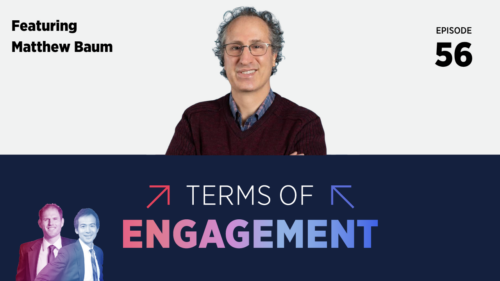
As the 2026 midterm elections approach, new research raises an urgent question: Are Americans operating within fundamentally different information realities? In this episode, Professor Matthew Baum examines what voters know about election rules, where they get their information, and how partisan divides shape perceptions of the voting process.
Feature
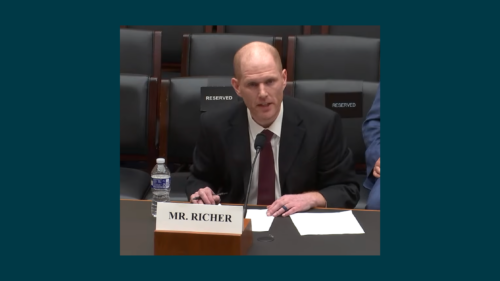
On Tuesday, September 15, 2026, former Maricopa County Recorder Stephen Richer, now an Ash Senior Fellow and election administration expert, testified before the House Judiciary Subcommittee on Oversight. The hearing examined allegations that approximately 6,600 noncitizens were improperly registered to vote in New Jersey between June 2023 and June 2024.