

Podcast
What now? Post-Election Day Special with Archon Fung and Stephen Richer
On this week of the Terms of Engagement podcast we have a special Post-Election Day Discussion with co-hosts Professor Archon Fung and Stephen Richer.

Podcast
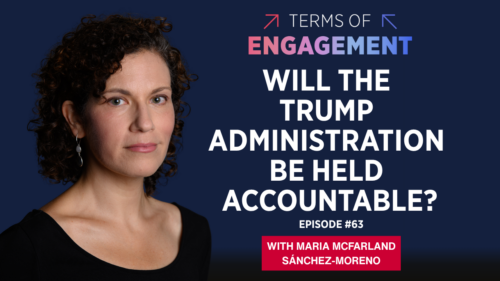
On this week’s episode of the Terms of Engagement podcast, co-hosts Archon Fung and Stephen Richer welcome Maria McFarland Sánchez-Moreno, CEO of RepresentUs, to discuss what accountability could look like in the next two years.
On this week’s episode of the Terms of Engagement podcast, co-hosts Archon Fung and Stephen Richer welcome Maria McFarland Sánchez-Moreno, CEO of RepresentUs, a non-profit whose mission is to make government accountable to the people. An advocate, author, and lawyer, she will discuss what accountability could look like over the next two years and who could be held accountable.
As Democrats are set to take control of both the House and Senate in January 2027, many Americans want Congress to hold the Trump administration accountable for alleged corruption and unlawful conduct over the past two years. What are the next steps that elected senators and members of Congress can take? Does this include opening investigations, pursuing impeachments, and seeking the disgorgement of financial gains—the return of profits gained through misconduct? Who is most likely to be targeted, and why? And how can Democrats do this in a way that will not negatively impact their newly gained political capital or presidential run in 2028?
This livestream aired on Tuesday, November 10th at 12:15 PM ET.
Maria McFarland Sánchez-Moreno is CEO of RepresentUs. She is an advocate, author, and lawyer with over two decades of experience globally and within the US on issues of corruption, authoritarianism, organized crime, and human rights. Maria has held multiple senior positions at Human Rights Watch and served as executive director of the Drug Policy Alliance. A Peruvian-American, Maria came of age in Peru at a time of internal armed conflict, economic crisis, and then corrupt autocracy. Early in her career, she contributed to the extradition and trial on charges of corruption and crimes against humanity of former Peruvian President Alberto Fujimori. Her narrative non-fiction book “There Are No Dead Here: A Story of Murder and Denial in Colombia” (Bold Type Books, Feb. 2017), won the 2018 Juan E. Méndez Human Rights Book Award.
Archon Fung is the Winthrop Laflin McCormack Professor of Citizenship and Self-Government at the Harvard Kennedy School and the Director of the Ash Center for Democratic Governance and Innovation. His research explores policies, practices, and institutional designs that deepen the quality of democratic governance with a focus on public participation, deliberation, and transparency. He has authored five books, four edited collections, and over fifty articles appearing in professional journals. He received two S.B.s — in philosophy and physics — and his Ph.D. in political science from MIT.
Stephen Richer is the former elected Maricopa County Recorder, responsible for voter registration, early voting administration, and public recordings in Maricopa County, Arizona, the fourth largest county in the United States. Prior to being an elected official, Stephen worked at several public policy think tanks and as a business transactions attorney. Stephen received his J.D. and M.A. from The University of Chicago and his B.A. from Tulane University. Stephen has been broadly recognized for his work in elections and American Democracy. In 2021, the Arizona Republic named Stephen “Arizonan of the Year.” In 2022, the Maricopa Bar Association awarded Stephen “Public Law Attorney of the Year.” In 2023, Stephen won “Leader of the Year” from the Arizona Capitol Times. And in 2024, Time Magazine named Stephen a “Defender of Democracy.”
The views expressed on this show are those of the hosts alone and do not necessarily represent the positions of the Ash Center or its affiliates.
Archon Fung (00:32):
Hey folks, this is Terms of Engagement and I’m Archon Fung, a professor at the Harvard Kennedy School and director of the Ash Center for Democratic Governance and Innovation.
Stephen Richer (00:41):
And I’m Stephen Richer. I’m the former elected Maricopa County recorder, and I’m now a lecturer at the Harvard Kennedy School and a fellow at the Ash Center. And I am coming to you today from Phoenix, Arizona. And so a little bit of a change of backdrop, I promise I will reconfigure this office so that you don’t have to be staring into the blinds through which the ever present Arizona sun is peeking through and may be piercing into your eyes. And so we’ll work on that for future shows, but excited to be here and excited to be chatting with you all. As always, if you are watching live, please feel free to put your comments into the chat box and we will integrate those into the conversation. And of course, as always, Archon and I are speaking on behalf of ourselves and not on behalf of any Harvard related entity.
(01:28):
So turning to the post-election world, Archon and I have a number of topics planned that we think are interesting questions now that we have a better sense of the landscape as it will exist in 2027 with Democrats having recaptured both houses in the Congress and with a lot of state legislatures having flipped to the Dems, governorships having flipped to the Dems, Attorney’s General offices having flipped to the Dems. And so we’re looking at one angle of this new dimension today. And I think Archon’s going to introduce that.
Archon Fung (02:05):
Great. And before we dive into the main meat, Stephen, what do you think the vibe is going to be over the next couple of years? So I had thought maybe after the election on that morning, after President Trump conceded at least the Republican side of it, I thought maybe it’s going to be a little bit win-win, some deal making, some negotiation. But then on the Democratic side, which we’re about to talk about, there’s much more accountability talk. And on the White House side, you have Stephen Miller, Mr. Miller, as the new chief of staff. So maybe it’s not going to be honey and roses for the next two years. What do you think?
Stephen Richer (02:44):
I don’t know, but it’s mixed signals because obviously during the 60 Minutes interview, which was excellent and I watched it all and I really recommend it, President’s interview with Ross Douthat from 60 Minutes, he talked about doing a deal with Dems and he said that he could even go six months without insulting Democrats if that was necessary to get a deal done. And especially on the topic of immigration he was interested in and that a number of the new Democratic congressmen are interested in that topic as well. But again, yeah, appointing Stephen Miller to chief of staff clearly isn’t a signal that they want to have a pivot, that they want to be more bipartisan or something like that. And then even on the election administration front, the president within the first 48 hours said that he accepted the results. Then another, I think 48 hours later, he said that nobody could possibly believe these results in a post on Truth Social. So there’s a lot of mixed messages out there.
Archon Fung (03:45):
Right. And so I’m sure all of that will unfold in future episodes, but today we are talking about corruption and the anti-corruption accountability agenda. A record high of 89% of Americans, that’s up about 10% from a decade ago, and that includes 83% of Republicans and 91% of Democrats say corruption in government is widespread. Last week’s midterm sweep gave Democrats both chambers of Congress. A lot of people think that concerns with corruption are a factor in that large swing. And so today we will look at corruption, what kinds of corruption actually damage democracy and then what can be done constructively to advance an anti-corruption agenda. And also what would be missteps and overreach maybe and vengeance in trying to advance an anti-corruption and accountability agenda. And then also, can anything at all be done over the next two years legislatively while President Trump holds the veto pen? And Stephen, who are we talking to today?
Stephen Richer (04:55):
And so to have this conversation, we’re fortunate enough to have Maria McFarland Sánchez-Moreno, who is the CEO of Represent Us. And the website is represent.us. For those of you who want to learn more about what the organization does, she, Maria, is an advocate, an author, a lawyer with two decades of experience globally and within the United States on issues of corruption, authoritarianism, organized crime, and human rights. She has previously held positions with Human Rights Watch and with the Drug Policy Alliance. She received her JD from New York University School of Law, and she served as a judicial clerk on the Fifth Circuit. And she comes to us today as somebody who is already thinking very deeply about what accountability should look like in the new Congress. So welcome, Maria.
Maria McFarland Sánchez-Moreno (05:44):
Thank you so much.
Stephen Richer (05:46):
So I guess the basic question at the outset is, should this be a priority for the new Congress? Because in many surveys, a lot of people said the most important things are the cost of goods. The most important thing is the price of gas. The most important thing is ending the war with Iran. The most important thing is any other thing other than corruption or accountability. Would this interfere with the Democrats being able to put forward a positive agenda? Should this be a priority basically?
Maria McFarland Sánchez-Moreno (06:24):
Yes, absolutely. This needs to be a top priority. It’s not the only priority, but it needs to be up there for a few reasons. One, the public is clearly furious about corruption. The exit polling that CBS News put out suggested that nine out of 10 Americans said that corruption was a major factor in their vote. Even in the lead up to the elections, you had a Fox News poll showing 88% of Americans saying they were extremely or very concerned about corruption. This was a vote that to a significant extent was driven by Americans’ frustration with corruption, and the new Congress needs to tackle that.
(07:12):
In addition to that, we have a huge problem. There’s a reason Americans are mad. This is a situation where an administration has come in and effectively taken over the government for profit. It’s what in other countries we would call state capture, or there are others who call it a mafia state, where instead of making decisions based on the public interest, the executive branch is making decisions based on how the president, his family members, his allies, people who buy access can profit. And they have changed the rules and put people in power and key roles that would normally serve as checks on power who will go along with them and let them get away with it. That is a critical problem that needs to be addressed right off the bat.
Stephen Richer (08:15):
But what would you say to somebody who says somebody going to jail or somebody having their money, their ill-gotten means stripped away from them, doesn’t make my life better. I want you to make my life better as an individual and my life, the challenges are feeling safe. My life, the challenges are being able to go on a vacation. My life, the challenges are having enough money to do the things that we want to do. And if we keep looking backwards, we will never address what going forward means and making it better for the American people. You certainly find that compelling, but what do you say to that?
Maria McFarland Sánchez-Moreno (08:49):
Yeah. I mean, I think there are so many different ways in which government corruption, especially state capture, makes our lives worse. When people feel that the price of gas is high, for example, how do we know that the decisions that the president made around the attack on Iran were driven by national interest and our safety as opposed to what was good for the pocketbook of Jared Kushner and Steve Witkoff who were negotiating in the Middle East on our behalf and who were simultaneously taking money from the Saudis and other governments.
(09:33):
When you have a system that has been taken over by people who are self-interested, who are using government for their own gain, then the decisions they’re making can have devastating effects on regular people that do ripple all the way into our pocketbooks. There are more direct examples. The IRS slush fund that the president was pushing earlier this year would’ve been taxpayer money that would’ve gone into the pockets of probably January 6th insurrectionists. That’s money that could otherwise go to healthcare, that could otherwise go to services, to fixing potholes ultimately.
(10:27):
So our quality of life is diminished when you have large scale corruption, taxpayer money being taken, contracts being assigned to people who are on the inside. When government is driven for the profit of insiders, everybody else is left out and government is such an important force in our lives that it just distorts everything.
Archon Fung (10:53):
Yeah. That’s a great set of thoughts that you just kind of put on the table. And I wanted to make a distinction. One reason to really care about corruption and the kind of kleptocracy that you’re talking about, one is that it’s grossly unfair that people in public office are abusing that office to enrich themselves and their families. So there’s an unfairness problem, but the other is a kind of more core democracy problem and how it’s hurting the public welfare, which was Stephen’s initial thing. Is it like it’s hurting me and my life at the gas pump or at the grocery store. And the mechanism there, which you laid out super clearly, is that officials are making decisions that should be about the public good, but they’re not making it to advance the public good. Sometimes they’re making it to enrich themselves.
(11:51):
And so you offer Iran as one example, but some people might say, even people who are very anti-war might say, “Well, look, it wasn’t really so much for the enrichment, but simply because Donald Trump thought that it would be a cakewalk, much like Venezuela, and so it was a piece of bad judgment rather than enrichment that drove that decision.” What would you say to that?
Maria McFarland Sánchez-Moreno (12:16):
I would say that that’s why we need to investigate. We don’t know exactly what was behind a lot of decisions. We do know that Jared Kushner is running Affinity Partners, which is a big investment firm that is almost all made up of investments from Saudi Arabia and the UAE. And he has been a lead negotiator on the Middle East, even as he’s profiting. What did the Saudis say? What did the UAE say about Iran? How did that play out? We also know that the president made big oil stock trades, in some cases right before significant decisions around Iran and made a lot of money on those. He says those are all managed by an independent advisor, but that needs to be looked at. The timing is not great. Was this a mix of motives? Quite possibly. Nonetheless, if corruption, if self-enrichment was a driver here, that is deeply problematic and that needs to be investigated and we need to pursue consequences and make sure that doesn’t keep happening.
Archon Fung (13:30):
Yeah, I agree. So do you think that it’s mostly the unfair enrichment that’s happening or the enrichment that hurts the general welfare? Because a huge source of enrichment has been the cryptocurrency in the Trump family, which is some people, the accounts I’ve read is something like $2 billion, which is kind of astonishing to me. But that seems like just … Not just, unfair enrichment, but doesn’t necessarily hurt somebody in Arizona or somebody in Boston going to the grocery store. It’s just grossly unfair rather than hurting me.
Maria McFarland Sánchez-Moreno (14:11):
I mean, I think, again, we need to dig into what happened. So the cryptocurrency has been used as a way to get all sorts of investments from people who had business before the government, who were interested in getting access to the president. And we don’t know what those people who made investments got in exchange. We do know, for example, that the United Arab Emirates made a huge investment through one of their royals, their national security advisor in World Liberty Financial. It was $500 million according to the Wall Street Journal. And three months later, they suddenly got access to these AI chips that they had wanted for years and that the US had refused to give them because it was concerned that the UAE would hand them over to China. That looks a lot like a quid pro quo, and that hurts Americans.
(15:12):
This is not just about, well, Trump is kind of getting rich and finding deals on the side that have no impact. If China is winning or beating the US in the AI race and you care about that, that has enormous implications for US national security, competitiveness and the economy and so on. And the same is true if you had, let’s just say it’s a business that has to do with healthcare and they then get advantages from government. If investigations aren’t happening because somebody made an investment in Trump’s crypto firm, that has ripple effects. If we end up with food that is contaminated, with lettuce that has parasites, all sorts of issues because government is not functioning as it should because people got access to the president, that hurts us.
Stephen Richer (16:13):
But whether ill or not, there’s always lots of stuff that go into different decisions and we don’t have full information on the decision making process. So why is it … I guess this is more of a global question, more theoretical question. Why is it that having this information is so important? We sort of elect people understanding that they are not puppets, that they are individual actors, and we trust them to deliver good results and we have imperfect information, they have better information, and so they make those decisions.
Maria McFarland Sánchez-Moreno (16:49):
Well, actually we don’t trust them to make decisions like this when they have a personal stake in them. Most government officials are not allowed to have conflicts of interest in decisions that they’re making. The president and vice president are the only executive branch officials who are not bound by existing laws on conflicts of interest. And so there’s this massive loophole in our law that has allowed the president to have these conflicts of interest this time, and he’s taken advantage of it in a way that previous presidents hadn’t because it was tradition not to have conflicts of interest, not to make decisions on matters where you have a chance to make a big profit.
(17:44):
In the private sector, we would not be allowing this sort of thing to happen. If a CEO is standing to gain from who they give a contract to, that would be really problematic. And yet we’re allowing it in the presidency, and that is something that we need to get to the bottom of. I’m not saying that these are all crimes. It may well be that some of these things are legal and yet they are deeply problematic. They are what amounts to corruption understood as the use of public office for private gain, and that needs to be fixed.
Stephen Richer (18:29):
Okay, so let’s get into that. So somebody says, “I accept the premise, this is problematic for the American people. Nobody likes ill-gotten gains and nobody likes the notion that American governance is rife with corruption.” Speaker Jeffries comes in, Senate President Schumer comes in and says, “Maria, we don’t have the presidency. He’s not necessarily going to sign everything we send him into law, but we do have some powers. Which of those powers should we flex in order for there to be more accountability for American government?”
Maria McFarland Sánchez-Moreno (19:08):
Right. So you’re right that legislation is going to be hard to pass if the president isn’t on board with it because he has the power to veto it. But where Congress does have tremendous power and the president can’t stop them is on oversight. Different committees in Congress have oversight authority over the different subjects that they cover, and you have committees on oversight and investigations, committees on the judiciary who have fairly broad ability to dig into what the executive branch has been doing and look at examples of fraud and abuse and misconduct. And given the scale of the corruption that we have been seeing, the abuse of power that we’ve been seeing, I’d say it’s critically important that they prioritize understanding it, helping Americans understand what has happened, telling the story, and then charting a path forward.
Stephen Richer (20:15):
And drilling in on that a bit, what does that actually mean when you have the power to investigate? Congress has the power to investigate. Does that mean having a congressional hearing in which the Secretary of Defense has to come to the hearing? Does that mean the power to get documents from the Department of Defense? Does that mean the ability to hire investigators who can go into the Department of Defense? I guess put that in more specific terms for those who are unfamiliar, as I am, with what might be leveraged here.
Maria McFarland Sánchez-Moreno (20:51):
Yes.
Archon Fung (20:51):
Yeah. And just also as you do that, what does the fuller menu of means look like? So I think you’re probably not in favor of a special investigator operating out of the Department of Justice and the AG’s office, but that would be a traditional mechanism. Another mechanism, you have to go back a little bit, but as a congressional committee, like the church committee, but what’s the full range of options that Speaker Jeffries or someone else should be considering in this effort?
Maria McFarland Sánchez-Moreno (21:25):
Yeah, sure.
Stephen Richer (21:26):
And I should say these are all presumed. Archon and I don’t have special information. Hakeem Jeffries is going to be speaker.
Archon Fung (21:33):
Yeah, we have less information probably than most people watching us.
Maria McFarland Sánchez-Moreno (21:40):
If you find out, let me know. No. So Stephen, for sure there’s all of the above. Everything that you said is available, right? They can subpoena documents from government. They can ask government officials to testify. They can ask private sector actors to testify. They can hold hearings. They can file requests for information from companies and so on, and they can hire expert investigators to follow the money, to put the facts together and help the rest of us understand what has happened. And you’re going to see probably, I’m guessing, a bunch of different committees taking action as opposed to one single committee, like the church committee that was a committee that came together after Watergate to look at what needed to happen. But that hasn’t been decided yet and we’ll have to see what new leadership does.
(22:47):
In terms of the broader map of accountability, I’m actually going to take a step even further back and tell you a little bit about what I’ve seen in other countries.
Stephen Richer (22:56):
Oh, great.
Maria McFarland Sánchez-Moreno (22:57):
I grew up in Peru under a corrupt autocrat, Fujimori, and I was also involved years later in helping bring him to justice. I was part of the effort to extradite him from Chile to Peru, and I was in the courtroom when he was convicted of crimes against humanity and corruption, and he ended up spending basically the rest of his life in prison. And what you saw there was after the fall of the Fujimori regime in the middle of a big corruption scandal, a special prosecutor who Fujimori himself had appointed to look into the scandal and who was widely respected as being very independent, happened to be my cousin by the way, full disclosure, he and a team of prosecutors and investigators started working their way through the evidence.
(23:54):
There were all these videotapes that had surfaced of the president’s right-hand man handing out cash to members of the opposition, to members of the military, to judges, prosecutors, media owners. And so they started chasing down all the evidence. They ended up investigating 1,500 people and building multiple cases and eventually getting to Fujimori. But the timeframe between when the investigation started and when Fujimori was convicted was nine years. It took a long time, and that process started again as the regime was falling.
(24:36):
In the United States, I think, no, I would not ask the Department of Justice to appoint a special prosecutor at this point. I think it is very clear that DOJ has been captured. In other words, it’s under the control of people who are using it to further their agendas and not in the public interest. And so I think we need to work around DOJ. This is one reason Congress is incredibly important because it is the only part of the federal government right now that would be able to do a comprehensive set of investigations and at least establish the facts and lay the groundwork for some future DOJ potentially to take action.
(25:29):
Now there may be pardons, so then that raises other questions about, well, what consequences are available? I personally don’t think Trump is going to remember to pardon everybody, and he’s already thrown some of his allies under the bus, like Kimberly Guilfoyle. So if I were in that group, I would be a little nervous and wouldn’t be counting on him. But even if you do have pardons, there are other options, including regulatory action. The Securities and Exchange Commission could pursue civil proceedings and the damages and fines available are substantial. And then you have state level prosecutions available.
Stephen Richer (26:18):
For the purposes of this Congress though, the goal is to expose, is to write a report, is to chronicle what has happened over the past two years. And then you’re saying any sort of punitive or remedial action will have to wait until there is what, an executive authority with the appetite to pursue the facts as detailed in the congressional investigations?
Maria McFarland Sánchez-Moreno (26:44):
I don’t think that’s necessarily the case for everything. Certainly Congress has impeachment and removal authority and that is available for cases that are well put together. I would recommend starting with the facts and making sure that investigations are on really solid footing and that the American public understands and is bought into the need for accountability because you’ve made the case effectively.
Archon Fung (27:20):
So it’s a factual project. And do you think that it would be important or desirable or just not feasible for such committees to be bipartisan?
Maria McFarland Sánchez-Moreno (27:33):
I think it is feasible for committees to be bipartisan in approach, and I would love to see Republicans join in on this effort. I thought actually Senator John Curtis, now a couple of months ago, wrote a letter to the Senate Judiciary Committee that took a very principled stand. This was after the story had emerged in ProPublica of Don Jr.’s wedding in the Bahamas being paid by someone tied to Russian oligarchs. And I guess that was the last straw for Senator Curtis who wrote a letter to the judiciary committee saying, “Look, this is a real problem. Presidential kids should not be getting away with also having all these conflicts of interest and making money off the presidency.” And so he said, “Hunter Biden, Don Jr. these are cases that the judiciary committee should be taking up and we need to fix these loopholes that got us to this place.” That was a very solid, reasonable approach, and I would think that other Republicans could get on board with it too.
Stephen Richer (28:52):
I mean some of the Dems who are super charged up about this might be like, “Oh my God, this is so feckless. You’re going to produce another report. Look at the January 6th committee. Great. You guys produced some books and nobody cared. Nobody went to prison. Nobody had their money disgorged, yada, yada, yada.” And I guess I’m disenchanted that that sort of thing is going to happen. And guess what? Well, it might be nice to think that Republicans are going to participate in some of these committees. They certainly don’t have to. They certainly didn’t have to, even though everyone at the time condemned January 6th. I mean, that’s a hard position maybe to put you in, but what is your answer to those Democrats who are like, “This is why we won Congress. Do something more than just putting a letter because-”
Maria McFarland Sánchez-Moreno (29:38):
I am fully on board with Congress doing something, and these are concrete things Congress can do. What I don’t want is a whole lot of political theater that goes nowhere. I would say that what happened with January 6th, the real shame there was not the January 6th committee. They did a great job. It was that DOJ failed to start those cases, and particularly the investigation of the precedent, early enough. And so by the time they were ready to move, it was too late. And that’s exactly the mistake that can’t be repeated. This country has actually a pretty bad track record of holding people with power to account.
Archon Fung (30:22):
Yeah. January 6th is an interesting comparison that you raised, Stephen. I mean, I think it did land and have the effect that you say not much happened out of it. And I guess to me, its big failure is as a … I mean, there was a whole lot of evidence gathered, but it failed to establish an American narrative that most Americans accept about what happened in January 6th. And I guess I would think that the value out of investigations and hearings over the next two years is not simply to establish a fact base. We have a fact base about January 6th. We know to a person and to the minute what happened, but it’s not broadly shared among Americans at large, and that’s the failure.
(31:12):
So beyond the investigation, I presume you’re interested in a broadly shared narrative about the level of corruption that has occurred over the last two years especially, but an investigation, as January 6th shows, doesn’t fall short of certainly guaranteeing that acceptance among all Americans.
Stephen Richer (31:33):
But it’s an important point to be raised because it gets to the goals. Why are we doing this? Is it to get the facts? Is it to get this narrative? Is it to put people in jail? Is it to get money back that the federal government should be owed? And my question to Maria is, do you have to decide, does everyone have to be on the same page as far as what the goals are here because they will shape the investigative strategy so much? Or does it matter if Archon wants to set the narrative and I want to see people in prison?
Archon Fung (32:04):
In jail.
Stephen Richer (32:07):
But that’s fine. We’re going to take the first few steps together anyways.
Archon Fung (32:12):
Good question.
Maria McFarland Sánchez-Moreno (32:12):
Yeah. I mean, I think if you want to see people in prison, it needs to start with investigations. I don’t think you want a situation where suddenly Congress is behaving arbitrarily and throwing people in prison for no reason. You want to be able to make the case that this was fair and grounded in evidence. And there is plenty of evidence to work with.
(32:40):
I think we need to go deeper. Congress needs to surface evidence before it disappears. They need to bring in private sector witnesses. For example, around the DOD loan that Don Jr., this firm that Don Jr. invested in got. It’s a $620 million loan from the Office of Strategic Capital, the Pentagon, the largest loan they’ve ever given to a startup just a few months after Jr.’s investment firm invested in it. And according to ProPublica, the White House actually intervened to make that happen.
(33:23):
This is a very serious case, but you can also dig deeper and get more information about it. Who else was up for that loan? What competitors didn’t get it? What do we know about this firm and whether it was qualified or not? Who made the call? Who spoke? All of that stuff can be fleshed out, and that is both about telling the story and helping Americans understand and about creating the record for eventual proceedings, whether those are prosecutions or civil proceedings or otherwise.
(33:57):
And this is not something that happens overnight. You do not ensure accountability, including consequences for corruption on this scale within two years. It’s just not possible, but you get started. And the idea here is let’s use these two years to get Americans on the same page as much as possible, to establish the evidence and to start sending the message, and this is critically important, that you’re not going to get away with it if you do engage in this kind of behavior, that you will be brought in to testify, that you will have to answer tough questions, that people will be looking.
(34:43):
Because that is one thing that this administration has really damaged, is the sense that people can’t get away with misconduct and possibly crimes. We need to change the message that people are getting that they’re above the law and help Americans trust that the laws will apply equally to everybody, including the most powerful.
Archon Fung (35:09):
Yeah. Good.
Stephen Richer (35:11):
A reminder that you can put your question in the chat and we’d love to hear from you. There’s an embarrassment of riches for investigative opportunity.
Archon Fung (35:23):
No doubt.
Stephen Richer (35:24):
Where do you start and does Congress have the capacity to do all of this? Because just in this conversation alone, you’ve named five things that yeah, I think would be fascinating to spend two years on individually getting all the details about.
Archon Fung (35:40):
Yeah, five things in the hundred million dollar plus range, which is amazing. What would be your one or two most important … Let’s say you can only really get it straight for one or two things over the next two years. What would those things be?
Maria McFarland Sánchez-Moreno (35:59):
I would probably prioritize one, self-dealing involving the family. I think there’s a storyline there that needs to be clarified and understood where Trump, his family, some very close associates have been becoming very wealthy based on decisions that should have served the public. That includes the DOD contracts, that includes what Jared Kushner has been doing abroad and Steve Witkoff and how that has impacted Americans, including taxpayer money that went to loans or contracts to the Trump family or their friends, and that should have gone to our things that mattered to us.
(36:50):
And the other bucket I would say is something we haven’t talked much about, but it’s the extent to which our agencies, our regulatory agencies seem to have been captured, again, for profit in areas that really matter to Americans that are really sensitive. And I’m thinking here about crypto, AI and prediction markets where you’ve seen the Commodity Futures Trading Commission, which now has only one member, even though it’s supposed to be a whole commission, it’s a member who is perceived as friendly to the industry. It really backed off from regulations of prediction markets and investigations of polymarket, and they also are supposed to be involved in looking at crypto and AI. And this coincides with the Trump family becoming heavily invested in crypto, AI, and prediction markets, as well as people working for the administration like David Sachs, who was the crypto and AI czar for a while, who simultaneously had tons of investments in AI.
(38:07):
And so it’s a situation where there seems to be no distance between sectors of those industries and the people running things. And given the tremendous importance of AI, of crypto, of prediction markets to our daily lives and the implications of all of this, I think it’s really important that we understand what’s been going on there and to what extent Americans have been harmed and how we fix that. So those are the two big buckets. There’s lots more, but if we can get those two pieces really clarified, that would be terrific.
Archon Fung (38:51):
That’s great. Can I ask, what would be going too far in the accountability agenda? And this comes out of, I really think that an accountability and anti-corruption agenda needs to both be and perceived as nonpartisan and inclusive of supportable by the vast majority of Americans. And I think it’s fairly easy for an accountability agenda to shade into a partisan vengeance agenda. And so what would be going too far in your mind? Things that a Congress or a set of committees should not do because it would be crossing the line into payback?
Maria McFarland Sánchez-Moreno (39:38):
Yeah. I mean, I think there is no need to get into payback because there is so much legitimate stuff that needs to be investigated. But certainly if you’re using your power to just randomly go after people you don’t like with no evidence or basis for doing so, that’s basically what the administration has been doing with the Department of Justice and even with executive orders against people like Miles Taylor. That is arbitrary behavior. That is the opposite of the rule of law.
(40:12):
True accountability is about restoring the rule of law. It’s about saying, “Okay, we have all of these facts that point to misconduct. Here are the laws that we need to apply. Let’s apply them and make sure that we’re looking out for the American people and restoring the rule of law.” Those are two totally different things, retribution and accountability, and we shouldn’t mix them up. And I would be deeply disturbed if you started to see the same kind of weaponization that we’ve seen from DOJ. In Congress, I have not seen any signs that that’s the direction Congress plans to head in.
Archon Fung (40:53):
Yeah. Good. Are you worried about that, Stephen, that it kind of goes too far?
Stephen Richer (40:59):
Yes.
Archon Fung (41:00):
Over zealousness?
Stephen Richer (41:02):
I guess I’m less worried about the reality than I am the perception.
Archon Fung (41:06):
Yeah. Okay. Yeah, that’s fair. And both are important, hugely important.
Stephen Richer (41:10):
And I don’t know how you … I mean, I would’ve said that January 6th was done so methodically and openly, the committee, that it would have been perceived as a fair investigation, and you can go read the actual deposition transcripts of the testifiers themselves. That being said, it was seen as the gross weaponization of the Justice Department. And there are many Americans who feel that the charges against James Comey, just to take one example, are simply the analog of the charges against the president during the Biden administration. And this goes a little bit to the question that was posed by Tig Leah, which is how do we set that narrative, especially in today’s media environment in which you know that a large percentage of the American public will be consuming from sources where anything that is driven along these lines will be said to not be a good faith effort.
Maria McFarland Sánchez-Moreno (42:16):
Yeah. Yeah. I mean, already you’re seeing Steve Bannon come out and say this is going to be a witch hunt, right? It’s totally predictable that people very close to the administration are going to be saying, “This is just tit-for-tat. They’re doing the same thing that we did.” And you need to push back on that. We need to make clear that, again, retribution is one thing and that’s bad. Accountability in the rule of law is something else entirely, and that is good and that is necessary. And we need to make the case and congressional leadership needs to, again, show leadership and show that it is being both thorough and fair, and they’re going to have to do their best to come out with a narrative that they can back up with evidence and receipts. And then I think there’s a lot of work for people outside of government, for groups like mine, for media and others to do our best to inform people of what’s happening.
(43:22):
Yes, it’s always hard to deal with misinformation and disinformation, but we already … I’m going to go back to the beginning of this conversation. We saw nine out of 10 Americans say that corruption was a major factor in their vote. A couple of weeks before the election, the Washington Post found that Republicans had significantly moved their views on executive branch corruption and were increasingly concerned about it. There is an opening there. People believe that corruption is there. They are mad, and Congress now needs to deliver on that by setting out what the facts were, explaining it, providing the evidence, and then charting a course forward that includes consequences for those most responsible, as well as reforms so that this never happens again. We should be working toward a never again moment when it comes to corruption and abuse of power in this country.
Archon Fung (44:26):
I hope so. So Chris Edelson in the chat asks a great question, which we touched on a little bit, but I think he deepens it. He says, “Do you think that some Democrats are making a mistake by framing the accountability versus affordability as a choice or zero-sum game?” And then I kind of agree, but I’m going to pick on George Doyle here who maybe frames it a little bit that way. He says, “Investigations are important, but economic issues are paramount, e.g. reverse the Medicaid and SNAP changes in the big ugly bill.” So we talked about that a little bit at the top of the time here, but do you think that some Democrats are posing that as a choice? You can pursue accountability or you can pursue affordability?
Stephen Richer (45:15):
I mean, so I did that a bit at the outset.
Archon Fung (45:18):
Yeah, right, right. And I did too. Yeah.
Stephen Richer (45:20):
And I guess I would say probably not, and I think Maria made a compelling case as to why they run together, but you have a limited amount of capital, you also have a limited amount of attention when you’re speaking as a member of Congress. And so what are you talking about? What are you going to be talking about over the next six months? And then I guess to the extent that you’re talking about accountability, are you not talking about your agenda to make America more affordable, even if they don’t actually detract from each other what you’re saying [inaudible 00:45:58]. I don’t know.
Maria McFarland Sánchez-Moreno (45:59):
I think you need both to operate together. I think corruption is a huge factor in everything else, and you need a government that is accountable to people, not just the interests of those who are running things. So if anything else that you care about, you do need to tackle corruption at the same time. I don’t think Congress has to pick one or the other issue. And frankly, once you get into affordability, they’re going to have a million different priorities and they’re going to have to figure out what they want.
(46:30):
Corruption is something that Americans themselves have made clear they’re upset about. It seems to be unifying across ideologies, and it’s something Americans have disliked for a long time. So actually, it would be amazing if congressional leadership could not just investigate this administration’s corruption, but also dig deeper and, again, chart an agenda for structural reforms that clean up Congress’s own problems like congressional stock trading, like reports of insider trading, prediction markets by officials. There are all sorts of things that can also be done and that may be movable even in this administration.
Archon Fung (47:13):
Yeah, good. I wanted to put an issue which I don’t hear people talk about that much in the accountability and anti-corruption space, but I think it’s really important. And so we’re working in an American context in which the vast majority of Americans don’t trust government at all. So in these public opinion surveys, it’s about 20% of people say they can trust government all the time or most of the time. It’s incredibly low, 20%, for Congress, et cetera.
(47:45):
And so one of my concerns is that every time we raise the anti-corruption agenda and accountability agenda, we’re reducing trust in government some. And I don’t have a solution to this because as you are doing and as you’re working toward, we have to establish the record of actual corruption, but unless there’s some way of lifting up the 95% of people in government who are acting with integrity and who are respecting conflict of interest standards and violations, then we draw a narrative for ourselves and for Americans in which all of government is corrupt and you shouldn’t trust it to do anything for you, which is just a mistaken picture. So how can you advance that agenda without destroying our faith in government?
Stephen Richer (48:38):
I like this. I like this tension. That’s a great question. Yeah.
Archon Fung (48:42):
I mean, I think it’s true. It’s happening, right?
Stephen Richer (48:44):
No, 100%. And look, it’s going to get more true. I mean, if successful, we’re going to talk about how this federal government defrauded billions of dollars and that potentially very significant decisions were made for reasons that I think most of America would find inappropriate. But then the next administration’s going to get in and be like, “No, we don’t do that. We do things for the right reason.”
Maria McFarland Sánchez-Moreno (49:13):
I think the worst thing for trust in government is actual corruption. So the best thing we can do is try to stop it and end it and hold people accountable who engage in it. And that’s the way you reassert accountability and start to regain trust, but it’s not going to come back overnight. I don’t think papering it over, pretending it’s not there helps. I think we need to be forward-looking and we need to explain what the solutions are and then take action toward them.
Stephen Richer (49:48):
Yeah. Which is why I think ultimately the agenda has to have some structural changes, not just some retrospective changes. I have said that, for instance, in the context of the 2020 election, I said, “Well, one of the reasons why you can rest assured that it was not wholesale fraudulent and that there weren’t thousands of election administrators who were all in on it together is this has been investigated. And if that were to have happened, there would’ve been charges brought by hopefully the Biden administration, but certainly over the past two years by the Trump administration against those wrongdoers.”
(50:21):
And so I do think that we have to show that there is accountability, not just because that we should punish wrong deeds, but because we show that the reason why you can trust what’s going on now is because if it’s wrong, then it will be punished in the future.
(50:37):
So my last question to you, Maria, is I’m already somewhat skeptical that Congress has the bandwidth to really even eat into even a small fraction of what has happened over the last two years. So what does Represent Us do over the next two years to facilitate, assist with this? What should other independent non-government actors be doing, thinking about to contribute to this if they think it’s important?
Maria McFarland Sánchez-Moreno (51:06):
Yeah, so we focus very much on the how to help Americans understand what’s going on and engage them in taking action. Represent Us is a grassroots organization. We have substantial base of followers who will be putting pressure on members of Congress through phone calls and texts and in-person outreach to insist that we need action on these issues, both the investigations and the reform agenda. But we’re also going to be explaining what’s happening. We’re going to be breaking down the stories for people of how the investigations are happening, of what we know about the corruption, and we are going to do it in a way that is easy to understand.
(51:54):
So we have a long history of reaching people on social media and with very compelling, engaging content, videos and so on. Corruption can get technical and dry and confusing with all of these stories. And so we’re prioritizing making this easy for Americans to understand and explaining where we need to go and then putting the pressure on Congress to get us there. And we’ll continue looking for opportunities at the state level too. And we didn’t talk about this, but state AGs may have a role to play on accountability as well where they have jurisdiction. So that’s another piece of this, but we’re going to be tracking everything very closely. We just launched a new campaign for accountability and you can come to our website, represent.us and find out about it and join in if you want to keep the pressure for accountability, not retribution, and for investigations that are thorough and fair.
Archon Fung (53:10):
That’s great. Hey, before I ask my last question, I want to give a shout-out to Sean in the chat. Sean asked, “What about Nancy Pelosi and the corruption of insider trading?” Sean, I would say I would love it if Congress’s first move out was a ban on congressional stock trading. I mean, it would say an enormous amount about the bipartisanship of it. Congress people on both sides were against that before. If they could be on both sides in favor of it and it’s a self-limiting thing, it’s against their self-interest. It would be a great statement to the American people. I think that would be terrific.
(53:46):
Maria, my last question is, we talked a lot about the agenda and the very real political constraints going forward, and with those in mind, what’s the optimistic story that you would like to tell on the eve of the election in 2028? What has the anti-corruption and accountability side managed to do roughly two years from now, 22 months from now, whatever?
Maria McFarland Sánchez-Moreno (54:15):
I would say one, we stopped it from continuing because people knew that they were going to have to answer for it, that they were going to be asked questions, and so we stopped it. We also helped Americans get on the same page about what happened, what’s wrong, and why this can never happen again, and why in a new administration, we’re all going to take transformative action to fix our laws, to rebuild an independent justice department, independent systems of accountability like Inspector’s General’s offices. I mean, we are going to have a huge task ahead of us, and I want us to go into 2029 and 2028 with a clear understanding and with Americans on board, no matter what your views are, whether left or right. This is not about ideology. Corruption exists in left and right wing governments globally, and they all need to take action and we need it here too.
Archon Fung (55:20):
Great. Well, thank you very much. We’re already a little bit past time, but this has been a great conversation. Thank you very much, Maria.
Maria McFarland Sánchez-Moreno (55:28):
And fabulous.
Stephen Richer (55:29):
Thank you to those of you who are watching online. Thanks to those of you who are going to watch later. Again, this is Maria who is the CEO of the organization called Represent Us. You can find them at represent.us, and that link is also in the chat. We appreciate, as always, the production team’s work to put this program together, and we appreciate you all for being here, and we look forward to seeing you next Tuesday, 12:15 Eastern Time, to discuss another fallout topic from this past week’s historic election. So we’ll see you then. Thanks.
Archon Fung (56:02):
Take care, everyone. See you next week.
Podcast
On this week of the Terms of Engagement podcast we have a special Post-Election Day Discussion with co-hosts Professor Archon Fung and Stephen Richer.

Liz B. Delia, Ph.D., an Ash Sports, Democracy and Civic Health contributor, explains that as bigger crowds and brighter spotlights are on women’s sports, longtime supporters may find that success also changes their sense of belonging.
Podcast
On this week’s episode of the Terms of Engagement podcast, co-hosts Professor Archon Fung and Stephen Richer will discuss everything related to the midterm elections.