Archon Fung (01:00):
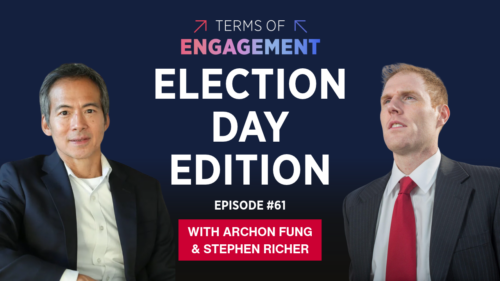
Hey. Oh, hey everyone. The intro didn’t play, so we are live. My name’s Archon Fung. I am the director of the Ash Center for Democratic Governance and Innovation here at the Harvard Kennedy School.
Stephen Richer (01:02):
And I’m Stephen Richer. I am the former Maricopa County Recorder, and I am a lecturer at the Harvard Kennedy School and a fellow at the Ash Center. And I’m coming to you live today from New York where I’m in the NBC studios doing a bit of election coverage and talking about any election administration questions, challenges, lawsuits. Obviously, there have been a good number of those over the past month, but so far today, everything has been smooth for the most part. Americans are voting. But before we get into that, as always, Archon and I are speaking on behalf of ourselves and only on behalf of ourselves, and we would love to hear from you. And so put your questions in the comment box and what are you following today? Which races are you particularly in? Are you concerned about anything? Do you have any questions about anything? This is a little bit of a different program than we normally have where we don’t have a guest and we’re just sort of chatting about things as they’re unfolding and things that we are watching.
Archon Fung (02:00):
Great. And like a lot of people in the audience, we will be watching today and tonight very, very closely. You can watch Stephen on MS, are you going to be on NBC or MSNBC?
Stephen Richer (02:13):
I’m doing a bit of both.
Archon Fung (02:15):
Okay.
Stephen Richer (02:15):
I will be, for instance, on MS at 2:30 is my next, and then otherwise doing a lot of NBC, both NBC main channel and streaming. So there, I got to get it all in.
Archon Fung (02:25):
Yeah. And I want you to have a lot of face time, but I’m hoping that you don’t because they’ll bring you on if something bad is happening to the election apparatus, I think.
Stephen Richer (02:34):
My face time is inversely correlated to the wellbeing of American democracy.
Archon Fung (02:40):
I gotcha. Well, I know that you voted a little early. I just voted this morning and I voted in person in the school gym that’s about a block away from my house. And in Massachusetts, it’s one of the states where you don’t have to have a voter ID. So I voted after I got done with my run. And so my ballot had a few drops of sweat on it, but the Scantron seemed to take it and accept all of my circles.
Stephen Richer (03:11):
Wait, explain. So you just straight off of the run, you’re just winding down your miles and then you just… Did you stop jogging at least a quarter mile before you went into the vote-
Archon Fung (03:24):
No, about a half a block.
Stephen Richer (03:25):
Oh, wow.
Archon Fung (03:26):
Half a block.
Stephen Richer (03:28):
Okay. So what do you normally run with?
Archon Fung (03:30):
Nothing. Just my watch and t-shirt and shorts.
Stephen Richer (03:34):
Okay. So you come up and you say, “I’m Archon Fung.”
Archon Fung (03:37):
They say, “Where do you live?” And they have a big paper notebook. It’s not even iPads. They have a paper notebook. And then so they look up my address and then they say, “What is your name?” And then I say my name and then it has to match, I guess. And then they give me the ballots.
Stephen Richer (03:55):
Do you sign it?
Archon Fung (03:58):
Nope.
Stephen Richer (03:59):
Okay. So this is fascinating. So Massachusetts is one of the last states in the country that doesn’t use electronic poll books, meaning that Archon has to show up to his assigned voting location because if he didn’t show up to his assigned voting location, they wouldn’t have him on that paper roster and he wouldn’t be able to get the correct style of ballots because in that model, they pre-print ballots. So they have a stack of ballots and then just hand them out to each voter as he comes in.
Archon Fung (04:27):
Yep. It’s definitely a paper ballot and this time it was long. There were two pages because there’s 10 ballot questions. And then you fill in all the bubbles. And then I was told when I insert them into the Scantron, that’s a validity test. So if it has trouble reading any of the dots, it will tell me right when I slide it into the receiver.
Stephen Richer (04:48):
Yeah. So the way that those are built, if you overvoted a contest, because it’s tabulating right there, if you voted for two United States House representatives members, then it would say overvote and then you would have the chance to either override the overvote and just want to overvote, or you could go and spoil your ballot and get a new ballot and fill it out again.
Archon Fung (05:10):
Oh, that’s great. Yeah. And so it holds that one ballot in place in a buffer until you decide what to do if it’s-
Stephen Richer (05:19):
Exactly. And then it swallows it and it records it on its internal memory drive and the ballot actually goes into the box such that you can later reconcile.
Archon Fung (05:28):
Yeah. And I think a lot of people in my precinct voted early because I was one of the few people in line. There wasn’t really a line. There were many more poll workers than voters. Some of them were young, the poll volunteers, which was very lovely to see. I don’t see that very often. And so it was a very painless process. It was very good, good voting experience.
Stephen Richer (05:51):
So they were all just standing around watching this sweaty guy come in and drip on his ballot a little bit and fill out his ballot and whatnot.
Archon Fung (05:57):
Yeah.
Stephen Richer (05:58):
Okay.
Archon Fung (05:59):
And then two people with the binders, making sure that asking for people’s addresses, one person standing by the machine to give help in case people had trouble inserting the ballot into the machine. But yeah, very good.
Stephen Richer (06:14):
How long did the whole process take?
Archon Fung (06:17):
Three minutes. Well, it took me a little more because there were 10 ballot questions, so I wanted to read each one.
Stephen Richer (06:22):
It’s got to take more than three minutes.
Archon Fung (06:23):
Yeah. So it probably took five minutes. Yeah.
Stephen Richer (06:27):
That’s it.
Archon Fung (06:29):
Yeah. I mean, I knew what I was going to vote. I had looked at a sample ballot before, and so it was just a matter of filling in the dots.
Stephen Richer (06:36):
But even so mine, because I had to vote on so many judicial retention elections that just going through, even though I knew how I was going to vote, took at least 15 minutes for me.
Archon Fung (06:47):
Yeah. Yeah. That’s very good.
Stephen Richer (06:49):
All right, so we’ve got some questions coming in.
Archon Fung (06:52):
Already got some questions coming in. Any word on the so-called federal election monitors? So Washington Post reports that the DOJ has deployed election monitors to all 50 states, which is unusual, maybe unprecedented. The Biden administration in 2022 deployed election monitors to 22 states, and the DOJ had plans to deploy 1,000 election monitors, which seems like a lot. Did they hit 1,000 people? Are they in all 50 states? Do we know?
Stephen Richer (07:23):
That was certainly the plan. Now, DOJ election monitors are not unusual. These happen every election cycle. We had them in Arizona. They would let us know in advance that they were going to show up and which voting locations they wanted to go to. And as I said earlier today, I said that it’s a little bit like Victorian-aged children where they should be seen but not heard in that they’re not supposed to be interacting with the poll workers. They’re not supposed to be interacting with the voters. They’re just supposed to be there observing. Traditionally, Justice Department personnel were there to ensure that the voting rights of each individual were upheld and they would go into court and file suit if that was not the case. Now I think the orientation is a little more shifted towards looking to any procedural error from election workers and looking for individual voter fraud.
(08:16):
Though how they would identify that, I don’t know. But during the primary in which the Justice Department had these same poll monitors out and about, there were really no incidents reported except for one in the state of Wyoming where even the Republican governor pushed back and said, “Hey, this one particular Justice Department poll monitor was getting a bit aggressive, asking questions about tabulation procedures, asking to see parts of the tabulator that were normally not something that would be shown to one of those poll monitors.” So these are normally just volunteers from the US attorney’s offices throughout the United States, and they’re usually from the civil division. It seems like they’ve expanded that a bit this cycle in part to try and hit that 1000 number, but I don’t think that there’s anything inherently problematic in simply having them there. So thanks Douglas Kev, for the question.
Archon Fung (09:12):
Yeah. So do you know whether the monitors have to be DOJ employees or anybody can sign up and get the training and be supervised and then be an election monitor?
Stephen Richer (09:28):
So they’re all coming from the federal government.
Archon Fung (09:30):
Oh, okay. Okay. Which is a big pool, obviously. Yeah.
Stephen Richer (09:33):
Yeah. But I do think that they have tapped other bodies within the federal government, whether from Homeland Security or the like, though I think it’s obviously being overseen by the Justice Department and the federal government has assured us and we have seen no reports to the contrary that none of these people would be armed.
Archon Fung (09:56):
Oh, okay. That’s very good. And then I read a post report this morning that something like two thirds of the election monitors are in democratic jurisdictions or maybe a little bit more, something like that, which is, I think, in past cycles when Democrats have been president, it’s also been the case that they’ve primarily gone to democratic jurisdictions because the worry has been voter suppression of different kinds. And so in any case, yeah. So you’re so far kind of urging calm, nothing really to be concerned about with regard to this piece of it.
Stephen Richer (10:34):
Right. Well, really in totality, because yesterday there was a flurry of activity regarding some litigation in California and Alaska. But in terms of today, in terms of the voter experience, so far so good. We haven’t seen anything extraordinarily out of the usual. We’ve seen some reports in New York of some fairly standard election day challenges. Same with Broward County in Florida, some fairly standard election day challenges that election workers will have to deploy contingency plans to be able to allow voters to vote. But again, we see stuff like that every cycle. What we haven’t seen is anything extraordinary from the federal government or some widespread outage as a result of election malfunction or error. And we haven’t seen really the reports or allegations of wrongdoing have been, I think, pretty tame so far.
Archon Fung (11:35):
Yep. And so fingers crossed that everything is calm for the day. And another cause for calm or at least some reassurance, as you mentioned last time, Stephen, many, many people have already voted. 59 million of the votes have already occurred. So election day being the pivotal window is not quite what it used to be. Two thirds of the people in Texas have already voted. So yeah.
Stephen Richer (12:04):
Yeah. And that’s why I was always a little less hair on fire regarding some of the concerns that might happen on election day, just because such a material amount of the vote is already banked by the time that we get to election day. And that appears to be the case as well. Now, we obviously won’t know. There’s still plenty of time. We could see a surge in election day voting and it could look larger than in 2024. But yes, as I mentioned last time in November 2024, in-person election day voting made up about 35% of the total vote cast.
Archon Fung (12:38):
Yeah. Good, good. We weren’t going to talk about this, but Luciana Bauer has a question in the chat. How about Lula and the Brazil election influence? Oh, in the USA election. I didn’t catch that last part, but I think the… Oh, about the influence of Lula’s victory. I don’t know. I though that was a different question about social media.
Stephen Richer (13:03):
Answer them all. Which question did you think it was going to be?
Archon Fung (13:06):
So I thought it was a question about social media influence and especially Meta, because there are complaints that either because of intentional politicking or poor management of social media, both in the Brazil election, but in US politics, things on Meta are not evenly played. So the Pete Lula’s party in Brazil thought that Meta social media was downplaying and suppressing algorithmically some of their campaigning and messaging. And I learned just a couple of days ago, probably a lot of people in the chat already know this, but the No Kings account on Instagram was actually disabled the last day of action for No Kings. So there’s quite some concern there. And I should disclose, I am on the national governing board of Common Cause and Common Causes sent a letter to Meta saying, “Please look carefully at these kinds of election communication things.”
Stephen Richer (14:12):
Okay. So reminder that we’re doing this one pretty casually. If you have any questions, please put them in the chat. We’d love to hear from you as far as what you’re watching, what you’re interested in. But Archon, how many miles did you get in today?
Archon Fung (14:26):
Only five on recovery day.
Stephen Richer (14:29):
You finished your five miles, you get in there. What were you especially excited or interested in voting on?
Archon Fung (14:36):
Well, I live in a one-party state. It’s not really a-
Stephen Richer (14:41):
What about some of the local candidates, like some local Brookline races or the ballot initiatives?
Archon Fung (14:46):
I mean, it’s just not that competitive this time around. I think the action was in the ballot questions, the Massachusetts ballot questions. I think the stealthy, tricky one was a ballot measure that was worded to limit state tax revenue and give people tax rebates. But I think the real intention was to limit kind of the millionaire tax that we have in Massachusetts. So that was one. A very controversial one was question three, which is one of the democracy ballot measures that there are quite a bit of them in the country today. That one was to establish kind of a California primary system, so non-party primary. So everyone would be in the same party, or I’m sorry, everyone would be in the same primary and the top two vote getters would go to the general election. And my colleague Danielle Allen is a kind of champion of that reform measure, but it’s quite controversial.
(15:47):
So the pro side thinks that it will open up political competition and reduce the grip of parties on it. And then some of the worries are that it is gameable. So what if you had two Republicans, but eight Democrats in a primary election, would the Democratic vote be split and then you end up getting a couple of Republicans running in the general election? So we’ll see how that one works out. But I think the polling is that it will pass, but we’ll see.
Stephen Richer (16:18):
So given what you said at the outset, is Brookline, Massachusetts a functioning democracy or is it a failed city state?
Archon Fung (16:26):
I think it’s a fairly functioning democracy, but not because of elections. It’s because people participate in… They watch very, very closely when there’s a bond override or just about anything. I mean, it’s a very politically active populace. I would not want to be a public official in Brookline.
Stephen Richer (16:46):
But without competition, is there true accountability?
Archon Fung (16:54):
Well, this wasn’t a select board election, right? So for the town, I think there is accountability and there’s so many positions and it’s nonpartisan that way. But at the Massachusetts level, I think there’s some serious, serious questions about the accountability for sure.
Stephen Richer (17:14):
And this is not a commentary on the current governor or on the politics, and in confession, I don’t follow Massachusetts state politics all that closely, but do you feel that if the current governor, Governor Kealy, were to be a just, let’s say bad, not an abomination, but bad, do you think that there is true accountability?
Archon Fung (17:36):
Well, I mean, it’s a good question. Before the Trump era, I think I would answer yes because Massachusetts has a history of center right Republicans being governor, Bill Wells, Charlie Baker.
Stephen Richer (17:54):
Charlie Baker, Mitt Romney. Yeah.
Archon Fung (17:57):
Mitt Romney. And so I think that there used to be pretty good competition and accountability that way. But in the Trump era, I think it’s difficult for a Republican even… I don’t know if there is a centrist Republican type that could run for statewide office at this point. Charlie Baker, during his last term, his approval ratings were extremely high. I mean, there’s really, in ordinary times, not a reason that he shouldn’t have run again.
Stephen Richer (18:25):
Okay. So Josh wants to move us up to the 40,000 vote left.
Archon Fung (18:28):
All right. What races are you watching, Stephen?
Stephen Richer (18:30):
And so what would make this a victory day? And I know that you have one slide. What would make this a big deal for Dad?
Archon Fung (18:37):
A big deal? Well, okay, so let me show my slide here. And so my thought in thinking about how to answer your question is to look historically and say, “Okay, well, we know that in a midterm election, it’s usually the case that the party that doesn’t control the presidency makes some gains in the House.” So they do better. There’s a little bit of blowback against the incumbent party, but what’s a big blowback? I think probably everybody who tunes into the show knows that the polls are predicting a pretty big Democratic victory. The Democrats, according to the polls, should take the House and maybe the Senate, although that’s a lot less certain or a lot less confident in terms of the poll numbers. But how big is big? And so one number that I’ll be looking at is the national vote share of the Democratic Party.
(19:39):
How many people vote Democratic? And then so here, the two big elections that really set the high watermark for the two party vote share being a big, big deal, the last one is 2018, and that’s when the votes swung, that’s Trump won, of course, the first Trump administration, and his midterm election swung very, very strongly by historical standards toward the Democrats. And so the Democrats got 54.4% of the vote share in that election. And then you have to go back a long way to get numbers that are as high as that. And the last swing that was higher than that was right after Watergate in 1976. This is not a midterm election, but a presidential election. That’s the election in which Jimmy Carter won. And a lot of people, I think, rightly read that as a response in large measure to Watergate, and the Democrats won 55.5% of the two-party vote.
(20:48):
And so if the Democratic Party gets 54 to 55% of the two-party vote, then I think it’s a big deal.
Stephen Richer (20:58):
Is that the right way of thinking about it though?
Archon Fung (21:03):
Well, I mean, that’s a good question. So what do you think this election is about? I think that’s a big… Is it about the price of eggs? Is it about democracy on the ballot? Is it…
Stephen Richer (21:15):
Yeah. Well, I just find it to be very interesting to think of what is the measurement? Is it really the percentage of national vote, which is of course not how we account for things in the United States in a midterm election especially, because you could theoretically win 52% of the national vote and still lose the House and lose the Senate.
Archon Fung (21:37):
Oh, for sure. Yeah.
Stephen Richer (21:39):
And then I find this interesting in that even when we’re talking about big swings and big victories, we’re talking still within 55.5% is “a blowout.” I think that if Dems pick up or have a plus 30 advantage in the House, and I think if they win the United States Senate, that this will be interpreted as a stern rebuke from the American people to President Trump’s agenda.
Archon Fung (22:08):
So you’re looking at how the votes translate into congressional seats.
Stephen Richer (22:13):
I think that will drive the narrative. And in terms of what is it about, I think President Trump, I think, is very much on the ballot. He’s even gone around campaigning saying, “Please vote, to Republicans, please vote as if I am on the ballot.” So I do think that is going to be the case. Now, his disapproval rating is the highest it’s ever been for him, and I think some of the highest numbers since Truman actually, and it’s showing about 60% disapproval. And so I don’t know if that’s the optimal strategy, but turning to predictions now, because that’s what Josh asked us to get into, I think that this will be much more about how do people in that state feel about the President of the United States than it will be about the individual candidates. And for that reason, I think that Michigan is much more likely to go to the Dems than is Texas, even though some people think that James Talarico is a stronger candidate than El-Sayed.
(23:24):
I probably agree with that statement, but I still think that there’s going to be more legacy challenges for a Democrat running in Texas, and I still think that Texas… I mean, the polling suggests that Texas on the whole is still more favorably inclined to President Trump than is the state of Michigan.
Archon Fung (23:46):
Yeah, I certainly agree with that. I mean, the Democrats have been hoping for a Texas victory in many, many cycles statewide and been repeatedly disappointed. So James Talarico is pulling ahead of Greg Abbott, or sorry, Ken Paxton-
Stephen Richer (24:06):
Ken Paxton, yeah.
Archon Fung (24:06):
Ken Paxton, sorry. Do you think that the polling is missing something, that it’s like the shy Trump voter, et cetera?
Stephen Richer (24:14):
Yeah, I mean, a lot of people have been talking about that, that polling consistently under-counts people who favor the president because they are, on average, more reserved in sharing their political opinions, but are especially skeptical of political pollsters. Greg, you’re absolutely right, and honestly, Greg asked, “Why waste time on opinions? Just wait for the results.” I’ve said the same thing. I’ve been shocked that professional polling has come out even as late as this weekend. It’s mind-boggling to me that somebody would spend a lot of money on polling when the results-
Archon Fung (24:58):
A lot of money is being spent.
Stephen Richer (24:58):
… are less than 48 hours away. I suppose the strategic reason you could say is if you are a large institutional actor, the Republican Party or the Trump PAC or the DCCC, then you do that last minute polling to see where you still have a chance, where you don’t have a chance, and then you throw your last few millions of bucks into last minute ad buys in a certain jurisdiction.
(25:28):
I think that’s a stretch, especially considering how voters are voting these days and when they’re making up their minds. But Greg, that’s honestly all I can think of, and you’re absolutely right. All this is sort of poppycock until 7:00 PM, 8:00 PM Eastern tonight.
Archon Fung (25:45):
Yeah. On the timing issue, Veronica asked, “Which states or counties can we anticipate will be slow to count tonight and why should we read slow counts as a sign of a problem?” And I would add, do slow counts really matter in this election given that so many of the pivotal races are going to be in the Midwest, going to be relatively early? I don’t know how fast Michigan, Texas, et cetera, counts, but nobody’s waiting for California to decide who controls the Senate.
Stephen Richer (26:25):
Who controls the Senate? I think that people were very nervous when they thought the United States House margins might be closer and that it might come down to California, which both because of its laws and because of its voting behavior, is one of the last states to call close races. And so will that be off the table? Again, I think probably yes, just because I think Dems will have secured the House by, let’s say, 12:00 PM or 12:00 AM Eastern tonight. So California, obviously, a heavy vote by mail state, as are most Western states. In the primary for California, one third of the total vote in Los Angeles County was mail ballots dropped off on election day. And of course, those still have to be picked up, they have to be scanned in, they have to be signature verified, so those results obviously aren’t available on election night.
(27:24):
And then California also allows ballots to come after election day so long as they’re postmarked on election day. And in the primary, that accounted for another 3% of the total vote. And so when you’re talking about razor-thin margins, as was the case for second place in the LA mayoral, that 3% matters, and election officials might not even have it on election day. So traditionally, the western states are the states with the “slower counts” and slower to be able to call races, particularly Arizona, Nevada, California. But I think the state that we might be watching is Alaska because-
Archon Fung (28:04):
Oh, that’ll come in very late.
Stephen Richer (28:06):
Yeah, because the way that Alaska does its results is it’s a ranked choice voting state, and so the tabulators go through and they tabulate the first place position for all of the candidates. And then once it does that, it drops the last place candidate, and for anyone who voted for that candidate in first place, it then goes down the line to their second place vote. And so just mechanically, this takes a while, and I think we’re going to be looking at a very close race between Representative Peltola and Senator Dan-
Archon Fung (28:46):
Sullivan.
Stephen Richer (28:47):
Sullivan. And obviously, there’s already a lot of brouhaha surrounding that race since the New York Times broke the story last week about the recruitment efforts from within Democratic machinery for “the other Dan Sullivan.”
Archon Fung (29:06):
Yeah. And so also, obviously, Alaska is in a far western time zone, so those of us on the East Coast will have to wait a while just timing-wise. And that’s one of the races that has been tightening in part because of, I think, the brouhaha, as you say, around the New York Times expose, the Peltola campaign.
Stephen Richer (29:28):
So what do you make of that? Real quickly, the New York Times, there have been two Dan Sullivans running in Alaska for United States Senate. One is the incumbent United States Senator. One is a random guy in Alaska who’s never run for office before, who was recruited, now we know by a lot of people, part of the Democratic machinery. To run in Alaska such that they wanted to, I don’t know, stir the pot, cause a little confusion, have two candidates with Dan Sullivan’s name on the ballot. And I’ve seen obviously allegations of unlawful action, which is of course another thing. But then there’s been a bit of a divide among Alaskans over whether this is just politics as usual, people have done this before, or whether this is like this is nauseating and it turns me off from representative [inaudible 00:30:33]
Archon Fung (30:34):
I agree with both. It is politics as usual. I think this is not unusual in political campaigns, but I think that our politics should be better than that. I don’t like really dirty tricks politics much. I don’t believe that anything illegal happened. And I think the saving grace is ranked choice voting. So if you happen to vote for the wrong Dan Sullivan, your vote will probably roll up to the right Dan Sullivan, I think in all likelihood.
Stephen Richer (31:09):
That’s certainly the case if you vote for one Dan Sullivan first and the other Dan Sullivan second. Your vote will get to the right Dan Sullivan eventually. The challenge becomes, though I think that this is less likely each day and each time people talk about this, is if you only vote for first place-
Archon Fung (31:29):
Yeah, that’s true. You have to vote all the way down.
Stephen Richer (31:32):
Yes. And you mark the fake Dan Sullivan. Now again, as has been discussed in many news outlets, Alaska election officials have tried to forestall this by on the ballot itself behind the incumbent Dan Sullivan putting incumbent and his political party, Republican Party, so as to hopefully prevent any confusion from I’m sure the well-educated civically engaged Alaska population.
Archon Fung (32:02):
Alaskan population. Yeah, that’s true. And then another issue on timing, this is not directly Veronica’s question, but related. I think it’s fairly safe to say that there will be a blue mirage tonight because so much of the vote is early, the early vote and certainly the mail vote tends capitally democratic and they’ll count those first. And so there’ll be a few hours where it looks like the democratic margins or whatever the total is going to be substantially higher than 12 hours later. Do you think that’s the case that instead of a red mirage, there’s really a blue mirage this time around?
Stephen Richer (32:46):
I don’t know. And I get uncomfortable making that both because the administrative procedures differ from state to state, but more meaningfully, just voting patterns have been in such a state of flux since 2020 and the messaging from different political actors has been in such a state of flux from the political parties. So if you’re a Republican right now, you hear President Trump say things about mail voting and early voting that might dissuade you from participating. But on the other hand, you hear things from the GOP machinery, from groups like Turning Point USA that says, “Get out there and bank your vote.” And I don’t know what to do. On the Democratic side, yes, in the 2020 context you were told vote by mail and vote early and that carried over into ’22, into ’24. But this year you’re being told, “Well, there’s some funny business going on at the USPS. The president’s been trying to weaponize the USPS or whatever the messaging is. And will that lead to a renaissance of Democrats showing up on election day?” I don’t know.
Archon Fung (33:57):
Could go a lot of different ways, I guess.
Stephen Richer (33:59):
Greg’s point, it’s kind of a fool’s errand and shut up and then the numbers will be what the numbers will be eventually.
Archon Fung (34:05):
Right. Good. Are there particular-
Stephen Richer (34:07):
Yeah, go ahead. Yeah. One, keep putting in your questions into the chat and what you’re thinking about. But also you got to give me sort of where you think you’re going to, because Josh asked where’s this going to come out?
Archon Fung (34:23):
Gosh. Okay. Well, let’s do this. I’ll rely on somebody else’s data here. Let’s see if I can share my screen. So this is my Harvard University Government Department colleague, Gary King, who is the data master and analysis master at the political science department or the government department. And so this is his model. I haven’t gone through it to completely understand what the inputs are and how they’re processed, but my understanding is everything is in this model. And so here’s what he thinks. In his forecast, the Gary King forecast, there’s a 96% chance that the Democrats will take the House and what he’s predicting plus 27 swing of seat changes right here, if people can see that, to the D side. And then the website you can probably see is just go to elected, elect IT, put that in the Google search window if you’re interested in looking at this.
(35:35):
And then this feels way high to me, but I’m not the data guy. So in his forecast on the Senate, he says that there’s a 78% chance that the Democrats will take the Senate and he’s predicting a whopping plus six seat change on the D side. And the Democrats need three seat. They need a four seat swing in order to have a majority.
Stephen Richer (36:01):
Okay. Scroll down a little bit. So it has Texas.
Archon Fung (36:03):
Yeah, yeah, yeah. So Talarico he’s got at 67%. What other races are you-
Stephen Richer (36:10):
And Peltola. Peltola in Alaska.
Archon Fung (36:14):
And Peltola at 51% of the vote, but 75% chance to win. Oh, okay.
Stephen Richer (36:23):
Wow.
Archon Fung (36:23):
What do you think about Kansas, Stephen?
Stephen Richer (36:28):
I don’t know. I don’t know. I mean, look, I hate the notion that things can’t be in play. I hate the notion that we’re so drawn to our partisan quarters. And so part of me celebrates that these states could be in play.
Archon Fung (36:39):
Could be in play.
Stephen Richer (36:42):
Going back to that central idea that we talked about Massachusetts lacking, which is that I do think that accountability and political competition is a very healthy thing. That’s why I support ballot measures that engender that type of accountability and competition. But that being said, I mean that just sort of goes against my learned politics over the last 30 years. So I’m not used to seeing Kansas color that shade. And then it looks like they had El Said winning as well, and they had Sherrod Brown in Ohio win as well.
Archon Fung (37:20):
Ohio. Right, right. And so Kansas, my understanding is there hasn’t been a Democratic statewide winner since 1930 or something like that. So that would be a big change for Kansas.
Stephen Richer (37:34):
Yeah. So can we talk about the question that I mentioned to you that I’m actually struggling with a little bit, which is if you’re voting in one of those states that’s in play for, let’s say particularly the United States Senate, what is the lens through which you should be viewing your vote? Should you be –
Archon Fung (37:52):
As a voter?
Stephen Richer (37:53):
As a voter. So if you’re in Michigan, should you be viewing it as El-Sayed and Rogers? Who is more qualified? Who would be the better emissary for the state of Michigan? Or should you be viewing it in the, this is a referendum on Donald Trump and it is levers against Donald Trump?
Archon Fung (38:20):
Yeah, there’s a third possibility, which is what I hear a lot from people I talk to, especially on the polling and I don’t know too many people on the campaigning side, but some people say it’s neither of those things, that what’s driving the voter is very basic kitchen table economic concerns, which is, do you lump that under the Trump bucket or would that be a third thing?
Stephen Richer (38:43):
I think a third thing.
Archon Fung (38:45):
Yeah, I think that’s a third thing to me. Yeah. Yeah. So I guess my own view is that there has been the last year and a half, the first half of the second term Trump administration has been so dramatic on so many very important policy issues and the balance of executive power that I think Americans as a voter, I think it’s very sensible. Certainly my view, although I’m not in a swing state of any kind at all, that casting your vote on the basis of that question, whether you like the way that this big national politics is going is a reasonable way to cast your vote. Not that the state and local politics aren’t important, but that really it will be read as a referendum on the president and maybe you should cast your vote that way, which is usually not how I think. I’m a local government person.
(39:53):
I think that’s what people should be thinking about, but this is just such a dramatic moment. I don’t know. What do you think?
Stephen Richer (40:01):
I hate the notion that candidate quality doesn’t matter, that his ability to represent the district, that his ability to deliver on items that are of importance to the district. We here in Arizona, for instance, are dealing with some very challenging conversations at the federal level regarding cuts to the Colorado River. Regardless of what you think of our United States senators, if they had delivered a materially better position for the state of Arizona, I would hope that that would factor into their reelection, even if it was inconsistent with the message that you wanted to send to Washington DC, even if it was inconsistent with the party that you wanted to control the United States Senate. And so I will tell you that I find myself in that category if I were a Michigan voter where I, just looking at the two individuals and lining them up with my political preferences and who I think would better represent me, I would go with Rogers.
(41:07):
If I were somebody as I am, who thinks that the federal government has grossly overstepped, has been fundamentally unchecked by the Congress over the past two years, part of me just says there is not a balance of power right now. And if Republicans aren’t going to do it, then you got to have Democrats take control of the United States House and the United States Senate. So I’m honestly torn on this one.
Archon Fung (41:39):
Yeah, I think it’s true.
Stephen Richer (41:40):
Maybe I would just not vote on that.
Archon Fung (41:44):
Although the state where your question is really sharpest, I think is Maine, is Senator Collins and Troy Jackson in Maine, right? She has delivered for the state by all accounts very well for a very, very long time. And I think that’s a big part of the case that she’s making. But the way to, it’s not happening now for sure, but the way to square the circle of the difficult choice that you pointed is if you had a wider range of views within the Republican Party that was willing to say no to the president, at least on some things on the vast overreach, but that’s not the Republican Party that we’re currently in.
Stephen Richer (42:28):
Or again, this gets you into the electoral reform thing. If we had proportional representation or if we had ranked choice voting, yada, yada, yada, or if we had fusion voting, I could sort of express my totally more nuanced preference. That’s not the case.
Archon Fung (42:46):
That’s not the case. Those movements have large, in 2024, they ground to a halt. We’ll see if there’s more interest in that after this election. I have my doubts. Let’s see. We’ve got to change one thing about how US elections are administered, what would it be? Veronica, I would harken back to a few shows ago and I would dramatically reduce the number of elected offices and hope that the offices on which people vote, they can be much more informed consumers about. And I would have some sort of electoral reform. So I am one of the Kool-Aid drinkers of whether it’s top two or top five, ranked choice voting, condorcet voting. I’m sort of a public choice nerd, and I do think that political science literature consistently shows that that yields a more representative representative.
(43:44):
Yeah. Yeah, I definitely agree with both of those. I would like to see some sort of fusion change or something that creates more space for independent parties or maybe different factions within the Democratic Party and the Republican Party so voters can have a better match to what they want to see. On a little bit on that note, there’s a bunch of ballot questions all over the country, some of them having to do with different kinds of democracy reform. So we talk a little bit about the primary reform in Massachusetts. In Alaska, ranked choice voting is back on the ballot, and some people may think that the Dan Sullivan and Dan Sullivan kerfuffle may get voters to reject ranked choice voting, although that’s contrary to how I see the logic, but that’s what people are talking about. There are redistricting questions to prevent midterm redistricting in some states. Voter ID is up in seven states, that is to require voter ID.
Stephen Richer (44:52):
Including in California.
Archon Fung (44:54):
Oh, and so right now, California, you do not have to have an ID to vote.
Stephen Richer (44:58):
To vote in-person, you do not have to have an ID. To vote by mail, you sign the mail ballot affidavit envelope.
Archon Fung (45:06):
Gotcha, gotcha.
Stephen Richer (45:07):
And a lot of money on that.
Archon Fung (45:10):
Yeah. Is there really? There’s a lot of money just in this-
Stephen Richer (45:14):
In that proposition.
Archon Fung (45:16):
Question. In that proposition, really. I wouldn’t necessarily have expected that. That’s interesting.
Stephen Richer (45:23):
It’ll be interesting to me because voter ID polls well with Republicans and Democrats. There’s always the implementation question, devil’s being in the details. And then it comes from the political right in California, and I don’t know if the median Californian will be able to swallow a ballot measure that they know comes from the political right.
Archon Fung (45:49):
Yeah. Right. Interesting. And then as we talked a little bit about this on the last show, but six states have ballot measures to ban non-citizen voting. So that would ban non-citizens from voting at the local level in their states, which is interesting. And then I’m interested in what you think about these, Stephen, the direct democracy ballot measures. So there are some states that want to up the super majority threshold for incorporating something into the state constitution. There’s a couple of states that want to protect direct democracy, that is ballot measures and so on. Do you land on the-
Stephen Richer (46:32):
Hate it. Hate it. I hate it. I hate it. I view it as a very coarse safety valve for when the state legislature has really lost its distance from the populace. But I think that legislation is a complicated business. I think that there are always unintended consequences. I think writing statute itself is very complicated. And I think that what you need to be a successful ballot measure is very different from what you need to be a functioning law, where for a successful ballot measure, you need simplicity and contrast. And in reality, well, you have to change Title 16 here and you have to change Title 19 here and you have to take into account this. And so I am generally speaking very skeptical of governing by citizen initiative or referendum.
Archon Fung (47:32):
So I’m on the other side of that. I agree with you as an ideal case. The first best is a representative democracy that actually represents and that legislates effectively. I feel like in many states and nationally, we’re really far from that ideal. And so I think the direct democracy pressure release valve is super important. And so the issues that this has played out on strongly are minimum wage issues. You have minimum wage ballot measures that have passed in quite a few red states where you think, oh, the politics wouldn’t be like that. But then also abortion ballot measures in some pretty red states. And I think among other factors, gerrymandering has made state legislatures oftentimes quite unrepresentative of the people in those states. And so I agree that the ballot measures propositions are such a blunt measure. I agree with you that there’s too many 10 in Massachusetts, too many, much less 40 in Arizona or California, but I feel like the release valve is really important.
Stephen Richer (48:40):
Yeah. And you identify, I think, two of the more friendly two ballot measure issues because usually you’re talking about a term of quantity. When you’re talking about minimum wage, you’re talking about whether it should be the federal minimum of 750 or up, and you’re not talking about the mechanics of it. And for abortion, you’re usually talking about a number of months. Now that one can have more nuance because there’s more potentially complicating requirements, but it’s also an issue that many Americans think about a lot, which is helpful because some of these issues are about criminal justice reform and it’s just like, I just don’t know that the average American is thinking about that on a regular basis. Everyone who sort of chats politics, I think abortion eventually comes up. And then the other thing, I’ll say one controversial thing is I’m very, very pro-lobbyists. I think that lobbyists are very healthy for the state legislator.
Archon Fung (49:39):
Because they just connect legislators to issues and industry.
Stephen Richer (49:44):
They’re the repeat players. They have access to lots of technical information, and I think that they inform the sausage making. And obviously you take that out when you’re talking about a referendum process.
Archon Fung (49:59):
Yeah. Good, good.
Stephen Richer (49:59):
So I’ll say my last thing, which was somebody texted me and asked for an update on the litigation in California and in-
Archon Fung (50:06):
Oh, good one. Yeah, that’s really important. You should explain what it is because not everybody may have followed that. Yeah.
Stephen Richer (50:11):
So in California, the Justice Department sued the state of California saying that we have reason to believe that 20,000 non-citizens are on your voter rolls. We’re going to ask you to set aside any ballots associated with these alleged non-citizens. California said, one, why are you filing this two weeks before the election when ballots are already out? Two, California law has a process for challenging individual voters and this ain’t it. Three, your data is fundamentally flawed and outdated. And four, if there is a criminal offense, then you have the ability to criminally prosecute after the election. California won, it was procedurally a little bit complicated and a little bit unusual, but California won at both the district court level and at the Court of Appeals, the Ninth Circuit, and then the Supreme Court did not take it. So it held in place the Ninth Circuit’s ruling.
(51:10):
And so those 20,000 voter registration forms will not be treated any differently, and California is proceeding afoot. In Alaska, the Justice Department has sued to put Alaska on notice, I suppose, that they will challenge-
Archon Fung (51:28):
In case Dan Sullivan loses.
Stephen Richer (51:30):
They will challenge the certification, but only under specific circumstances if the incumbent Dan Sullivan loses and only by a not defined but small margin.
Archon Fung (51:44):
Oh, I didn’t know that.
Stephen Richer (51:46):
Yeah. And so the Justice Department lost at the district court. They said ballot access has already been ruled on many months ago. The other Dan Sullivan was in the primary. The Alaska Supreme Court ruled on this. And again, if there is a nexus for criminal prosecution, you can criminally prosecute people, but that doesn’t come into play for certification. That’s governed by Alaska state law. And again, you’re not following Alaska State law. So the Justice Department has said that they will appeal and they did appeal, but that’s in front of the Ninth Circuit right now. I don’t know what the timetable is on that. Presumably, it would have to go pretty fast, and then whether or not they appeal up to the United States Supreme Court. But the rub is that despite all the noise, the rules of the game are the same for now in both Alaska and California.
Archon Fung (52:40):
Yeah. It would’ve been nice for the Ninth Circuit to have ruled already so we can have a little more certainty there. Unfortunately, that’s not the case.
Stephen Richer (52:48):
Yeah.
Archon Fung (52:48):
Yes. So my last… Yeah, go ahead. So my last one is a ballot measure that I’m interested in that I’ll be watching is Prop 40 in California, which is the billionaire tax. I think that the polling is that it’s going to go down. And then well, you wonder why would it go down? Aren’t there many more people who aren’t billionaires than are billionaires? A lot of reasons for that, but one of them may be that the spending ratio is 250 to one. So the no campaign has spent $380 million to defeat this Prop 40 in California, which makes it the most expensive ballot campaign ever. I mean, no surprise. It’s hard to get to 380, but so that’s one to watch.
Stephen Richer (53:37):
That’s amazing. If it loses, that will make me very proud to be an American.
Archon Fung (53:42):
I suspected that. I suspect we probably will lose.
Stephen Richer (53:45):
We celebrate going out there and doing something that makes you as rich as possible. We don’t punish it. And I just find it really kind of gross that 99% of people could vote to treat, it’s actually far less than 1%, could vote to treat a small minority of the population differently. I know that this isn’t apples to apples, but I don’t like the idea that all of you non-redheads, which are 99% of you, could vote to do something to us redheads. Although I dare say we deserve it as much or more than billions.
Archon Fung (54:23):
No, no, you deserve a special place. Positive treatment. All right. So we will be coming back at you tomorrow, Wednesday at 1:00 PM because Wednesday at 1:00 PM, hopefully we’ll be able to take Greg’s suggestion into account, which is wait for the results or many of them and see where things have landed. And hopefully all we’ll be talking about is where things have landed, not the ricketiness of the election apparatus. Hopefully things will stay calm on that dimension. Fingers crossed.
Stephen Richer (54:59):
Fingers crossed. Absolutely. In the meantime, let us know if there’s things that you think we should be watching and we’ll integrate them into tomorrow’s show and we will try to cover all things election administration if need be. Otherwise, we’ll just talk about what potentially the new Congress is going to look like and what that means. So thanks very much for joining us today and thanks for the lively chat for those of you who were watching live.
Archon Fung (55:23):
Great. And hopefully we’ll see you tomorrow at 1:00 PM. See you later.