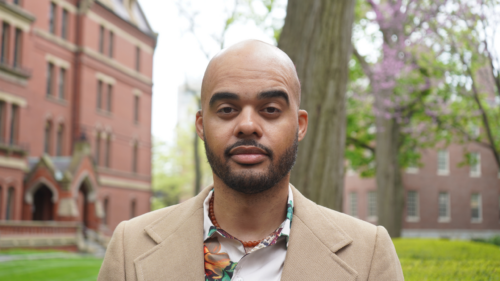
“I didn’t expect to be on this career path,” shares Marcus Board Jr., Associate Professor of Political Science at Howard University in Washington, D.C., and 2025-27 Democracy Visiting Fellow at the Ash Center for Democratic Governance and Innovation. “I was a smart student but not very committed, because I knew that the world was unjust, and I anticipated that taking me at some point. And then it didn’t.”
As a child, this awareness of the injustices around him sometimes manifested in contradictory ways. Board recalls being suspended from school and getting into fights, while at the same time being placed in “talented and gifted programs.” To teachers and administrators, the combination was confusing; to him, it was an honest response to what he saw around him.
“People would say, ‘You shouldn’t act like that. You’re so smart.’ And I would say, ‘How does a smart person act? Seems like the world’s really messed up.’”
Board originally hails from Anchorage, Alaska, but his sense of “home” is more layered than a single location on a map. With a father in the United States Air Force, his childhood included frequent relocations that took him from Nevada to Virginia to England to Maryland, before settling for a longer stint in Chicago as an adult. “I only call Chicago home,” Board shares. “I say I learned home in Chicago, and I learned family in Maryland.”
Growing up in a series of different places, he often found himself relying on the communities around him. “I was raised outside of my home in a lot of ways by a whole bunch of different friends’ parents,” he explains. “And they poured into me out of the kindness of their hearts, so I try to do the same.” This foundational experience of being cared for by many now informs how he shows up for others, paying forward the same generosity that raised him.
Board’s early experiences as a “precocious child” with “a lot of ideas … [he] was not allowed to express” ignited a lifelong commitment to young people and a dedication to ensuring their ideas and efforts were central to meaningful community transformation. Through community engagement work that took him from Maryland to Chicago in the early 2000s, Board’s early career focused on building opportunities to uplift the next generation. “I think the biggest thing that motivated me was empowering young people to know when they were right about something, or smart, or engaged or insightful. I wanted to make sure that they knew that, too. I’ve been doing that work beyond the academy and within for over 20 years.”
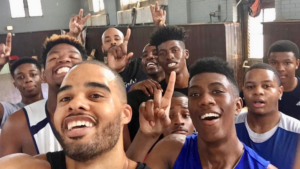 At a youth community-building program at First Baptist Church of Chicago, June 2017.
This ethos of elevating youth voices has never been a matter of symbolic inclusion for Board — he has worked vigorously across diverse communities to empower young people to shape real change. Reflecting on his time working in Chicago, Board recalls meeting “a student who wasn’t even a part of the program that I worked with, but because of my approach, and I’m just open to all the young people, he ended up tagging along a bit. [I] stayed in touch with him over the years, and now he runs one of the most impactful community organizations in the city.”
“I think there’s an opportunity there to make sure that we both understand why people are engaged in the way that they are and give us opportunities to grow ourselves. And I think every time we ignore a young person, we lose that chance.”
Eventually, those experiences led him toward academia — not because he wanted to move away from community work, but as another way to pursue it.
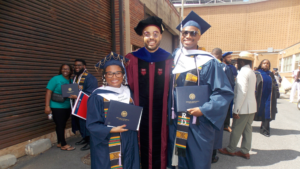 Board with two graduating students from his class at Howard University in 2026.
Howard’s Lasting Influence
While his early engagement with community organizations and work with young people laid the groundwork for his practice and scholarship today, Board emphasizes that his path to Harvard Kennedy School and the Ash Center “really begins at Howard University.”
“Howard was opened in 1867 after people freed themselves from chattel slavery … as a space for Black intellectual thinkers. … It’s an amazing place and without it, I don’t make it to Harvard.”
From the outside, Board’s decision to leave a conventional tenure-track position at another university to teach at Howard University might have seemed like a gamble. For Board, it was anything but. “I couldn’t have made a better decision,” he says.
“For most folks, the idea of leaving when I had extra years on my tenure clock was a little questionable. … [I] went to Howard with tenure in my fifth year, and then over the last few years I’ve been able to push toward full professor. … [It] made me more confident about … how important it is to make decisions that work for you.”
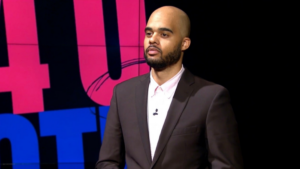 Board at B4U Vote Segment with WHUT Howard University PBS Station in 2024.
Choosing Howard was one of several choices in Board’s career representative of a broader commitment to charting his own path. Another was his refusal to choose between the classroom and the community — from his earlier work in community engagement to his academic position at Howard University, Board has worked vigorously to reconcile and unify his role as a practitioner within his position as an academic. Rather than treating these as competing identities, Board sees them as mutually reinforcing.
“I do both. And I’ve always done both. … I’d say everything good that I do … is because I worked with people,” Board explains. “And I think it’s one of the big setbacks to education in the United States in particular is teaching us to connect more with ideas than we do with people instead of doing both.”
That commitment can come at a professional cost in traditional academic terms. Board is candid about the disconnect between what universities may reward and what he finds most meaningful. “None of the work that I’ve done in youth and community organizing over 20 years counts in academia. … At the same time, the only reason I’m able to do what I do is because I care about people. I’m better as a person. … The people that I reach know they matter the same way that I do.”
It was precisely this desire to connect rigorous scholarship with community-rooted practice that drew Board to the Ash Center. “We’re working with folks like Ashu Varshney, who’s at Brown University, but then also folks like Nikishka Iyengar and Jon Alexander [fellows at Harvard University] who are doing local community work. … So, to have them be able to sit side by side and be able to have these conversations is something that I’ve always wanted for my colleagues. … I’m grateful to [Ash Director] Archon [Fung] for being able to put that together for us. Without him, we can’t do this.”
Throughout his fellowship, Board came to appreciate what he dubs “the power of a good team” he found at the Ash Center — a culture that promotes a collaboration he wishes were more common in both of his worlds. “The thing that I see is people willing to give a little. … That’s something that, again, I wish I could bring to my academic colleagues. I wish I could bring to the organizers as well.”
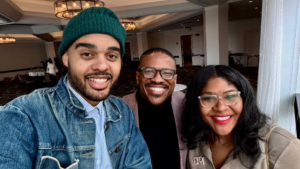 Board at the MLK Breakfast in Boston with Ash Center fellows Jonathan Jayes-Green and Christine Slaughter in January 2026.
Reframing Democratic Issues
At the Ash Center, Board’s positioning on democratic issues has been notably marked by a shift in how he understands both crisis and possibility. He describes his fellowship year as transformative, pushing him to “reframe the issues of democracy today.”
“I think a lot of folks were thinking about it like a circuit breaker, and a switch had flipped, and we just needed to find the right switch,” he explains. “And I was trying to help people understand that the house is on fire. … I’m particularly referring to generally communities at the margins that if you’re trying to flip that switch … you’re ignoring the fact that you’re trying to stay in this safe space and trying to get other people to keep you back in that space without recognizing that those people are suffering and dying.”
While he insists on confronting that reality, Board is equally committed to emphasizing agency and the possibility of flourishing. “I do try and help people understand that they’re alive and that they have a chance to have an impact in the world. … It doesn’t always have to be rah, rah, fight, fight. It can just be thriving.”
This orientation shapes his current book project, “Democracy is Black: Erasing Political Violence and Embracing Pluralism at the Margins.” “I think the contribution I’m trying to make there is to explain that communities at the margins aren’t a second thought,” he says. “If you want to solve the problems in the center of U.S. democracy, you actually need to start at the margins. The way through is not a straight line, it’s actually to go around.”
For Board, that is the core of the intervention he hopes to make — intellectually and practically. “I want to … make sure that people understand that, ‘Hey, if you’re trying to solve some of these problems, you actually need to turn to the folks who you’ve been pushing out.’ As opposed to saying, ‘Hey, we’re going to solve it here first and then we’ll get back to you.’”
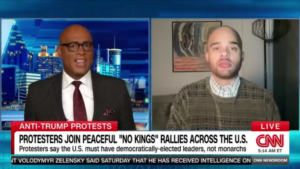 Board discussing the “No Kings” protests on CNN in 2026.
Looking Toward the Future
As he looks ahead to a second year as a Democracy Visiting Fellow in AY 2026–27, Board is focused on deepening both relationships and roots. “I’m excited to be a fellow next year. … I want to try to help the cohort come together to connect with one another, to find their people, but I also want to find some deeper roots here at Harvard.”
Those roots, for him, also extend beyond the university gates. Board hopes to rekindle partnerships with local institutions that shaped his work during his first fellowship year at Harvard, deepening his commitment to community engagement and youth development in the area. “I would also just love to reconnect with Roxbury Community College and the high school that I worked with to try and do some ongoing work with them, a little bit more substantive. Everything is possible and I will be creative and use my imagination and figure it out.”
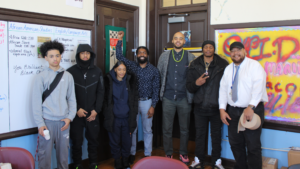 Board with students at Community Academy in Jamaica Plain.
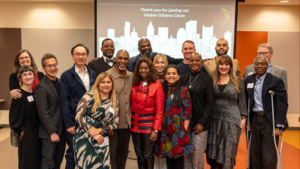 Community organizing event with Global Citizens Circle, Roxbury Community College, Get Konnected, and the Ash Center in December 2025.
When he speaks about the future, the language of titles and accolades quickly gives way to the language of connection. Success, for Board, is measured less by what he leaves behind than by how he shows up for others in the here and now. “When I was a little more fatalist, I used to think success was like, ‘die doing what you believe in.’ It’s about what you would give your life for. Very cliché, but now I’m like, what are you willing to live for? How are you willing to give to people and improve their life while you’re living?”
He cautions that a narrow focus on legacy can pull people away from the very relationships that make their work meaningful. “I think a lot of folks are focused on legacy and doing things that will be left behind and remembered … greatly somehow. And I think that stops them from connecting to people. Literally, we can reach each other. So, if I can reach you, then you matter.”
Colette Anton is the Communications Coordinator at the Ash Center for Democratic Governance and Innovation. She previously worked as an Outreach and Communications Assistant for the Davis Center for Russian and Eurasian Studies at Harvard University.