


Additional Resource
How A.I. Can Be Good For Democracy
In a recent guest essay for The New York Times, Allen Lab Democracy Stack Fellow Beth Noveck argues for putting A.I. behind every public servant.

Commentary
As cord-cutting erodes the funding that sustains local cable access channels, the Allen Lab for Democracy Renovation offers recommendations for preserving vital sources of community information, government transparency, and civic participation.
The same medium that brings you high school football games is an underappreciated pillar of local civic and democratic health. While advocates for democracy reform are increasingly turning their eye to the importance of local newspapers, another critical local information source — the local cable access channel — is also in danger of disappearing. As residents “cord-cut” cable television in favor of streaming, they are unknowingly defunding the local cable access channels whose programming capabilities are now being stretched to the breaking point.
Local cable access channels are a window into local government, providing coverage of local selectboard and council meetings, town meetings, zoning hearings, community events, high school sports, and everything in between. These stations are, for many towns, the only outlet covering these local events and doing so in an on-demand, digital format residents expect. As a critical piece of digital civic infrastructure, the stations allow residents to see, understand, and participate in local government and civic life, with over 3,000 communities nationwide having used local cable access channels for over 40 years. While long the butt of comedy sketches, these local nonprofit stations actually play an important role in providing the information necessary for local democracy to thrive. As their funding mechanism continues to erode at an alarming rate, policymakers must act quickly to preserve this public good.
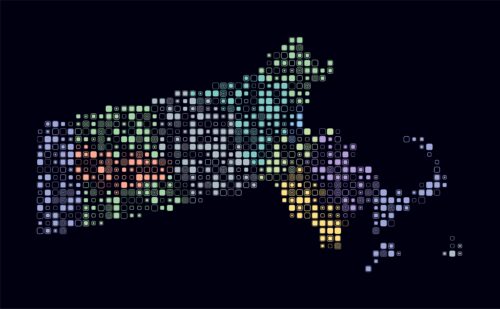
Local cable access channels produce what is known as PEG programming — public, educational, and governmental content. Massachusetts has more than 250 local cable access channels that serve as the primary producers of PEG programming and are a main source for viewing town meetings, hearings, local sports, and other community events, especially for those who are elderly, disabled, or otherwise can’t make the meetings in person.
These local cable access channels also often fund the technological infrastructure that is necessary for communities to hold remote and hybrid meetings. As a piece from the Harvard Nieman Lab notes, “when Covid halted in-person community activities, PEG media practitioners used their technical expertise and neighborhood networks to help struggling communities including local government officials, teachers, and elderly residents — transition to virtual public life.” In rural communities where technical expertise and infrastructure is limited, these local cable access channels fill an increasingly important gap.
The funding for these local cable access channels comes from the fees that cable operators pay in exchange for access to local rights-of-way and infrastructure. Under Massachusetts law, cable operators, like Comcast and Astound, are required to pay an annual License Fee of $1.30 per subscriber. The fee is split between the subscriber’s municipality and the Commonwealth, with the municipality receiving 50 cents and the Commonwealth receiving 80 cents per subscriber which goes towards the state’s General Fund. Additionally, local officials, in negotiating a cable license, may require cable operators to set aside channels and funding for PEG use, up to 5% of the cable operator’s annual gross revenue from operating in the municipality. Cable operators are allowed to be reimbursed for both types of fees by recovering the costs from subscribers.
In practice, this means that whenever a Massachusetts resident has a cable subscription, a small amount of additional fees on their bill allows the cable operator to use the local infrastructure to deliver service and, in exchange, the resident traditionally has access to PEG programming. The fees received through the municipality from cable operators usually make up the vast majority of the revenue for local cable access channels.
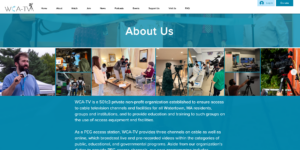
WCA-TV Watertown, Massachusetts
While this arrangement lasted for decades, state data show that cable subscriptions in Massachusetts have fallen more than 50% from their peak, dropping from about 2.19 million in 2013 to just over 1 million as of December 2025. The national trend is even more stark, with only 36% of U.S. adults subscribing to cable. Fewer subscribers means fewer license fees and less gross revenue, which has led to less overall funding for local cable access channels.
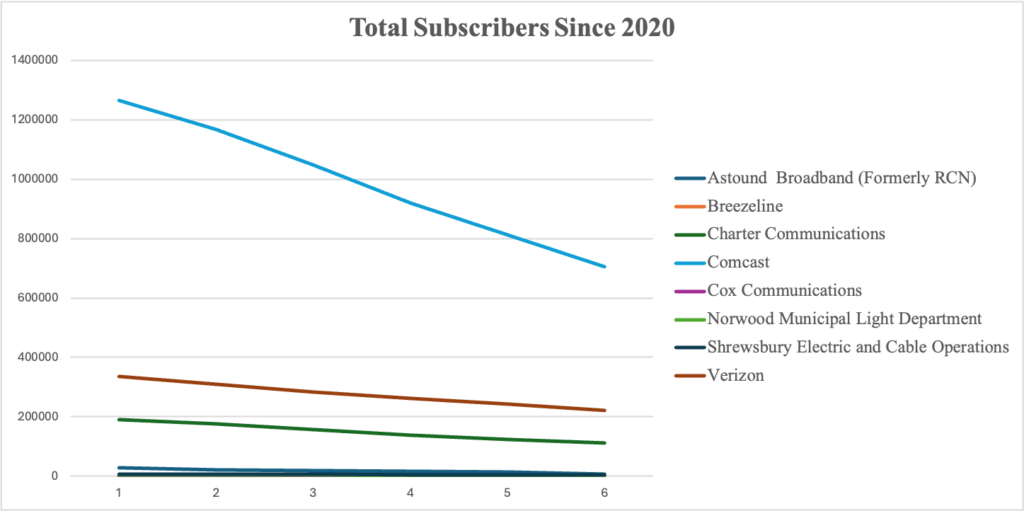
Source: https://www.mass.gov/info-details/massachusetts-cable-subscriber-data
Cord-cutting isn’t the only pressure that local cable access channels are facing. In 2019, the FCC allowed cable operators to deduct the non-cash support they already provide, like equipment and channel space, against the cash fees they owe to local governments, leading to even less funding for local cable access channels. Senators Markey and Baldwin and Representative Carter introduced the Protecting Community Television Act in June 2025 to reverse this, but the bill has remained stalled in committee.
If the main provider of video access to local government is forced to scale down operations, regionalize, or otherwise reduce services due to budget constraints, what will this mean for access to local democracy generally? This trend is compounded by the disappearance of local newspapers and other forms of local media, including mostly recently the shutdown of the Corporation for Public Broadcasting which for nearly 60 years provided federal funding for more than 1,500 local public television and radio stations.
Public meetings of local government bodies have very low participation rates. In the current era of declining public trust in local government and limited local press coverage, the importance of local access channels for maintaining transparency has never been greater. A new funding model is needed. Public access channels must survive.![]()
Kevin Mizikar
Town Manager, Shrewsbury, MA
As local cable access channels are the main source for residents to watch local government meetings and also often enable communities to hold remote and hybrid meetings, a risk to these services is a risk to resident engagement and government transparency.
Policymakers have the following options to sustain local cable access channels:
“All politics is local,” said Tip O’Neill, the long-serving Speaker of the U.S. House of Representatives and Massachusetts native. But politics can only be local if residents can actually find out what is happening. As we consider how digital civic infrastructure plays a role in strengthening democracy at the local level and supporting civic engagement, community access stations must be a part of the conversation. These stations play a vital role in ensuring residents have transparency and access to information, along with providing the infrastructure and support for transitioning communities into the digital age.
Sarah Hubbard is a researcher at the Allen Lab for Democracy Renovation at Harvard Kennedy School’s Ash Center for Democratic Governance and Innovation. Her research focuses on the intersection of artificial intelligence, democracy, and civic life.
Kenneth Woodland is a mid-career Master in Public Administration student and researcher at the Harvard Kennedy School. He focuses his legal practice in municipal law and is a former city councilor.
The views expressed in this article are those of the authors alone and do not necessarily represent the positions of the Ash Center or its affiliates.
Additional Resource
In a recent guest essay for The New York Times, Allen Lab Democracy Stack Fellow Beth Noveck argues for putting A.I. behind every public servant.
Media Release

Open Access Resource
With a majority of municipalities publishing their budgets as PDFs, Open Book offers a free alternative that towns own and run themselves.